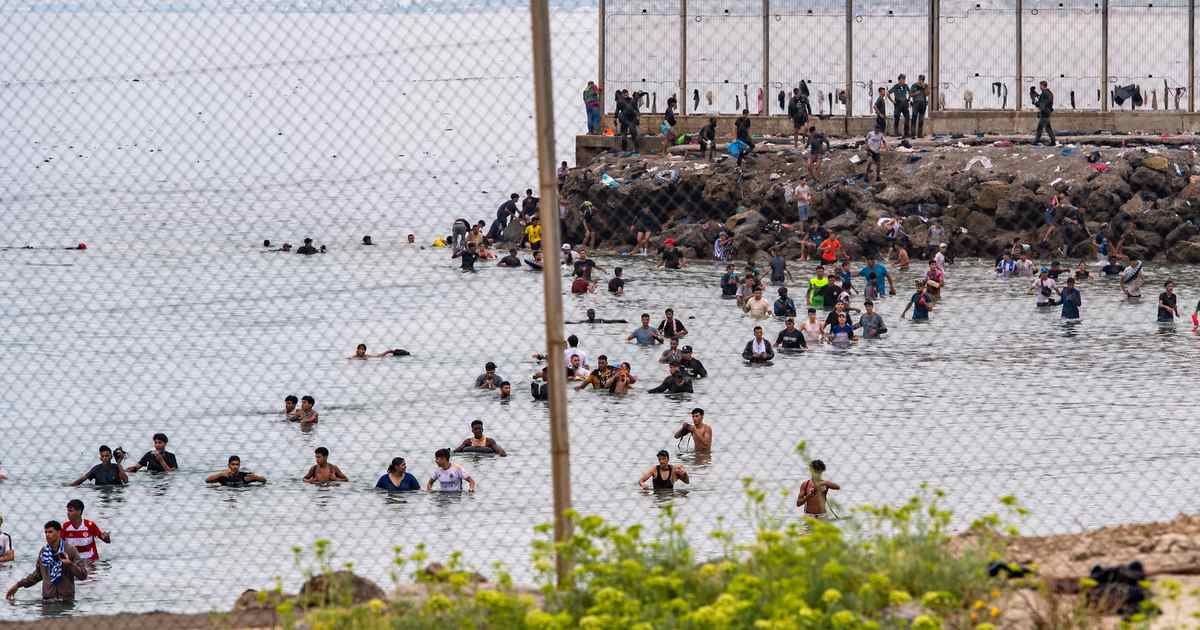
 Migrants wade through water near the border fence at the Spanish enclave.
60,000 Migrants Storm Spanish Enclave: Crisis or 'Invasion'?
Left says
- •Migrants are largely young people fleeing poverty and seeking economic opportunity, as personal testimonies show, including a mother supporting her parents and daughter on an inadequate waitress salary.
- •A Spanish Supreme Court ruling limiting immediate deportation of migrants arriving by sea is a legal and humanitarian safeguard, not an invitation to disorder, and most who crossed voluntarily returned to Morocco within a day.
- •Prime Minister Pedro Sánchez's broader amnesty policy reflects a deliberate humane alternative to what he describes as unlawful and cruel deportation crackdowns elsewhere.
- •Framing the surge as an 'invasion' by 'military-age men' dehumanizes people who are, by their own accounts, searching for work and a better future for their families.
Right says
- •The scale of the crossing, roughly 60,000 people in 48 hours equal to 70% of Ceuta's population, represents a security and humanitarian breakdown that local officials call 'absolutely unsustainable.'
- •Ceuta's own president blames the surge directly on the Spanish Supreme Court ruling and criticizes the national government's response as 'too late and insufficient.'
- •Reports of looting, break-ins, and clashes with police during the crisis raise serious public safety concerns that deserve scrutiny rather than dismissal.
- •Sánchez's open-border-style policies, including mass amnesty for over a million migrants, are cited as encouraging further unauthorized crossings and are viewed as reckless given the strain on local resources.
Common Take
High Consensus- At least 34 to 57 migrants died during the crossing, with drownings and a stampede at a border checkpoint among the causes.
- Roughly 60,000 people crossed from Morocco into Ceuta over Thursday and Friday, overwhelming a territory of about 83,000 residents.
- Spain deployed its military and Prime Minister Sánchez traveled to Ceuta in response to the crisis.
- A recent Spanish Supreme Court ruling restricting immediate deportation of migrants arriving by sea is widely cited as a key factor behind the surge.
- Most of the migrants who entered ultimately returned to Morocco within a day or two, leaving the situation less permanent than initial reports suggested.
The Arguments
Right argues
The scale of the event—60,000 people entering in roughly 48 hours, equivalent to 70% of Ceuta's population—created a genuine security and humanitarian breakdown that overwhelmed local police, resources, and infrastructure, as Ceuta's own president publicly declared 'absolutely unsustainable.'
Left counters
The fact that most migrants left voluntarily within a day, hungry and disappointed, suggests this was a chaotic but temporary surge rather than a sustained 'invasion,' and the scale itself doesn't justify dehumanizing language about people fleeing poverty.
Left argues
Personal testimonies from migrants like Dounia Kherradi, a waitress supporting her parents and daughter, reveal ordinary people seeking economic survival and opportunity, not an organized incursion or threat, and should be understood in human terms rather than security terms alone.
Right counters
Sympathetic individual stories don't erase the reality that the overwhelming majority of those who crossed were young men, not families, and that reports of looting and break-ins during the crisis represent real harm to Ceuta's residents that deserves scrutiny, not dismissal.
Right argues
Local officials, including Ceuta's president, directly blamed the surge on the Spanish Supreme Court ruling limiting immediate deportations and criticized the national government's response as 'too late and insufficient,' suggesting policy choices—not just poverty—drove the timing and scale of the crisis.
Left counters
A legal safeguard against unlawful summary deportation is not the same as an 'open border' invitation; the ruling protects due process rights, and blaming it for a spontaneous mass movement conflates a narrow legal ruling with an active policy of encouraging illegal crossings.
Left argues
Prime Minister Sánchez's broader migration policy, including regularizing over a million migrants, reflects a deliberate humane alternative to what he calls unlawful and cruel deportation crackdowns seen elsewhere, arguing that Spain can absorb and benefit from newcomers rather than treating them as a threat.
Right counters
Critics argue that policies signaling leniency create predictable incentives for further unauthorized mass crossings, and that a 'humane' policy which strains a small territory's resources to the breaking point is not humane to Ceuta's own residents either.
Right argues
Multiple reports of looting, break-ins, and clashes with police during the chaos represent legitimate public safety concerns for Ceuta residents, who described being afraid to open their doors, and these incidents deserve serious coverage rather than being waved away as incidental to a larger humanitarian story.
Left counters
Isolated incidents of disorder amid a chaotic, high-density crossing of desperate people do not justify characterizing the entire event as a criminal 'invasion,' especially when the vast majority left peacefully and voluntarily within a day.
Challenge Questions
These questions target genuine internal contradictions — meant to provoke honest reflection.
Right asks Left
“If the Supreme Court ruling is merely a narrow due-process safeguard as claimed, why did Spain's own Interior Ministry and Ceuta's president both directly attribute the surge's timing and scale to that ruling, and why did crossings spike so sharply right after it was announced?”
Left asks Right
“If the crossers were overwhelmingly 'military-age men' engaged in an 'invasion,' how does that framing square with the fact that most left voluntarily within a day, hungry and disappointed, rather than staying to occupy territory, riot indefinitely, or advance any organized agenda?”
Outlier Report
Left Fringe
Groups like the Democratic Socialists of America (DSA) and pro-open-border advocates such as some voices at The Intercept represent a small fraction (roughly 10-15%) of the left who explicitly celebrate or defend mass border crossings as a positive assertion of migrant rights with minimal enforcement concern.
Right Fringe
Commentators like those at Visegrád 24, Legal Insurrection, and figures such as Bill Melugin who use 'invasion' rhetoric and emphasize 'military-age men' represent a vocal but not majority segment (perhaps 20-25%) of the right, with more mainstream conservatives focusing on policy/enforcement critique rather than dehumanizing language.
Noise Assessment
High noise ratio: much of the loudest discourse comes from partisan X accounts (Visegrád 24, Legal Insurrection) and ideologically driven outlets on both sides, while the actual American public likely holds more measured, mixed views blending sympathy for migrants with support for orderly, controlled borders.
Sources (10)
A Spanish territory in northern Africa is experiencing a humanitarian and security crisis after thousands of migrants continue to swim across the border from Morocco, with at least 34 dying in the chaos.
At least 10 people died Thursday after thousands of migrants poured into the tiny Spanish territory of Ceuta from neighboring Morocco, overwhelming authorities and posing a political problem for Prime Minister Pedro Sánchez.
An unprecedented wave of nearly 50,000 illegal migrants from Africa has flooded the Spanish enclave of Ceuta, prompting Spain to deploy its military – as locals liken the invasion to an "apocalypse."
The mass migration event taking place in Ceuta, Spain, is a result of multiple push and pull factors that enticed thousands to make the swim from Morocco this week. Between Thursday and Friday, an estimated 60,000 migrants, mainly young men from Morocco, swam around or scaled border fences to reach nearby Ceuta, a Spanish territory ...
<p>Europe is NOT happy. Open borders doesn't sound that great now, does it?</p> The post <a href="https://legalinsurrection.com/2026/07/spain-60000-crossed-border-from-morocco-over-30-dead/">Spain: 60,000 Crossed Border from Morocco, Over 30 Dead</a> first appeared on <a href="https://legalinsurrection.com">Le·gal In·sur·rec·tion</a>.
<p>Bill Melugin: "This takes me back to Del Rio, TX in 2021 w/ the Haitian surge. Similar images."</p> The post <a href="https://legalinsurrection.com/2026/07/thousands-of-military-age-men-from-morocco-invade-spains-ceuta-territory/">Thousands of Military-Age Men From Morocco Invade Spain’s Ceuta Territory</a> first appeared on <a href="https://legalinsurrection.com">Le·gal In·sur·rec·tion</a>.
There are new images surfacing of tens of thousands of migrants rushing into Ceuta, a Spanish enclave, sparking reaction around the world. So far, dozens of people have died in the chaos. NBC News’ Raf Sanchez has the latest.
On Thursday, tens of thousands of Moroccans broke into Ceuta, a Spanish territory that neighbors Morocco. By Friday evening, most of them had left, hungry and disappointed.
Spain is rushing troops and resources to one of its territories in North Africa, after tens of thousands of migrants crossed the border from Morocco into the small city of Ceuta. Geoff Bennett reports.