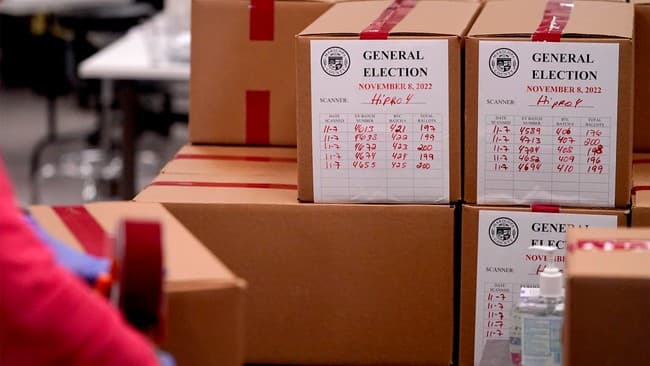
633K Arizona Voter Files Hacked in 2020 — No One Prosecuted
Intra-Party Split Detected
Most right-leaning coverage frames this as vindication of 2020 election security concerns and blames Biden-era/local prosecutors broadly, but the Arizona Attorney General's office (a Republican-led office at the time) pushed back, noting the decision not to prosecute was made under a prior Republican AG, complicating the narrative that only Democrats/Biden officials declined to act.
Left says
- •The breach involved no altered ballots or voter registrations, and investigators found no evidence of foreign involvement, undercutting claims that it reveals systemic 2020 election fraud.
- •The Maricopa County District Attorney's Office disputes the framing that it 'refused' to prosecute, saying it recused itself due to a legitimate conflict of interest since the Recorder's Office was a potential victim.
- •The decision not to prosecute was made under a Republican Arizona attorney general, not a Democratic official, complicating narratives that partisan Democrats buried the case.
- •This disclosure fits a broader pattern of the Trump administration using selectively declassified documents and aggressive tactics like IP tracing and mass voter roll requests to fuel unproven claims of widespread election fraud ahead of the midterms.
Right says
- •A confessed hacker extracted up to 1-2 million voter records over time, including 633,000 in the run-up to the 2020 election, yet faced zero prosecution from any level of government despite FBI urging.
- •Nearly 930 of the exposed files contained highly sensitive data on domestic violence victims, judges, and law enforcement officers, representing a serious security failure with real safety implications.
- •The suspect destroyed evidence, including wiping hard drives and deleting cloud copies, just before an FBI raid, yet still avoided any legal consequences after confessing.
- •This case demonstrates a genuine vulnerability in the 2020 election infrastructure that contradicts repeated claims by Democrats and media that the election was 'the most secure in American history.'
Common Take
High Consensus- 633,000 Maricopa County voter files were extracted, including about 930 containing sensitive information on domestic violence victims, judges, and law enforcement officers.
- The suspect confessed to FBI investigators and destroyed evidence, including wiping hard drives and deleting cloud storage, shortly before agents raided his home.
- No ballots were accessed or altered, and no voter registrations were changed as a result of the breach.
- The U.S. Attorney's Office in Arizona, the Arizona Attorney General's Office, the Maricopa County District Attorney's Office, and the Pinal County District Attorney's Office all declined to bring charges.
The Arguments
Right argues
A confessed hacker extracted up to 1-2 million voter records over time, including 633,000 around the 2020 election, yet faced zero prosecution from federal, state, or county authorities despite FBI urging — a stark accountability failure regardless of intent.
Left counters
The lack of prosecution reflects prosecutorial discretion and legitimate conflicts of interest, not a coverup, and the key decisions declining charges were made under a Republican U.S. Attorney's office and a Republican state attorney general, not Democratic officials.
Right argues
The breach exposed nearly 930 records containing sensitive data on domestic violence victims, judges, and law enforcement officers, revealing a serious security failure with real safety implications that has nothing to do with partisan spin.
Left counters
That the sensitive-data exposure is a genuine security concern doesn't establish anything about election fraud or vote manipulation — investigators explicitly found no altered ballots or registrations, which is the claim this story is being used to bolster.
Left argues
Investigators found no evidence of foreign involvement and confirmed no ballots or registrations were altered, meaning this was a data-privacy breach, not evidence of the systemic 2020 election fraud that Trump and allies have long alleged.
Right counters
Even if no votes were changed, the case still proves that a hobbyist hacker exploited a real, unaddressed vulnerability in Maricopa's voter systems during the most scrutinized election in modern history, directly undercutting claims it was 'the most secure election ever.'
Left argues
This disclosure fits a broader pattern of the Trump administration using selectively declassified documents, IP tracing, and mass voter-roll demands to fuel unproven fraud narratives ahead of the midterms, raising concerns about politicized use of law enforcement tools.
Right counters
Releasing FBI documents about a confirmed, confessed hack that authorities buried for years is basic transparency, not manipulation — the underlying facts of the breach and non-prosecution are independently verified by the FBI's own case file, not manufactured by the administration.
Left argues
The Maricopa County District Attorney's Office disputes the 'refused to prosecute' framing, noting it recused itself due to a legitimate conflict of interest since the Recorder's Office was a potential victim it legally represents.
Right counters
A conflict-of-interest recusal by one office doesn't explain why three other independent prosecutorial bodies — the U.S. Attorney, the state AG, and Pinal County — all also declined to charge a suspect who confessed and destroyed evidence.
Challenge Questions
These questions target genuine internal contradictions — meant to provoke honest reflection.
Right asks Left
“If the decision not to prosecute was made under a Republican U.S. Attorney and a Republican state attorney general, as the left notes, how does that square with continuing to frame concern over this case as merely a partisan Trump-administration narrative rather than a bipartisan systemic failure?”
Left asks Right
“If the FBI itself confirmed no ballots, registrations, or vote tallies were altered and found no foreign involvement, on what basis does this case establish a vulnerability in the 2020 election's integrity rather than simply a data-privacy breach separate from vote counting?”
Outlier Report
Left Fringe
Figures like MSNBC's Rachel Maddow or election-law commentators who dismiss the story entirely as a nothingburger or pure Trump-administration political theater represent roughly 15-20% of the left.
Right Fringe
Figures like Mike Lindell or some MAGA-aligned commentators (e.g., on War Room with Steve Bannon) who present this as definitive proof the 2020 election was stolen represent roughly 20-25% of the right, going beyond what the actual documents support.
Noise Assessment
High noise ratio: much of the loudest online reaction (from accounts amplifying Catherine Herridge's thread or Bannon-aligned commentary) frames this as vindication of stolen-election claims, which outpaces the more modest, bipartisan public concern about a genuine but limited security/accountability failure.
Sources (6)
<img src="https://www.theblaze.com/media-library/fbi-says-hacker-scraped-massive-voter-data-from-maricopa-county-in-2020-arizona-officials-declined-to-prosecute.jpg?id=67583705&width=1245&height=700&coordinates=0%2C0%2C0%2C78" /><br /><br /><p>The Federal Bureau of Investigation revealed Thursday that a hacker had been able to scrape voter data from the 2020 election in Maricopa County, Arizona.</p><p>FBI Director Kash Patel released a letter <a href="https://roar-assets-auto.rbl.ms/files/111135/Maricopa_County_FBI_D_Letter%5B1%5D.pdf?rand=1786036813441" target="_blank">outlining</a> that the hacker had allegedly confessed, but local prosecutors refused to file charges against him.</p><p class="pull-quote">'He kept the files stored at his home but destroyed them shortly before the FBI raided his home in Fountain Hills.' </p><p>The digital infiltration included an astounding 633,000 voter files, of which 930 were described as "sensitive voter information," according to one FBI <a href="https://roar-assets-auto.rbl.ms/files/111136/Opening_Communication_8.5.26_Redacted_FINAL%5B1%5D.pdf?rand=1786037039716" target="_blank">document</a>. The sensitive voter information was described as "domestic violence victims, judges, and law enforcement officers."<span></span></p><p>"He kept the files stored at his home but destroyed them shortly before the FBI raided his home in Fountain Hills," the FBI director added.</p><p>Despite the suspect's confession, the U.S. Attorney's Office in Arizona, the Arizona attorney general, the Maricopa County district attorney, and the Pinal County district attorney all declined to prosecute, according to Patel.</p><p>The case was thoroughly investigated by the FBI and was closed in 2023, according to another <a href="https://roar-assets-auto.rbl.ms/files/111138/Closing_Communication_8.5.26_Redacted_FINAL%5B1%5D.pdf?rand=1786037114407" target="_blank">FBI document</a>.</p><p>A White House official <a href="https://www.thecentersquare.com/national/article_a6ad90fe-3f92-4166-a4b0-57557c72ff66.html" target="_blank">told</a> the Center Square that investigators did not believe the hacker was working with foreign agents. The suspect expressed remorse, and no ballots or voter registrations were altered, according to the official.</p><p><strong>RELATED: </strong><a href="https://www.theblaze.com/news/maryland-election-fraud-trump-doj" target="_blank"><strong>Trump accuses Democrat governor of MASSIVE election fraud</strong></a></p><p class="shortcode-media shortcode-media-youtube"> <span class="rm-shortcode" style="display: block; padding-top: 56.25%;"></span> </p><p>A spokesperson for the Arizona Attorney General's Office released a statement to Blaze News about the incident.</p><p>"The decision not to pursue a prosecution was made by the prior Republican Attorney General Mark Brnovich's administration," the statement reads. "The information in question was also publicly available. We do not have any other comments to make."</p><p>Brnovich passed away in Jan. 2026 at the age of 59.</p><p>The Maricopa County District Attorney's Office denied refusing to prosecute the case in a statement to Blaze News. </p><p>"We had a conflict of interest and conflicted off the case because the Maricopa County Recorder’s Office was a potential victim, and, as County Attorney, we are the legal representatives for that office," the office told Blaze News. </p><p>Blaze News reached out to the Pinal County Attorney's Office and the U.S. Attorney's Office in Arizona for comment.<span></span></p><p><em>Editor's note: This article has been edited after publication to include statements from the Arizona Attorney General's Office and the Maricopa County District Attorney's Office. It has also been corrected to identify the Pinal County Attorney's Office instead of the </em><em>Pima County Attorney's Office. </em></p><p><em>Like Blaze News? Bypass the censors, sign up for our newsletters, and get stories like this direct to your inbox. </em><em><a href="https://www.theblaze.com/newsletters/theblaze-articlelink" target="_self">Sign up here</a></em><em>!</em></p>
<p>The <a href="https://www.axios.com/politics-policy/donald-trump" target="_blank">Trump</a> administration has a new tactic for trying to isolate cases of alleged voter fraud — digging into the IP addresses of those who went online to register to vote.</p><ul><li>The FBI recently obtained the IP address of someone who registered online in South Carolina, according to documents first shared with Axios.</li></ul><p><strong>Why it matters:</strong> The bureau's request for the address, which state and local officials complied with, offers a glimpse of how federal authorities are stepping up their probe of voter rolls and registration practices under pressure from President Trump.</p><hr /><ul><li>The president's persistent <a href="https://www.axios.com/2026/07/17/trumps-warning-elections-4-takeaways" target="_blank">complaints</a> about the 2020 election have expanded into federal investigations that also involve the Justice Department and the Department of Homeland Security.</li></ul><p><strong>It's unclear how often </strong>the FBI plans to take the extraordinary step of seeking IP addresses, but its push in South Carolina has broad implications nationwide: 43 states allow some form of online voter registration. </p><ul><li>An IP address would show a user's geographic location and service provider, but not their specific identity. It could tell whether the user was outside a state or even the U.S., for example.</li><li>Trump has claimed that operatives in China and elsewhere have tried to influence U.S. elections.</li></ul><p><strong>The big picture: </strong>As the bureau investigates South Carolina, <a href="https://www.axios.com/2026/06/13/ice-voter-files-texas-north-carolina" target="_blank">ICE</a> has been requesting voter data in Texas and North Carolina.</p><ul><li>The <a href="https://www.justice.gov/opa/pr/justice-department-sues-idaho-failure-produce-voter-rolls" target="_blank">Justice Department</a>, meanwhile, is trying to get voter rolls from states that have resisted sharing registration information, and is suing 30 states and Washington, D.C., for that access.</li></ul><p><strong>Critics say it's a federal intrusion </strong>rooted in Trump's baseless claims about widespread fraud in the 2020 election.</p><ul><li>"The administration has gone down every rabbit hole, pursued every possible avenue to undermine the confidence in the integrity of the federal election process and to undermine the process itself," said Robert Weiner, former senior counsel at DOJ's civil rights division and director of the Voting Rights Project at the Lawyers' Committee for Civil Rights.</li></ul><p><strong>Driving the news:</strong> An FBI agent in South Carolina stepped up the probe there in March by asking state and local officials for the IP address of a voter's online registration, according to emails revealed in a public records request by Democracy Forward, which shared them with Axios. </p><ul><li>The email exchange between the FBI and the general counsel of South Carolina's State Election Commission is partially redacted. The general counsel didn't respond to a request for comment. </li><li>Another exchange, under the subject line, "Voter Investigation" shows the FBI agent receiving the voter's digital information in June. </li><li>The FBI didn't respond to several requests for comment.</li></ul><p><strong>What they're saying: </strong>"It is not common" to get this kind of request, York County (S.C.) election official Alan Helms told Axios. "In my tenure as an election official, going on 20 years, that is the first interaction with law enforcement."</p><ul><li>Helms said his office complied with the request, as is permitted under the law.</li><li>"It's not typical for the FBI to be calling state election officials and just asking and conducting a fishing expedition to see private voter data," a former senior Justice Department official told Axios. "It's not typical and it's not appropriate."</li></ul><p><strong>Ahead of the Nov. 3 midterms</strong>, Assistant Attorney General Harmeet Dillon has sent a <a href="https://x.com/AAGDhillon/status/2074992379447099681?s=20" target="_blank">letter</a> warning election officials about statutes that ban non-citizens from voting in federal elections. DHS general counsel James Percival <a href="https://x.com/DHSGenCounsel/status/2064438600448496064/photo/1" target="_blank">issued</a> a memo asking immigration officials to use any voting-related crimes as evidence in deportation proceedings for noncitizens.</p><ul><li>Dillon's office also <a href="https://www.justice.gov/opa/pr/justice-department-announces-monitoring-polling-sites-three-arizona-counties" target="_blank">announced</a> it would send poll watchers to three Arizona counties ahead of that state's primary on July 21.</li></ul><p><strong>Zoom in: </strong>Since the Trump administration <a href="https://truthsocial.com/%40realDonaldTrump/posts/116959709239826209" target="_blank">claimed</a> to have found hundreds of thousands of voters registered illegally or deceased across the U.S., New Jersey has revealed that about 6,600 noncitizens had registered to vote because of a software error.</p><ul><li>New Jersey Gov. Mikie Sherill (D) <a href="https://x.com/govsherrillnj/status/2082160567175741493?s=46" target="_blank">said</a> her team's investigation so far has removed about 4,500 people from the state's voter rolls, and that some people initially identified as ineligible actually might be eligible to vote. </li><li>Trump's administration is holding up New Jersey, a Democrat-led state, as an example of a state with election issues and is trying to force it to share its full voter rolls with federal investigators. So far, it's resisting.</li></ul><p><strong>Flashback: </strong>A similar software issue was investigated in <a href="https://www.carolinajournal.com/wp-content/uploads/2022/08/Cleaned-Redacted-Summary-Report.pdf" target="_blank">North Carolina</a> in 2021. The state found about 700 potential noncitizens had registered and more than 100 of them had voted in 2016. </p><ul><li>No charges brought in most cases because the registration error was no one's fault. In some cases, voters were registered despite acknowledging on a DMV form that they weren't citizens. Others were registered after leaving the question blank. </li></ul>
<img alt="voting booths" class="webfeedsFeaturedVisual wp-post-image" src="https://thefederalist.com/wp-content/uploads/2026/08/3002212217_24b41ef85f_k-1200x675.jpg" style="display: block; margin: auto; margin-bottom: 5px;" />An official says the breach displays a major vulnerability in the 2020 election that Democrats insist was the most secure in history.