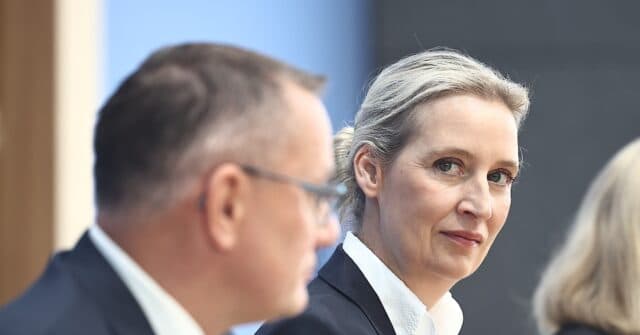
 AfD co-leader Alice Weidel appears alongside a fellow party official at an event.
AfD Surges Nationwide as Far-Left Die Linke Wins Berlin, Aided by Muslim Vote
Intra-Party Split Detected
On the right, CDU's Merz faces internal pressure over election 'disaster' but resists resignation calls amid AfD's rise; on the left, mainstream SPD/Greens face tension over Die Linke's growing dominance and coalition talks, with debate over whether AfD support is uniquely eastern or a broader national phenomenon.
Left says
- •The AfD's rise reflects deep economic and social grievances that extend well beyond the former East Germany, showing this is a nationwide crisis of trust in centrist parties rather than a regional quirk.
- •Die Linke's Berlin victory demonstrates that a genuine left alternative focused on housing, inequality, and social welfare can build broad coalitions across young voters, secular Germans, and minority communities.
- •Highlighting Muslim voting patterns to delegitimize Die Linke's win risks stigmatizing an entire religious minority for exercising normal democratic participation.
- •The CDU's collapse in its own strongholds suggests voters are punishing establishment parties for failing to address cost-of-living and governance concerns, not simply embracing far-right ideology.
Right says
- •The AfD's expansion into North Rhine-Westphalia, Germany's largest and wealthiest state, proves its appeal is no longer confined to the former communist east and reflects a genuine national shift.
- •Chancellor Merz's refusal to resign despite calling the Meck-Pomm result a 'disaster' signals a CDU leadership disconnected from the scale of voter rejection.
- •The revelation that a majority of Muslim voters backed the far-left Die Linke raises legitimate questions about shifting demographic coalitions and their influence on German politics.
- •Voters turning to the AfD in record numbers are responding to unresolved concerns over mass migration and establishment parties' inability to offer a credible alternative.
Common Take
High Consensus- The AfD has achieved record polling numbers and consecutive state election victories in September 2026.
- The CDU under Chancellor Merz suffered significant losses, which Merz himself described as a 'disaster.'
- Die Linke won the Berlin election and is now pursuing coalition talks with the SPD and Greens.
- Traditional centrist parties are losing ground to parties on both the far-right and far-left across Germany.
The Arguments
Right argues
The AfD overtaking the CDU in North Rhine-Westphalia, a wealthy West German industrial state, shows the party's appeal has broken out of its East German base and represents a genuine nationwide realignment.
Left counters
A single poll showing a narrow lead in one West German state is not proof of a durable realignment, and it still coexists with strong far-left gains in Berlin, suggesting general anti-establishment volatility rather than a uniform rightward shift.
Left argues
Die Linke's Berlin win, built on youth, secular voters, and minority communities, demonstrates that a substantive left platform on housing and inequality can build a broad, energized coalition rather than relying on protest votes alone.
Right counters
A coalition this dependent on a narrow set of demographic blocs, including a majority of one religious minority, raises questions about how broad-based and durable this support really is beyond Berlin's unique urban makeup.
Right argues
Reporting that a majority of Muslim voters backed Die Linke is a legitimate empirical finding about shifting voter coalitions that deserves scrutiny like any other demographic voting pattern in a democracy.
Left counters
Singling out Muslim voting behavior specifically, rather than treating it as one data point among many religious and secular voting blocs, risks framing ordinary democratic participation by a minority as inherently suspicious or illegitimate.
Left argues
The CDU's collapse in its own historic strongholds signals that voters are primarily punishing establishment failures on cost-of-living and governance, not necessarily embracing AfD's substantive ideology.
Right counters
If voters were merely protesting mismanagement, they could have shifted to any number of alternatives, yet they specifically and repeatedly chose the AfD's platform on migration, suggesting real ideological alignment rather than pure protest.
Right argues
Merz calling the Mecklenburg-Vorpommern result a 'disaster' while refusing to resign exposes a leadership disconnected from the scale of the CDU's rejection by voters, undermining confidence in the party's ability to respond.
Left counters
Demanding a chancellor's resignation over a single state election result, rather than allowing for a substantive policy response, reflects the same instability and short-termism that has destabilized German governing coalitions for years.
Challenge Questions
These questions target genuine internal contradictions — meant to provoke honest reflection.
Right asks Left
“If Die Linke's Berlin victory is celebrated as evidence that a genuine left platform can build broad coalitions, why does highlighting the specific demographic composition of that coalition, including Muslim voters, become illegitimate to discuss rather than a straightforward electoral fact?”
Left asks Right
“If the AfD's gains in NRW and the East alike are attributed to substantive voter concerns about migration and governance, how does that account for the party's continued strength in poorer regions with comparatively little direct exposure to migration, versus wealthier western areas?”
Outlier Report
Left Fringe
Commentators like Mehdi Hasan or writers at Jacobin who would frame any scrutiny of Muslim voting blocs as inherently Islamophobic, and who fully embrace Die Linke as a model for US-style democratic socialism; roughly 10-15% of the left.
Right Fringe
Figures like Tucker Carlson or contributors at outlets like The Gateway Pundit who frame the AfD's rise as vindication of a 'great replacement'-style narrative and view Die Linke's Muslim support as proof of demographic subversion; roughly 15-20% of the right.
Noise Assessment
High amplification relative to actual public salience; most Americans have limited awareness of German state elections, so the loudest voices online (foreign policy Twitter/X accounts, immigration hawks, and socialist media) disproportionately shape perceived opinion.
Sources (5)
<p>Recent historic election victories appear to be putting wind in the sails of the Alternative for Germany (AfD) party, which continues to widen its lead over the establishment and expand its support base.</p> <p>The post <a href="https://www.breitbart.com/europe/2026/09/25/afd-becomes-most-popular-party-in-germanys-largest-state-for-first-time/" rel="nofollow">AfD Becomes Most Popular Party in Germany’s Largest State for First Time</a> appeared first on <a href="https://www.breitbart.com" rel="nofollow">Breitbart</a>.</p>
<p>Muslim voters were a major contributing factor to the far-left Die Linke party's victory in the Berlin elections last week, an analysis of religious affiliation exit polling has revealed.</p> <p>The post <a href="https://www.breitbart.com/europe/2026/09/26/red-green-alliance-majority-of-muslim-voters-backed-victorious-far-left-die-linke-party-in-berlin-elections/" rel="nofollow">Red-Green Alliance: Majority of Muslim Voters Backed Victorious Far-Left Die Linke Party in Berlin Elections</a> appeared first on <a href="https://www.breitbart.com" rel="nofollow">Breitbart</a>.</p>
German Chancellor Friedrich Merz called the results a “disaster” for his center-right party.
Die Linke is back in charge of Berlin. <img src="https://i0.wp.com/www.nationalreview.com/wp-content/uploads/2026/09/die-linke.jpg?fit=617%2C360&ssl=1" />
<p>David Broder</p> <div><img alt="" src="https://www.thenation.com/wp-content/uploads/2026/09/afd.jpg" /></div> <div> <div class="wp-block-the-nation-dek article-title__dek"> <p>The Alternative für Deutschland has a stable national poll lead, including in the former West Germany. Its rise owes to much more than Eastern grievances.</p> </div> </div> <p>The post <a href="https://www.thenation.com/article/world/afd-germany-east-west-far-right/">The AfD’s Rise Isn’t Just About East Germany</a> appeared first on <a href="https://www.thenation.com">The Nation</a>.</p>