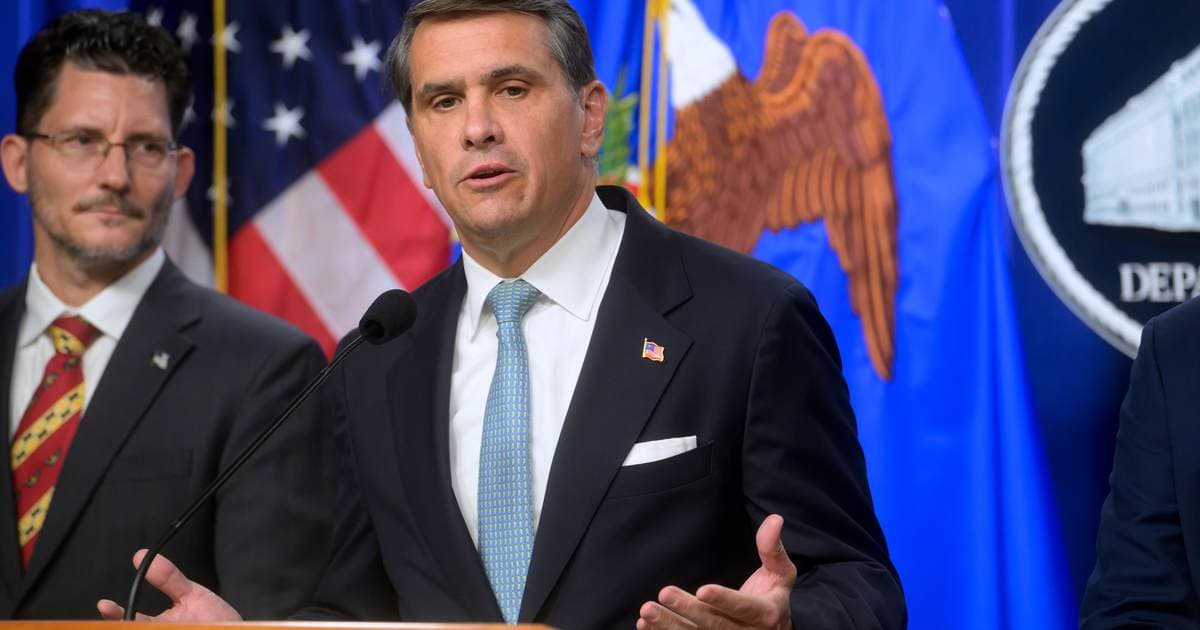
 AG Todd Blanche speaks at a Justice Department press podium.
AG Todd Blanche Becomes De Facto Press Secretary, Breaking Norms
Left says
- •An Attorney General holding regular White House press briefings blurs the traditional separation between the Justice Department and political communications, raising concerns about the DOJ's independence.
- •Blanche's dodges on questions like the diGenova resignation illustrate how using a sitting AG as spokesperson can shield sensitive personnel and legal matters from proper scrutiny.
- •Framing Democratic concerns about AI regulation as a midterm 'hoax' rather than engaging substantively suggests the administration is using the briefing platform to score political points rather than inform the public.
- •The repeated absence of a permanent press secretary since Karoline Leavitt's resignation signals instability in the administration's communications structure.
Right says
- •Cabinet officials stepping in to brief the press reflects an administration willing to have its most knowledgeable officials directly engage with reporters rather than filtering everything through a single spokesperson.
- •Blanche used the briefing to highlight concrete law enforcement achievements, including noncitizen voting prosecutions and a major daycare fraud bust, showing the administration's results on election integrity and public corruption.
- •The administration affirms it will comply with the Supreme Court's mail-in ballot ruling, demonstrating respect for judicial authority even while continuing related legal efforts.
- •Criticism of sudden Democratic focus on AI regulation ahead of midterms is framed as pointing out political opportunism rather than genuine policy concern, especially given the importance of staying competitive with China.
Common Take
High Consensus- Todd Blanche, the sitting Attorney General, took the podium in the Rose Garden on Tuesday to brief reporters, marking only the second such briefing since Karoline Leavitt's resignation.
- The briefing covered a range of topics including election integrity, noncitizen voting prosecutions, AI regulation, and the Supreme Court's mail-in ballot ruling.
- Blanche declined to answer directly whether he asked for Joe diGenova's resignation from the Justice Department.
- This arrangement, with cabinet officials like Blanche and Vice President Vance filling the press secretary role, departs from the traditional norm of a dedicated White House press secretary.
The Arguments
Left argues
Having the Attorney General regularly serve as press secretary erodes the traditional firewall between the Justice Department and political messaging, creating the appearance that law enforcement decisions are being filtered through a political communications lens.
Right counters
Cabinet officials directly briefing the press can mean more informed, substantive answers from the people actually running these agencies, rather than a spokesperson relaying secondhand talking points.
Right argues
Blanche used the platform to detail concrete law enforcement results—quadrupled noncitizen voting prosecutions and a $10 million daycare fraud bust—giving reporters and the public tangible evidence of DOJ priorities in action.
Left counters
Touting prosecutorial statistics from a White House podium blurs the line between neutral law enforcement reporting and political self-promotion, especially when the AG is also fielding questions about internal personnel disputes he won't discuss.
Left argues
Blanche's refusal to explain whether he pushed out Joe diGenova exemplifies how using the sitting AG as spokesperson lets sensitive DOJ personnel matters get deflected with vague appeals to 'fairness to prosecutors' rather than genuine accountability.
Right counters
Declining to discuss personnel communications is a normal, defensible practice for any AG protecting internal deliberations, not evidence of evasion unique to this briefing format.
Right argues
Blanche's dismissal of the sudden bipartisan and Democratic focus on AI regulation as election-season opportunism is a fair critique given the timing, especially when the stakes of falling behind China economically and technologically are so high.
Left counters
Labeling substantive AI regulation concerns a midterm 'hoax' dodges legitimate policy questions about safety, labor impacts, and oversight, using political framing to avoid engaging with the substance.
Left argues
The administration's inability to name a permanent press secretary since Karoline Leavitt's departure, relying instead on rotating cabinet officials like Blanche and Vance, signals real instability in its communications operation.
Right counters
Rotating high-level officials through briefings could reflect a deliberate strategy to showcase substantive expertise rather than disorganization, and no single format is required by law or tradition.
Challenge Questions
These questions target genuine internal contradictions — meant to provoke honest reflection.
Right asks Left
“If Democrats' AI regulation concerns are genuine and not timed to the midterms, why did substantive congressional action on the issue remain largely dormant for months before suddenly accelerating close to the election?”
Left asks Right
“If having the Attorney General serve as press secretary is simply about maximizing expertise and transparency, why did Blanche decline to answer direct questions about DiGenova's resignation rather than using the platform to clarify the matter?”
Outlier Report
Left Fringe
Commentators like Rachel Maddow or accounts pushing narratives that this represents 'authoritarian capture' of DOJ represent a more extreme framing than mainstream Democratic officials, likely around 20-25% of the left.
Right Fringe
Figures like Charlie Kirk or Mark Levin who might frame any criticism of Blanche's role as purely partisan media attacks with no legitimate concern represent an extreme dismissal of institutional norms, likely 20% of the right.
Noise Assessment
Moderate-to-high noise; much of the specific back-and-forth over diGenova's resignation and AI 'hoax' framing is inside-baseball political theater that engages partisan bases more than it reflects broad public sentiment, which is more focused on tangible outcomes like fraud prosecutions.
Sources (7)
An administration that often exhibits ostentatious pride in bursting through norms did so yet again Tuesday afternoon, when Attorney General Todd Blanche took a turn as de facto White House press secretary. Blanche spoke to reporters in the Rose Garden, mixing together commentary on legal matters, praise of Defense Secretary Pete Hegseth’s prosecution of the…
Attorney General Todd Blanche dodged a question Tuesday about whether he asked for the resignation of Trump-ally Joe diGenova from the Justice Department amid reports that there was a tense phone call between the two before the lawyer’s departure. “I don’t want to talk about communications I have with prosecutors. It’s not fair to them.…
Attorney General Todd Blanche briefed reporters in the Rose Garden on Tuesday, saying the White House would follow the Supreme Court’s Monday ruling on mail ballots, declining to answer whether he asked for a South Florida prosecutor’s resignation and addressing China and artificial intelligence. A judge once again ruled the Kennedy Center could not inscribe…
Attorney General Todd Blanche spoke with reporters Tuesday afternoon in the White House Rose Garden. Few details were known ahead of time about the briefing, but it marked only the second since former press secretary Karoline Leavitt resigned from the post. The DOJ has played a major role in arguing on behalf of President Trump’s…