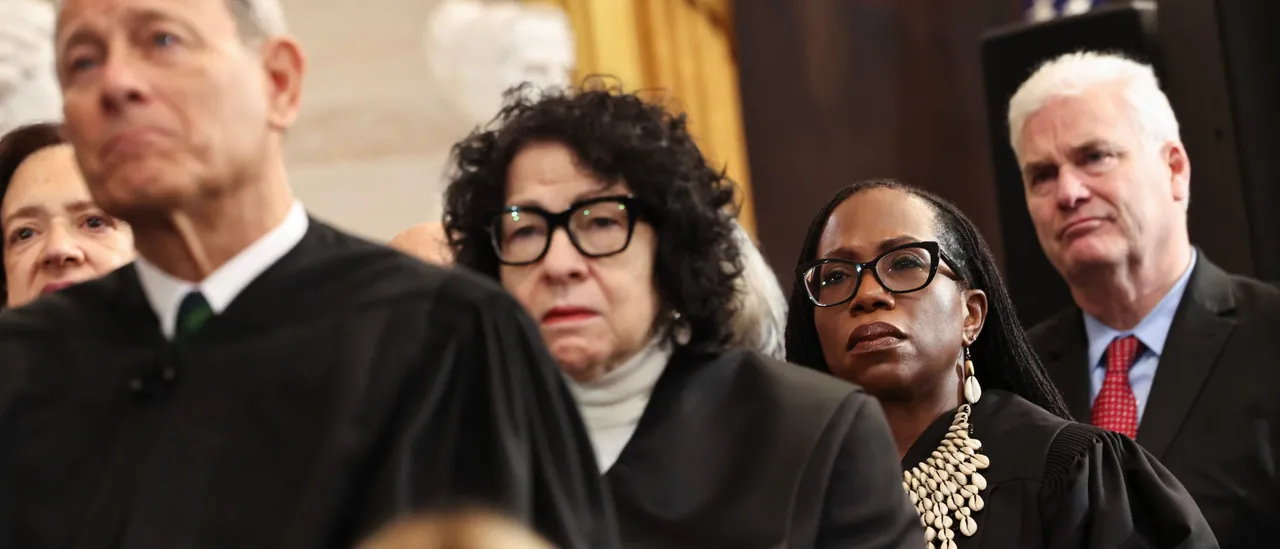
Alito Torches Jackson's 'Insulting' Dissent on Louisiana Redistricting Order
Intra-Party Split Detected
Jackson wrote a solo dissent with no other liberal justices joining, suggesting even fellow liberals disagreed with her approach
Left says
- •The Supreme Court's expedited order undermines judicial restraint by abandoning established procedures to influence political implementation rather than simply deciding the law
- •Fast-tracking the ruling creates chaos in Louisiana's election process and gives the appearance of partisan favoritism toward Republican redistricting efforts
- •The Court's decision to bypass normal waiting periods represents an unprecedented departure from institutional constraints that protect judicial legitimacy
Right says
- •Jackson's dissent irresponsibly accuses the Court of bias when expediting procedures to prevent unconstitutional maps from being used in elections
- •The 32-day waiting period is a procedural default that can be waived when appropriate, not an inviolable principle that must never be shortened
- •Jackson failed to explain why Louisiana should be forced to hold elections under a map already ruled unconstitutional, especially when no party opposed the expedited timeline
Common Take
High Consensus- The Supreme Court ruled 6-3 that Louisiana's congressional map constitutes an unconstitutional racial gerrymander
- Louisiana needs to redraw its congressional districts before the 2026 midterm elections
- The Court has procedural rules allowing it to adjust the standard 32-day waiting period when circumstances warrant
- Both the timing and implementation of redistricting decisions can significantly impact electoral outcomes
The Arguments
Left argues
The Court's decision to bypass its standard 32-day waiting period represents an unprecedented abandonment of institutional constraints that protect judicial legitimacy and creates the appearance of partisan favoritism in election timing.
Right counters
The 32-day period is explicitly described as a 'default' that can be waived when appropriate, and no party opposed the expedited timeline, making adherence to the delay purely procedural formalism that would force unconstitutional elections.
Right argues
Jackson failed to explain why Louisiana should be forced to hold elections under a map already ruled unconstitutional, especially when expediting the ruling allows time for proper constitutional compliance before the 2026 midterms.
Left counters
The Court's rush to implement its decision creates chaos in Louisiana's election process and gives the appearance that the justices are actively managing political implementation rather than simply deciding legal questions.
Right argues
Jackson's accusation that the Court abandoned principles for power is 'groundless and utterly irresponsible' since the expedited process follows established rules and prevents the continuation of acknowledged constitutional violations.
Left counters
By 'unshackling itself from constraints' and diving into implementation details, the Court crosses the line from judicial interpretation into political management, undermining the separation of powers.
Left argues
Fast-tracking the ruling creates electoral chaos by forcing Louisiana to suspend primaries and redraw maps under compressed timelines, demonstrating how procedural shortcuts can destabilize democratic processes.
Right counters
The chaos stems from Louisiana's use of an unconstitutional map in the first place, not from the Court's decision to allow timely correction of constitutional violations before another election cycle.
Right argues
Jackson's solo dissent, unsupported even by her liberal colleagues, reveals the weakness of her position and suggests her rhetoric exceeded reasonable bounds of judicial discourse.
Left counters
The isolation of Jackson's dissent may reflect institutional pressure to avoid challenging the majority's procedural innovations rather than the merit of her constitutional concerns about judicial restraint.
Challenge Questions
These questions target genuine internal contradictions — meant to provoke honest reflection.
Right asks Left
“If the Court's primary duty is to uphold constitutional law, how can you justify forcing Louisiana to conduct elections under a map that has been definitively ruled unconstitutional, and what principle of judicial restraint requires perpetuating acknowledged constitutional violations?”
Left asks Right
“If procedural rules like the 32-day waiting period are merely defaults that can be waived at will, what meaningful constraints exist to prevent the appearance that the Court is timing its interventions to favor particular political outcomes in election cycles?”
Outlier Report
Left Fringe
Progressive legal scholars like Elie Mystal and some Squad members who view any conservative Supreme Court procedural decision as inherently illegitimate represent about 15-20% of the left. They frame routine judicial administration as constitutional crisis.
Right Fringe
Hard-right commentators like Nick Fuentes and some America First adherents who celebrate this as complete vindication against all minority voting protections represent about 10-15% of the right. They see this as justification for broader rollbacks of civil rights law.
Noise Assessment
High noise ratio - much of the heated rhetoric comes from legal Twitter and partisan media amplifying procedural disputes that most Americans find arcane and irrelevant to their daily lives.
Sources (6)
<img src="https://www.theblaze.com/media-library/image.jpg?id=66683384&width=1245&height=700&coordinates=0%2C0%2C0%2C49" /><br /><br /><p>The U.S. Supreme Court <a href="https://www.supremecourt.gov/opinions/25pdf/24-109_21o3.pdf" target="_blank">issued</a> a hugely consequential 6-3 ruling in <em>Louisiana v. Callais</em> last week, striking down the Bayou State's controversial 2024 congressional map as an unconstitutional racial gerrymander and providing some much-needed clarity on "whether compliance with the Voting Rights Act can indeed provide a compelling reason for race-based districting."</p><p>Democrats and other liberals — including Justice Elena Kagan — <a href="https://www.theblaze.com/news/obama-mamdani-and-other-libs-throw-ugly-tantrums-after-scotus-cracks-down-on-racist-gerrymandering" target="_blank">condemned the ruling</a>, construing it as a gutting of the <a href="https://avalon.law.yale.edu/20th_century/voting_rights_1965.asp" rel="noopener noreferrer" target="_blank">Voting Rights Act of 1965</a> and a setback for racial minority representation in American politics.</p><p>Less than a week after its monumental ruling, the high court gave critics another reason to rend their garments.</p><p class="pull-quote">'The dissent's rhetoric ... lacks restraint.'</p><p>While it customarily waits 32 days after a ruling to issue its judgment, the Supreme Court on Monday <a href="https://www.supremecourt.gov/opinions/25pdf/25a1197_097c.pdf" target="_blank">granted</a> Louisiana Republicans' request to fast-track the process and immediately finalize its opinion in the case, thereby enabling the Bayou State to draw a new congressional map favoring the GOP in time for the 2026 midterm elections.</p><p>The court noted in its unsigned order that the usual 32-day delay ordinarily affords the "losing party time to file a petition for rehearing"; however, in this case, the defenders of the unconstitutional gerrymander "have not expressed any intent to ask this Court to reconsider its judgment."</p><p><strong>RELATED: <a href="https://www.theblaze.com/news/obama-mamdani-and-other-libs-throw-ugly-tantrums-after-scotus-cracks-down-on-racist-gerrymandering" target="_blank">Obama, Mamdani, other Democrats throw ugly tantrums after SCOTUS strikes racial gerrymander</a></strong></p><p class="shortcode-media shortcode-media-rebelmouse-image"> <img alt="" class="rm-shortcode" id="056dd" src="https://www.theblaze.com/media-library/image.jpg?id=66685102&width=980" /><small class="image-media media-photo-credit">U.S. Supreme Court Justice Ketanji Brown Jackson. JACQUELYN MARTIN/POOL/AFP/Getty Images</small></p><p>Absent that expression of intent or any opposition from Louisiana, the court allowed its ruling to go into effect immediately, prompting Justice Ketanji Brown Jackson to lash out at her colleagues in an unhinged four-page dissent.</p><p>"The Court's decision in these cases has spawned chaos in the State of Louisiana," Jackson said in her opening salvo.</p><p>After criticizing Louisiana's eagerness to ditch its unlawful congressional map in the wake of the <em>Callais</em> ruling, Jackson said that "to avoid the appearance of partiality here, we could, as per usual, opt to stay on the sidelines and take no position by applying our default procedures. But, today, the Court chooses the opposite."</p><p>Jackson said further that the court's expedited certification of the ruling "is tantamount to an approval of Louisiana's rush to pause the ongoing election in order to pass a new map" and represents an abandonment of constraints and principles that is "unwarranted and unwise."</p><p>Evidently it was Justice Samuel Alito's <a href="https://www.theblaze.com/news/justice-amy-coney-barrett-humiliates-justice-jackson-over-her-apparent-ignorance-of-american-law" target="_blank">turn</a> to dunk on Jackson over the latest in her series of trademark screeds.</p><p>Alito underscored in an opinion joined by Justices Clarence Thomas and Neil Gorsuch that the charges leveled in Jackson's dissent "cannot go unanswered."</p><p>The conservative justice pointed out that if Jackson had her way, the 2026 congressional elections in Louisiana would be "held under a map that has been held to be unconstitutional," and that the Biden-nominated justice had failed to make the case for why it is somehow now too late for Louisiana to adopt a new, constitutionally compliant map and "not feasible for the elections to be held under such a map."</p><p>In response to the two reasons Jackson <em>did</em> provide for dooming Louisiana to use an unconstitutional map in the midterm elections — first, that the court should observe the customary 32-day delay, and second, that the court should do so to avoid the appearance of bias — Alito wrote that "one is trivial at best, and the other is baseless and insulting."</p><p>Turning on its head the assertion by Jackson that an expedited ruling-certification process screams bias, Alito noted that the Biden-nominated justice failed to explain why "unthinking compliance" with the custom "does not create the appearance of partiality (by running out the clock) on behalf of those who may find it politically advantageous to have the election occur under the unconstitutional map."</p><p>Alito called Jackson's claim that the decision represents an unprincipled use of power "a groundless and utterly irresponsible charge."</p><p>The conservative justice concluded, "The dissent accuses the Court of 'unshackl[ing]' itself from 'constraints.' It is the dissent's rhetoric that lacks restraint."</p><em>Like Blaze News? Bypass the censors, sign up for our newsletters, and get stories like this direct to your inbox. </em><em><a href="https://www.theblaze.com/newsletters/theblaze-articlelink" target="_self">Sign up here</a></em><em>!</em>
'The dissent in this suit levels charges that cannot go unanswered'
U.S. Supreme Court Justice Samuel Alito on Monday rebuked one of his liberal colleagues for writing an “insulting” and “utterly irresponsible” dissent. In a Monday night order, the high court allowed its landmark Voting Rights Act ruling to take effect immediately. The 6-3 decision, authored by Alito, struck down Louisiana’s congressional map and sharply limited ...
<p>Alito reminds Jackson that SCOTUS exists to interpret the law, not to be activists.</p> The post <a href="https://legalinsurrection.com/2026/05/alito-obliterates-jacksons-dissent-groundless-and-utterly-irresponsible/">Alito Obliterates Jackson’s Dissent: ‘Groundless and Utterly Irresponsible’</a> first appeared on <a href="https://legalinsurrection.com">Le·gal In·sur·rec·tion</a>.
<img alt="Alito and Jackson giving interviews." class="webfeedsFeaturedVisual wp-post-image" src="https://thefederalist.com/wp-content/uploads/2026/05/Alito-and-Jackson.jpg" style="display: block; margin: auto; margin-bottom: 5px;" />"The dissent accuses the Court of 'unshackl[ing]' itself from 'constraints.' ... It is the dissent’s rhetoric that lacks restraint," wrote Justice Alito.