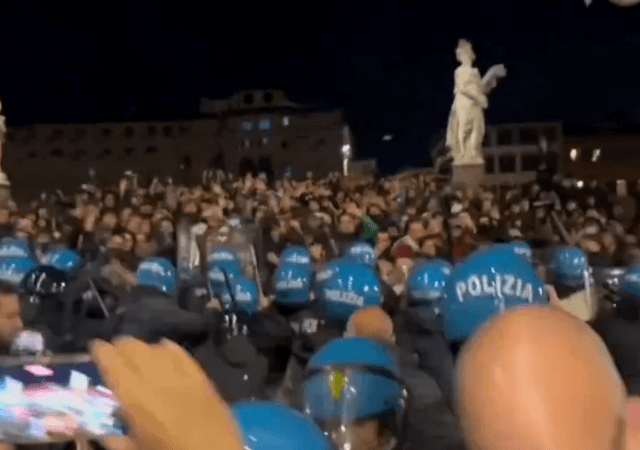
 Riot police face a large crowd of protesters at night in Italy.
Are 'Far-Left Infiltrators' or Genuine Grievances Driving Europe's Riots?
Left says
- •A generation facing crumbling schools, unaffordable housing, job precarity and pensions they'll likely never collect is reacting to a genuinely broken social contract, not manipulation from outside agitators.
- •Each country's protests have distinct local causes — education funding in France and Greece, housing costs in Spain and Portugal, conscription fears in Germany — making a single coordinated far-left plot implausible.
- •Blaming 'hard-left infiltrators' for violence lets governments avoid confronting the underlying failures driving hundreds of thousands into the streets.
- •Most demonstrations have been largely peaceful, with only a minority hijacking marches into looting and destruction.
Right says
- •Officials across multiple countries — France, Belgium, Italy — have independently pointed to organized far-left and Antifa-linked networks moving between cities to escalate otherwise peaceful student and cost-of-living protests into riots.
- •Authorities are investigating specific organizers, including a suspected 'mastermind' behind Italy's October 17 movement, suggesting coordinated instigation rather than purely spontaneous unrest.
- •The scale of security response — 70,000 police deployed, thousands arrested, hundreds of officers injured — reflects a serious public order crisis that governments have a duty to contain.
- •Genuine grievances don't excuse deliberate violence, arson and looting carried out under cover of legitimate demonstrations.
Common Take
High Consensus- Protests have spread across France, Albania, Italy, Belgium, Spain and Portugal over the past several weeks.
- Tens of thousands of police have been deployed and thousands of arrests made, with both officers and protesters injured.
- Young people's economic anxiety over education, housing and job prospects is a real driving force behind the unrest.
- A minority of participants have engaged in violence, looting and property destruction during otherwise large demonstrations.
The Arguments
Left argues
The protests span France, Spain, Portugal, Germany, Greece, and Albania with distinct local triggers — school funding, housing costs, conscription fears, pension insecurity — which makes a single coordinated far-left conspiracy implausible as the primary explanation for such widespread unrest.
Right counters
Distinct local grievances and organized infiltration aren't mutually exclusive; opportunistic networks can exploit genuine local anger in multiple countries simultaneously without having caused the underlying discontent themselves.
Right argues
Officials in France, Belgium, and Italy have independently — not in coordination with each other — identified far-left and Antifa-linked actors infiltrating demonstrations, and Italian authorities are investigating a specific named individual as an organizational 'mastermind,' which points to deliberate escalation rather than purely spontaneous rage.
Left counters
Governments facing embarrassing mass unrest have an obvious political incentive to blame shadowy outside agitators rather than admit their own policy failures are driving citizens into the streets, so official accusations alone aren't proof of a coordinated plot.
Left argues
The scale of peaceful participation — hundreds of thousands marching with only a minority involved in violence — shows the dominant story is legitimate mass frustration with broken promises on education, housing, and retirement security, not riot tourism by professional agitators.
Right counters
Even a small number of organized instigators can hijack a peaceful mass movement into arson and looting, so the overall peacefulness of a march doesn't negate the real and separate problem of coordinated violent infiltration that governments must address.
Right argues
The severity of the response — 70,000 police deployed in France alone, thousands of arrests, hundreds of injured officers — reflects a genuine public order crisis that governments are obligated to contain regardless of how sympathetic the underlying grievances may be.
Left counters
Heavy security deployments and mass arrests can themselves escalate tensions and criminalize legitimate dissent, potentially making governments look like they are suppressing a political movement rather than neutrally policing isolated criminal acts.
Left argues
Focusing public attention on 'far-left infiltrators' conveniently shifts blame away from the structural failures — unaffordable housing, precarious jobs, crumbling schools, pensions many won't live to collect — that are the actual root cause driving a whole generation into the streets.
Right counters
Acknowledging that organized actors are deliberately turning protests violent isn't incompatible with also acknowledging real grievances; governments can address both the instigators and the underlying policy problems rather than treating it as an either-or choice.
Challenge Questions
These questions target genuine internal contradictions — meant to provoke honest reflection.
Right asks Left
“If each country's protests have genuinely distinct local causes, why do witnesses report Italian demonstrators chanting in French and clear cross-border echoes in tactics and timing, and what would count as evidence of coordination that the left would accept?”
Left asks Right
“If officials in multiple countries are blaming far-left infiltrators for violence, what specific evidence beyond government assertions and a single ongoing investigation has been produced to show organized coordination, rather than each country's security services independently reaching for the same politically convenient explanation?”
Outlier Report
Left Fringe
Figures like Jacobin writers or DSA-aligned commentators who would go further, framing the unrest as a justified anti-capitalist uprising and dismissing any far-left organizing concerns as government propaganda; roughly 10-15% of the left.
Right Fringe
Commentators like Emily Schrader or outlets like Legal Insurrection pushing a strong 'coordinated Antifa network' narrative treating the riots as a deliberate transnational plot; roughly 15-20% of the right.
Noise Assessment
Moderate noise: this is a low-salience foreign story for most Americans, so actual public opinion is thin and loosely held, while online discourse amplifies the infiltration narrative far beyond how much ordinary Americans are actually thinking about European protest organizing.
Sources (7)
The chaos and unrest still gripping France continued to spread Saturday to its European neighbors. In Albania, protesters rallied outside the Ministry of Education to demand lower tuition fees, greater state investment in education and the resignation of Prime Minister Edi Rama. The crowds set fire to dumpsters and couch cushions that Rama had placed as a symbolic invitation to dialogue with students, Euro News reported.
Protests over a range of issues have taken place in cities across Europe, from Milan and Madrid to Lisbon and Tirana. Demonstrators are taking to the streets over pensions, housing, education, corruption and opposition to war, reflecting a diverse mix of grievances across the continent. Despite precautions, bans and heavy policing the protests led to violent clashes in several cities in France - around 2,400 people have been arrested, while nearly 1000 members of the security forces were injured, as well 100 protesters and residents in Paris alone.
Fresh protests: Almost 1,000 people were detained during largely peaceful demonstrations across France today, according to authorities. As night fell, police were on standby to guard against looting, the interior ministry said, and clashes in several cities resulted in the deployment of tear gas and water cannon. Security operation: Some 70,000 officers are positioned across the country this weekend as part of a huge security operation. At least 400,000 people protested on Saturday, with 110,000 of these in Paris, the interior ministry said. Discontent across Europe: Anti-government demonstrations are also taking place in a number of other European countries. Police in Albania used water cannon during clashes with protesters, while in Italy, scuffles broke out as hundreds gathered in the cities of Naples, Rome and Milan.
<p>European unrest spreads as French and Belgian officials accuse far-left activists of fueling violence and Italy deploys more soldiers to Milan.</p> The post <a href="https://legalinsurrection.com/2026/10/european-riots-spread-as-officials-blame-far-left-groups/">European Riots Spread as Officials Blame Far-Left Groups</a> first appeared on <a href="https://legalinsurrection.com">Le·gal In·sur·rec·tion</a>.
PARIS, Oct 25 (Reuters) – French protest groups and unions called on Sunday for further demonstrations as they sought to maintain pressure on the government after a huge security operation helped to contain unrest during nationwide rallies on Saturday. The Interior Ministry said 410,000 people took part in Saturday’s marches as authorities deployed 70,000 police,...
<p>An electoral supercycle over the next year may redefine the continent’s future. But what’s happening on the streets is shaping it, too</p><p>France sneezed, and Europe has again caught the cold. The wave of unrest which began with teenagers at a high school soon drew in hundreds of thousands of people nationwide and then <a href="https://www.theguardian.com/world/2026/oct/18/europe-protests-france-spain-portugal-2026-explainer">spread across the continent</a>. Protests have filled the streets in Lisbon and Madrid, and have ignited into violence in <a href="https://www.theguardian.com/world/2026/oct/23/milan-unrest-italy-lost-generation-protests">Milan</a>, <a href="https://www.dw.com/en/brussels-rioters-clash-with-police-at-anti-austerity-rally/a-79620594">Brussels</a> and <a href="https://www.theguardian.com/world/2026/oct/14/student-protests-tirana-albania-police-clashes">Tirana</a> as well as in French cities.</p><p>French authorities say they are deploying 70,000 officers on Saturday and are allowing only marches organised by unions. They blame hard-left militants as well as opportunistic young perpetrators for last weekend’s destruction and looting, when a minority <a href="https://www.theguardian.com/world/2026/oct/19/looting-french-cities-continues-second-night">hijacked largely peaceful protests</a>. But with fuel prices set to rise further over the winter, the demands and participants broadening, and President Macron <a href="https://www.theguardian.com/world/2026/oct/19/emmanuel-macron-criticism-isolation-france">utterly failing to meet the moment</a>, there is no sign of an end to the wider discontent and no speedy resolution in sight.</p> <a href="https://www.theguardian.com/commentisfree/2026/oct/23/the-guardian-view-on-europes-protests-the-social-contract-has-broken-and-young-people-want-solutions">Continue reading...</a>
Hundreds of thousands of people joined protests in France on Saturday, leading to arrests, arson and injuries.