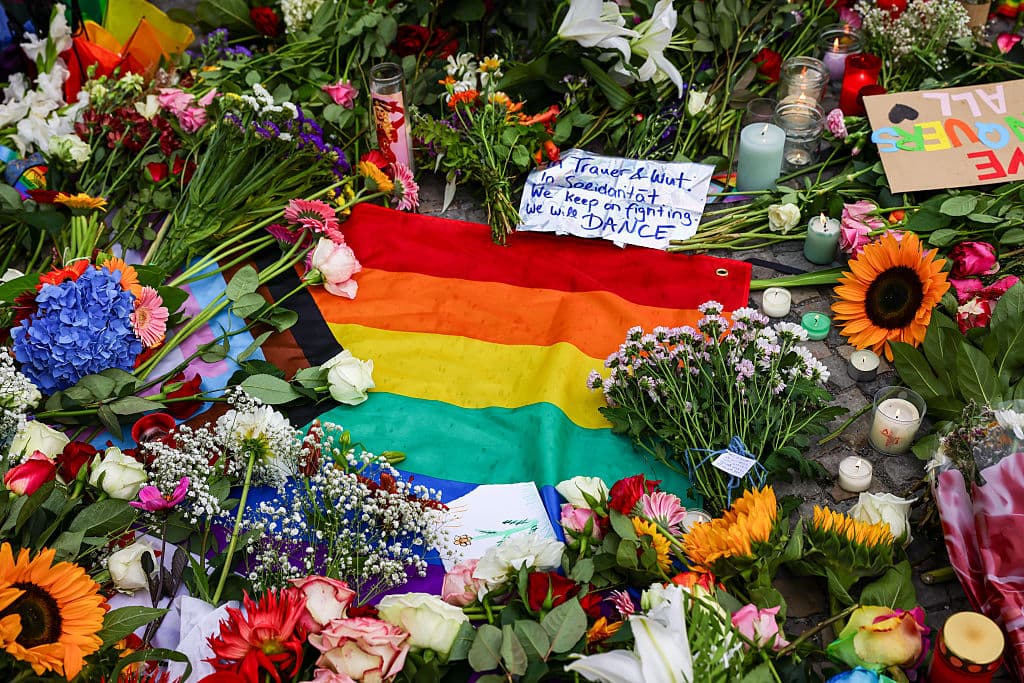
 Rainbow Pride flag and flowers form a memorial at the Berlin Pride attack site.
Berlin Pride Attack: Islamist Terror or Far-Right Opportunism?
Intra-Party Split Detected
Most left-leaning outlets focus on far-right exploitation of the attack and warn against anti-Muslim backlash, emphasizing domestic queerphobia and racism, while acknowledging the attacker's Islamist motive; center/right outlets more directly frame the attack as an Islamist terrorism problem and criticize the left for downplaying that threat.
Left says
- •The suspect was born and raised in Germany, undercutting attempts to blame the attack on migration policy specifically, since he was not an immigrant but a German citizen radicalized domestically.
- •The far-right AfD party moved to exploit the tragedy within hours to push anti-immigrant and anti-Muslim narratives, despite the party's own record of opposing LGBTQ+ rights like marriage equality and gay adoption.
- •Pride organizers explicitly asked that the attack not be used to divide society or cast suspicion on entire groups, warning against political exploitation of the tragedy.
- •Structural and everyday queerphobia within German society and institutions deserves as much scrutiny as the singular violent act, since focusing solely on 'foreign' threats lets domestic homophobia off the hook.
Right says
- •Germany's interior minister officially classified the attack as Islamist terrorism, and the suspect had previously tried to join ISIS and had been imprisoned for planning an attack before his release in May.
- •The attacker's history reveals a pattern of lenient treatment of known Islamist threats, raising serious questions about whether authorities failed to adequately monitor or detain someone who had already shown intent to commit violence.
- •Islamism represents a distinct and growing ideological threat to the freedoms of secular, liberal societies, including the safety of LGBTQ+ people themselves, and should be named and confronted directly rather than downplayed.
- •Some criticize segments of the political left for being reluctant to acknowledge or condemn Islamist extremism forcefully, seeing this hesitancy as inconsistent with the left's usual advocacy for LGBTQ+ safety.
Common Take
High Consensus- A van attack near Berlin's Christopher Street Day Pride celebration killed one woman and injured 29 others on Saturday night.
- The suspect, 21-year-old German citizen Abdul Ballout, was shot and killed by police during a manhunt on Sunday.
- Ballout had previously attempted to join the Islamic State and had been imprisoned for preparing an attack before his release in May.
- Both sides recognize the safety and dignity of LGBTQ+ communities as a value worth protecting, even while disagreeing on the greater threat to that safety.
The Arguments
Right argues
The interior minister officially classified this as Islamist terrorism, and the suspect had a documented history of trying to join ISIS and being imprisoned for planning an attack, making the ideological motive clear rather than ambiguous.
Left counters
Naming the ideology accurately doesn't require blaming migration policy, since the attacker was a German citizen born and raised domestically, meaning tougher immigration enforcement would not have prevented this attack.
Left argues
The AfD moved within hours to demand migration policy changes despite the attacker being a native-born German citizen, revealing that the party's response was opportunistic messaging rather than a genuine security-policy fix, especially given its own record opposing LGBTQ+ rights.
Right counters
Pointing out AfD's hypocrisy on LGBTQ+ issues doesn't refute the substantive point that Islamism is a distinct ideological threat that authorities failed to contain, since the attacker was released from prison in May after already showing intent to commit violence.
Right argues
The suspect's release from prison in May, despite a prior conviction for planning an attack and known ties to Islamist circles, raises legitimate questions about whether German authorities are too lenient in monitoring and detaining known extremist threats.
Left counters
Focusing solely on the failures of counterterrorism monitoring risks ignoring the broader structural queerphobia in German society that also endangers LGBTQ+ people daily, not just through singular dramatic attacks.
Left argues
Pride organizers explicitly and preemptively asked that the attack not be used to divide society or cast suspicion on entire groups, reflecting the community's own priority of solidarity over political exploitation.
Right counters
Declining to discuss the ideological nature of the threat out of fear of 'division' can amount to downplaying a real and growing danger to the very LGBTQ+ people Pride organizers are trying to protect.
Right argues
Segments of the political left have historically been reluctant to name and confront Islamist extremism forcefully, which is inconsistent with their otherwise strong advocacy for LGBTQ+ safety, since Islamist ideology poses a direct threat to queer lives.
Left counters
Left commentators did report the interior minister's terrorism classification and the suspect's ISIS ties plainly; the concern is not denial of the ideology but resisting its use to smear an entire religious or immigrant population who are themselves often LGBTQ+ or allies.
Challenge Questions
These questions target genuine internal contradictions — meant to provoke honest reflection.
Right asks Left
“If structural queerphobia within German institutions is as urgent a concern as this attack, why did it take a mass-casualty Islamist terror attack—rather than routine discrimination—to generate this level of national and international attention to that structural critique?”
Left asks Right
“If the primary lesson is that authorities were too lenient toward a known Islamist threat, how does emphasizing migration policy changes address a case where the attacker was a native-born citizen who fell through the cracks of domestic counterterrorism and prison systems rather than border policy?”
Outlier Report
Left Fringe
Writers at The Intercept and The Nation (e.g., the framing in 'The Right Seeks to Capitalize on Berlin Pride Attack') represent a fringe position emphasizing structural queerphobia and Western/right-wing culpability over Islamist ideology as the primary threat; this view likely represents 15-20% of the left, concentrated among academic/activist-aligned progressives.
Right Fringe
Commentators like those at RealClearPolitics ('Berlin Pride Attack Shows Left's Insane Love for Islamism') and some AfD-aligned voices push a narrative blaming the entire political left for Islamist sympathies and using the attack to broadly indict immigration policy despite the German-born suspect; this represents perhaps 20-25% of the right, more visible on social media than in mainstream conservative discourse.
Noise Assessment
High noise ratio — the framing battle (Islamist terror vs. far-right opportunism) is largely an elite media and activist discourse; most ordinary Americans across the spectrum would simply view this as a terrorist attack committed by a radicalized individual, without engaging deeply in the structural-queerphobia-vs-Islamism framing war that dominates opinion pieces.
Sources (7)
A man drove a minivan into a crowd of people near Berlin’s Pride celebrations on Saturday, killing one person and injuring 29 others. Authorities shot and killed the man during an operation on Sunday. The alleged suspect was identified as Abdul Ballout, a 21-year-old German citizen. According to authorities, Ballout tried to join the Islamic State in 2025 and was released from prison in May after being jailed for preparing an attack.</p> <p>“The far right here in Germany is, of course, waiting for an attack like this one to use it in order to highlight that the foreigners are the problem,” says Alfonso Pantisano, <span class="caps">LGBTQ</span> affairs commissioner for the Berlin state government. “By doing so, they completely forget and avoid to look at how much queerphobia there is in this country in all various levels of structures.”
Police searching for suspect after a van drove into crowds at Germany's largest LGBTQ+ Pride event
The annual Christopher Street Day, as Pride parades are known in Germany, has been a fixture of Berlin's cultural calendar since 1979. Yet what was supposed to be Germany's largest event for gay, lesbian and other sexual minorities ended on Saturday night in panic and bloodshed.
The Islamist attack at Berlin's Christopher Street Day highlights the threat Islamism poses to freedom, leader of Germany's liberal Free Democratic Party (FDP) Wolfgang Kubicki writes in Euronews, arguing that it is growing in Germany and must be confronted.
German police seem to know a great deal already about the man who drove his car into a Pride march in Berlin over the weekend, killing one woman and injuring many more.
<p>Day in and day out, it is the likes of Germany’s conservative parties, and the Republicans at home, who are assaulting LGBTQ+ rights.</p> <p>The post <a href="https://theintercept.com/2026/07/27/berlin-pride-attack-afd-trump/">The Right Seeks to Capitalize on Berlin Pride Attack — Even as It Poses Its Own Existential Threat to Queer Lives</a> appeared first on <a href="https://theintercept.com">The Intercept</a>.</p>
<p>Edna Bonhomme</p> <div><img alt="" src="https://www.thenation.com/wp-content/uploads/2026/07/ubahn.jpg" /></div> <div> <div class="wp-block-the-nation-dek article-title__dek"> <p>I left America in 2017 to flee an authoritarian government and the culture it facilitated. What I found in Berlin was not all that different.</p> </div> </div> <p>The post <a href="https://www.thenation.com/article/world/germany-racism/">The Bitter Paradox of German Racism</a> appeared first on <a href="https://www.thenation.com">The Nation</a>.</p>