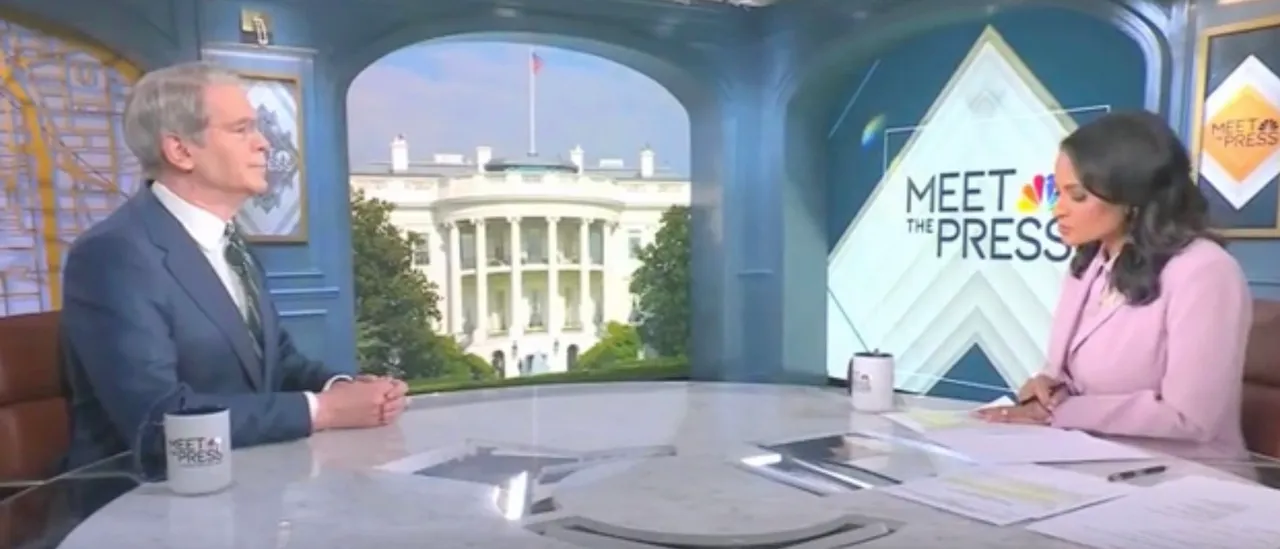
Bessent Says US Must 'Escalate to De-escalate' Iran War
Intra-Party Split Detected
Some Republicans in Congress questioning the need for $200 billion in additional Iran war funding despite large defense appropriations
Left says
- •The administration's aggressive military escalation against Iran risks spiraling into a prolonged, costly conflict reminiscent of Iraq and Afghanistan
- •Rising gas prices and economic disruption from the war disproportionately burden working families while defense contractors profit
- •The $200 billion supplemental funding request comes after record defense spending increases, raising questions about fiscal priorities
- •Trump's ultimatum threatening to 'obliterate' Iranian power plants represents dangerous brinksmanship that could destabilize the entire region
Right says
- •Strong military pressure is the only effective way to force Iran to reopen critical shipping lanes and end their nuclear weapons program
- •The administration has adequate funding for current operations without raising taxes on American families
- •Temporary economic pain from higher energy prices is justified to eliminate Iran's long-term nuclear threat to global security
- •Iran's closure of the Strait of Hormuz and attacks on shipping constitute acts of war that demand decisive military response
Common Take
High Consensus- The closure of the Strait of Hormuz has caused significant increases in global oil prices and U.S. gas prices
- The conflict has already cost over $11 billion in its first six days of operations
- Iran's nuclear weapons program poses a serious security concern that needs to be addressed
- The war represents the most expensive U.S. military engagement since Iraq and Afghanistan
The Arguments
Right argues
Iran's closure of the Strait of Hormuz—through which a fifth of global oil flows—constitutes an act of war that threatens the entire global economy and requires decisive military response to reopen critical shipping lanes.
Left counters
Military escalation risks transforming a regional crisis into a prolonged, costly conflict that could destabilize the entire Middle East while imposing severe economic hardship on American families through sustained high energy prices.
Left argues
The $200 billion supplemental funding request comes after record defense spending increases to $1.5 trillion, raising serious questions about fiscal priorities when working families are already struggling with rising costs from the conflict.
Right counters
The administration has adequate existing funding with a trillion-dollar military budget and won't raise taxes on families—the supplemental request ensures long-term military readiness while eliminating Iran's nuclear threat permanently.
Right argues
Temporary economic pain from higher energy prices is justified to eliminate Iran's nuclear weapons program, which poses an existential long-term threat to global security that far outweighs short-term costs.
Left counters
This 'temporary' pain disproportionately burdens working families while defense contractors profit, and there's no guarantee the conflict won't spiral into another decades-long quagmire like Iraq or Afghanistan.
Left argues
Trump's ultimatum threatening to 'obliterate' Iranian power plants represents dangerous brinksmanship that could escalate into a broader regional war, potentially drawing in other powers and creating humanitarian catastrophe.
Right counters
Strong military pressure and clear ultimatums are the only language Iran understands—this decisive approach forces them to negotiate and prevents the longer-term threat of a nuclear-armed Iran.
Right argues
The 'escalate to de-escalate' strategy has already demolished Iran's military capabilities including their air force and navy, demonstrating that overwhelming force can achieve objectives more quickly than prolonged diplomatic engagement.
Left counters
This strategy mirrors the failed logic that led to costly interventions in Iraq and Afghanistan, where initial military success gave way to prolonged occupation and insurgency without achieving lasting stability.
Challenge Questions
These questions target genuine internal contradictions — meant to provoke honest reflection.
Right asks Left
“If Iran's closure of the Strait of Hormuz truly threatens global economic stability and constitutes an act of war, how can you simultaneously argue that military action to reopen it is unjustified escalation rather than necessary defense of international commerce?”
Left asks Right
“If you acknowledge that Iran's nuclear program poses a long-term existential threat and that diplomatic engagement has failed for decades, what specific alternative strategy would you propose that doesn't ultimately require the credible threat of military force?”
Outlier Report
Left Fringe
Progressive Squad members like Alexandria Ocasio-Cortez and Rashida Tlaib who call for immediate withdrawal and compare this to Iraq WMD lies, representing roughly 15% of the left coalition.
Right Fringe
Hardline hawks like John Bolton and Tom Cotton who advocate for regime change and unlimited military spending regardless of costs, representing about 20% of the right coalition.
Noise Assessment
Moderate noise level - while partisan media amplifies extreme positions, the core debate over military intervention versus economic costs reflects genuine public concerns rather than manufactured controversy.
Sources (7)
'again, Kristen, terrible framing'
In an exclusive interview with Meet the Press, Treasury Secretary Scott Bessent discusses the Trump Administration’s decision to remove sanctions on Iranian oil and talks about the cost of war with Iran.
Treasury Secretary Scott Bessent defended strikes on Iran's infrastructure since the U.S and Israel's joint operation began, saying "sometimes you have to escalate to de-escalate."
The United States may need to "escalate" its attacks against Iran to be able to wind down the war, Treasury Secretary Scott Bessent said Sunday, after President Donald Trump gave seemingly contradictory trajectories for the US military campaign.Trump on Saturday threatened...
The U.S. government has "plenty of money" to fund the war against Iran, but is requesting supplemental funding from Congress to ensure the military is well supplied in the future, U.S. Treasury Secretary Scott Bessent said on Sunday.Bessent, speaking on NBC News' "Meet the...
“Fifty days of temporary elevated prices – prices will come off on the other side – for 50 years of not having an Iranian regime with a nuclear weapon, the American people, they are beginning to understand, thanks to President Trump, that there is no prosperity without security,” he said.
<p>WASHINGTON, March 22 (Reuters) — The U.S. government has “plenty of money” to fund the war against Iran, but is requesting supplemental funding from Congress... <a class="call-to-action" href="https://www.dailysignal.com/2026/03/22/treasurys-bessent-says-us-has-plenty-of-funds-for-iran-war/">Read More</a></p> <p>The post <a href="https://www.dailysignal.com/2026/03/22/treasurys-bessent-says-us-has-plenty-of-funds-for-iran-war/">Treasury’s Bessent Says US Has ‘Plenty’ of Funds for Iran War</a> appeared first on <a href="https://www.dailysignal.com/">The Daily Signal</a>.</p>