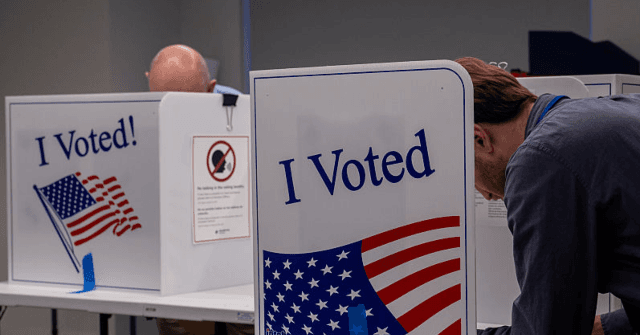
 Voters cast ballots at polling booths displaying 'I Voted' signs.
Biden Judge Rules Congress Can't Ban Noncitizens From Voting
Left says
- •The ruling rests on a textual reading of the Constitution, which assigns states — not Congress — the primary authority to set voter qualifications for elections.
- •Judicial independence matters even when a ruling is unpopular or politically inconvenient, and judges should be free to interpret constitutional structure without being accused of partisan motives simply because of who appointed them.
- •The decision addresses a narrow constitutional question about which branch of government holds authority, not whether noncitizen voting itself is desirable policy.
- •Precedent and separation-of-powers questions deserve careful judicial scrutiny rather than dismissal, and this case will likely be clarified further on appeal.
Right says
- •Congress has long relied on its immigration and federal election authority to bar noncitizens from voting, and this ruling undermines a commonsense safeguard that has existed since 1996.
- •Allowing a single district judge to nullify a federal statute protecting the integrity of federal elections sets a troubling precedent that could affect other pending prosecutions nationwide.
- •The case involved a noncitizen who reportedly knew she was ineligible yet voted anyway, raising concerns that the ruling could shield clear instances of illegal voting from federal accountability.
- •Quick appeal by the Trump administration reflects urgency to restore clarity and deterrence against noncitizen voting before the ruling influences other courts or cases.
Common Take
High Consensus- Judge David Leibowitz, appointed by President Biden in 2024, issued the ruling dismissing the case against Chelsea Michelle Ann Cox.
- The case centers on whether the Constitution grants Congress or the states the authority to regulate noncitizen voting eligibility in federal elections.
- The 1996 federal law in question makes it a crime, punishable by prison time and fines, for noncitizens to vote in federal elections.
- The ruling is expected to be appealed and could have broader implications for other pending noncitizen voting cases.
The Arguments
Left argues
The Constitution's text and structure assign states primary authority over voter qualifications, and a judge faithfully applying that structural reading is doing their job even if the outcome is politically unwelcome.
Right counters
Congress has long regulated federal elections under its Article I, Section 4 authority and its immigration powers, and courts have historically upheld federal statutes like the 1996 noncitizen voting ban without treating them as constitutional overreach.
Right argues
A federal law barring noncitizens from voting in federal elections has stood since 1996 and reflects a basic, widely shared safeguard for election integrity that most Americans assume is settled law.
Left counters
Longevity and popularity of a statute don't establish its constitutionality; courts exist precisely to assess whether Congress exceeded its enumerated powers, regardless of how entrenched or popular a law has become.
Right argues
Allowing a single district judge's ruling to potentially nullify federal prosecutions nationwide creates dangerous uncertainty and could let clear-cut cases of knowing illegal voting go unpunished while the issue winds through appeals.
Left counters
This is exactly why the appeals process exists — a district court ruling is not final, and the swift appeal by the Trump administration shows the system is working as designed to resolve the question authoritatively.
Left argues
The ruling addresses a narrow separation-of-powers question about which branch holds authority over voter qualifications, not a policy endorsement of noncitizen voting, and conflating the two mischaracterizes the judge's reasoning.
Right counters
Regardless of the judge's narrow framing, the practical effect is to shield a defendant who allegedly knew she was ineligible and voted anyway, which makes the ruling's real-world consequences impossible to separate from the policy question.
Right argues
Labeling the judge by who appointed him is relevant context, since the ruling's novel interpretation — contradicting decades of assumed congressional authority — invites scrutiny of whether broader ideological priors shaped the legal reasoning.
Left counters
Judicial independence requires evaluating rulings on their legal merits rather than assuming bias from the appointing president, and doing otherwise undermines public trust in courts across the political spectrum.
Challenge Questions
These questions target genuine internal contradictions — meant to provoke honest reflection.
Right asks Left
“If judicial independence means rulings should be assessed purely on legal merit regardless of who appointed the judge, why does the left's synopsis itself emphasize that accusations of partisan motive are unfair, rather than simply defending the ruling on its textual merits alone?”
Left asks Right
“If the right's primary objection is that a single district judge can nullify a federal statute and create nationwide uncertainty, does that objection also apply to past instances where district judges have blocked other federal policies the right supported, and if not, why is this case different?”
Outlier Report
Left Fringe
Some progressive legal scholars and immigration advocates (e.g., writers at Slate, The Intercept, or groups like the Brennan Center for Justice) who argue noncitizen voting restrictions are overstated as a 'problem' and emphasize states' rights or judicial independence; this represents a small slice, roughly 10-15% of the left, as most Democratic voters still oppose noncitizen voting in federal elections.
Right Fringe
Figures like Mike Davis or certain America First commentators who go further, framing this ruling as evidence of a 'deep state judiciary' requiring impeachment of judges or mass removal of 'activist' appointees; this is a vocal but limited segment, roughly 15-20% of the right, with most conservatives focused on the appeal process rather than judicial impeachment rhetoric.
Noise Assessment
High performative amplification on social media (X especially) with hyperbolic framing like 'election tourism' or comparisons to foreign interference, but the underlying public sentiment against noncitizen voting is genuine and widely shared, not merely manufactured outrage.
Sources (5)
<p>A Biden-appointed federal judge in Miami claims a federal ban on noncitizens voting is unconstitutional and has dismissed a case against a migrant who voted in 2020.</p> <p>The post <a href="https://www.breitbart.com/immigration/2026/10/02/biden-judge-claims-congress-cant-stop-noncitizens-from-voting/" rel="nofollow">Biden Judge Claims Congress Can’t Stop Noncitizens from Voting</a> appeared first on <a href="https://www.breitbart.com" rel="nofollow">Breitbart</a>.</p>
A Biden-appointed judge ruled that Congress cannot ban noncitizens from voting, striking down federal charges against an illegal alien alleged to have voted in multiple federal elections in Florida. U.S. District Judge David Leibowitz of the Southern District of Florida ruled that the Constitution only gives power to the states to regulate elections. Thus, he...
The Trump administration announced an immediate appeal Friday, a day after a federal judge issued a startling ruling finding that Congress doesn't have the power to outlaw noncitizens casting ballots in federal elections.
The judge who made the call says the Constitution leaves voter qualifications to the states, not Congress -- a distinction that could reshape dozens of pending cases.