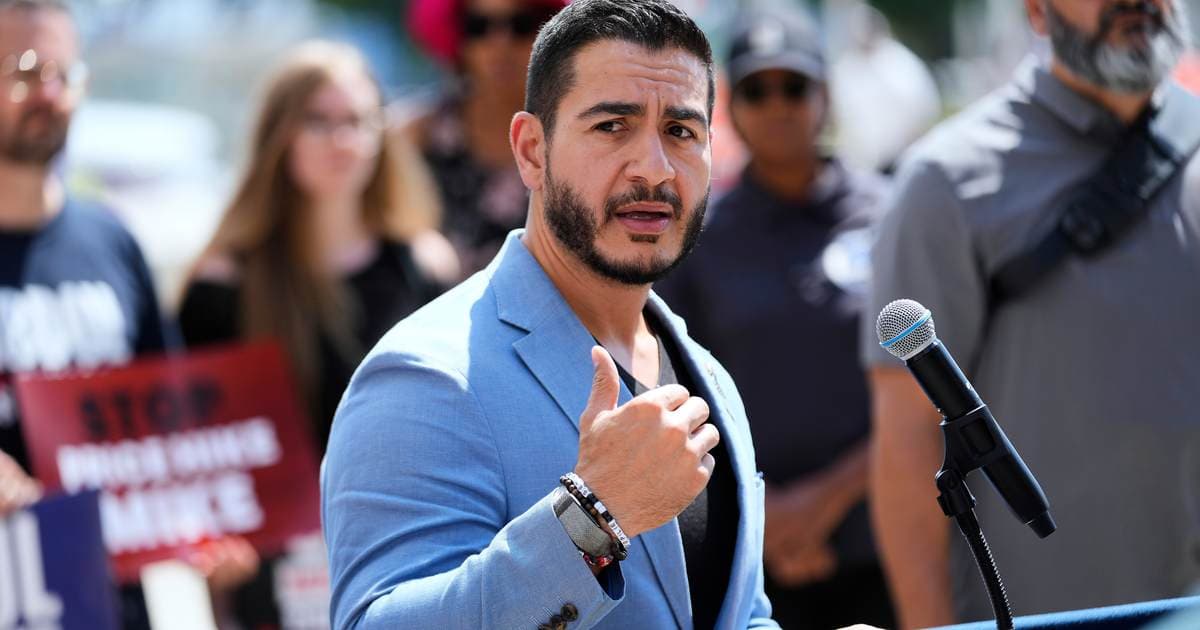
 Abdul El-Sayed speaks at a podium during a campaign event.
Can El-Sayed Win Over Jewish Voters Without Disavowing Piker?
Intra-Party Split Detected
Some Jewish and centrist Democrats in Michigan, including Rep. candidate Jeremy Moss, are uneasy with or openly critical of El-Sayed's associations (e.g. Hasan Piker) and his response to the synagogue attack, while much of the progressive left and national Democratic base continues to embrace his candidacy.
Left says
- •El-Sayed's opposition to Zionism as a political ideology has been repeatedly and falsely conflated with antisemitism by opponents seeking to damage his campaign.
- •His comments after the Temple Israel attack attempted to contextualize the perpetrator's motivations within a broader cycle of violence, not to excuse or justify the attack itself.
- •Piker's inflammatory remarks about Jewish Americans came from a broadcast he made independently, and El-Sayed's campaign has stated that no one but El-Sayed and his official spokespeople speak for his campaign.
- •Jewish Democrats in Michigan are actively engaging with El-Sayed in good faith, working through disagreements rather than writing him off, suggesting room for coalition-building despite real tensions.
Right says
- •El-Sayed has scrubbed left-wing content and softened his public image since launching his Senate campaign while maintaining relationships with figures who hold far more extreme views than he publicly admits to.
- •His continued association with Hasan Piker, who has made comments many view as justifying violence against Jews, raises legitimate questions about his judgment and the company he keeps.
- •His response to the Temple Israel synagogue attack, framing the assailant's violence as understandable rage rather than unequivocally condemning terrorism against a Jewish institution, struck many as deeply insensitive.
- •His broader pattern of associations, including with controversial clerics and activists, combined with past behavior like boasting about destroying a store owner's property, raises character concerns that deserve scrutiny equal to that given his opponent.
Common Take
High Consensus- El-Sayed campaigned with Hasan Piker during the primary, and Piker's later remarks about Jewish Americans created real controversy for the campaign.
- El-Sayed responded to the March attack on Temple Israel's Jewish preschool by describing the perpetrator's actions within a 'cycle of violence,' a framing that drew criticism from multiple directions.
- Jewish voters in Michigan represent a meaningful and closely watched constituency in this Senate race.
- El-Sayed's campaign has stated that no one but he and his official spokespeople speak for his campaign, distancing him from Piker's specific comments.
The Arguments
Left argues
El-Sayed's opposition to Zionism as a political ideology is a substantive policy position, and critics have repeatedly and misleadingly conflated it with antisemitism to damage his campaign without engaging his actual arguments.
Right counters
The concern isn't merely his stance on Zionism as a policy matter, but the pattern of associations with figures who go well beyond policy disagreement into rhetoric that many perceive as justifying or excusing violence against Jews specifically.
Right argues
El-Sayed's response to the Temple Israel attack — framing the perpetrator's truck attack on a Jewish preschool as understandable 'displaced rage' from a 'cycle of violence' — struck many as a failure to unequivocally condemn an act of terrorism against a religious minority.
Left counters
El-Sayed did condemn the attack explicitly; providing context about the perpetrator's personal loss in an airstrike is an attempt at diagnosing root causes of violence, not an excuse or justification, and public health framing of violence as cyclical is standard analytical practice, not moral equivalence.
Right argues
El-Sayed continues to associate with Hasan Piker, who has made comments many view as justifying or predicting violence against Jewish Americans, and this ongoing relationship — not a single stray remark — raises legitimate questions about his judgment.
Left counters
Piker's inflammatory comments came from his own independent broadcast, not a campaign event, and El-Sayed's campaign has explicitly stated that no one but El-Sayed and his official spokespeople speak for the campaign, meaning Piker's views cannot fairly be attributed to the candidate.
Left argues
Despite real tensions, Jewish Democrats in Michigan, including pro-Israel figures like Jeremy Moss, are engaging with El-Sayed in good faith and working through disagreements rather than writing him off, demonstrating that coalition-building is possible and that blanket antisemitism charges don't reflect the on-the-ground relationship.
Right counters
The fact that Jewish Democrats feel compelled to publicly and repeatedly seek reassurances, distance themselves from Piker's comments, and negotiate basic terms of trust itself reflects how much doubt and discomfort El-Sayed's associations have created within his own coalition.
Right argues
El-Sayed has scrubbed left-wing content and softened his public image since launching his Senate campaign while maintaining ties to socialists, controversial clerics, and activists whose views are far more extreme than what he now publicly presents, suggesting strategic image management rather than genuine moderation.
Left counters
Politicians routinely refine their public messaging as they run for higher office and reach broader electorates; having varied allies and endorsers across a broad coalition is normal in politics and doesn't mean a candidate secretly holds his most extreme supporters' views.
Challenge Questions
These questions target genuine internal contradictions — meant to provoke honest reflection.
Right asks Left
“If context about a perpetrator's personal trauma is offered to explain what drove him to attack a Jewish preschool, why is that framing appropriate here but would presumably be rejected if applied to, say, an attacker motivated by economic grievance who targeted a mosque or Black church?”
Left asks Right
“If associations with extreme online figures are disqualifying evidence of a candidate's true character and judgment, how should voters weigh the Rogers campaign's own associates who have downplayed the 2020 election results or opposed gay marriage — and if that standard shouldn't apply equally, why not?”
Outlier Report
Left Fringe
Figures like Hasan Piker himself and some DSA-aligned activists who view anti-Zionism critiques of El-Sayed as entirely bad-faith and see no issue with his associations represent perhaps 10-15% of the left, being more absolutist than the median Democrat.
Right Fringe
Commentators like those at Townhall pushing narratives tying El-Sayed to Muslim Brotherhood-linked clerics or implying terrorist sympathies represent a more extreme framing embraced by maybe 20-25% of the right, going further than the median Republican voter's concerns about judgment and associations.
Noise Assessment
High noise ratio: much of this story is driven by campaign opposition research, viral clips, and social media amplification (RNC Research, Fox News Digital) rather than organic broad public engagement, meaning actual voter sentiment in Michigan is likely more nuanced and less polarized than the discourse suggests.
Sources (7)
Abdul El-Sayed is trying to win over undecided Jewish voters in Michigan — without compromising his substantive positions on Israel or disavowing his most radical allies.   During both his primary and general election campaigns, El-Sayed’s opponents have portrayed him as insensitive to Jewish concerns, if not outright antisemitic. These charges have often rested on falsely […]
Abdul El-Sayed claims he's not a socialist, but Bernie Sanders, Alexandria Ocasio-Cortez and Democratic Socialists of America ties tell a different story.
The former Fox News host said he believes El-Sayed, who is bidding to be the first Muslim elected to the U.S. Senate, will eke out a victory this fall.
The progressive streamer’s comments suggesting people may “take action” against Jews in the U.S. drew a rebuke from other Michigan Democrats.
<p>The Nation</p> <div><img alt="" src="https://www.thenation.com/wp-content/uploads/2026/09/El-Sayed-QA-getty.jpg" /></div> <div> <div class="wp-block-the-nation-dek article-title__dek"> <p>A conversation with Michigan’s Democratic Senate nominee about public health, outside money, and a new kind of politics.</p> </div> </div> <p>The post <a href="https://www.thenation.com/article/politics/abdul-el-sayed-interview-michigan-senate/">Abdul El-Sayed Diagnoses American Politics </a> appeared first on <a href="https://www.thenation.com">The Nation</a>.</p>