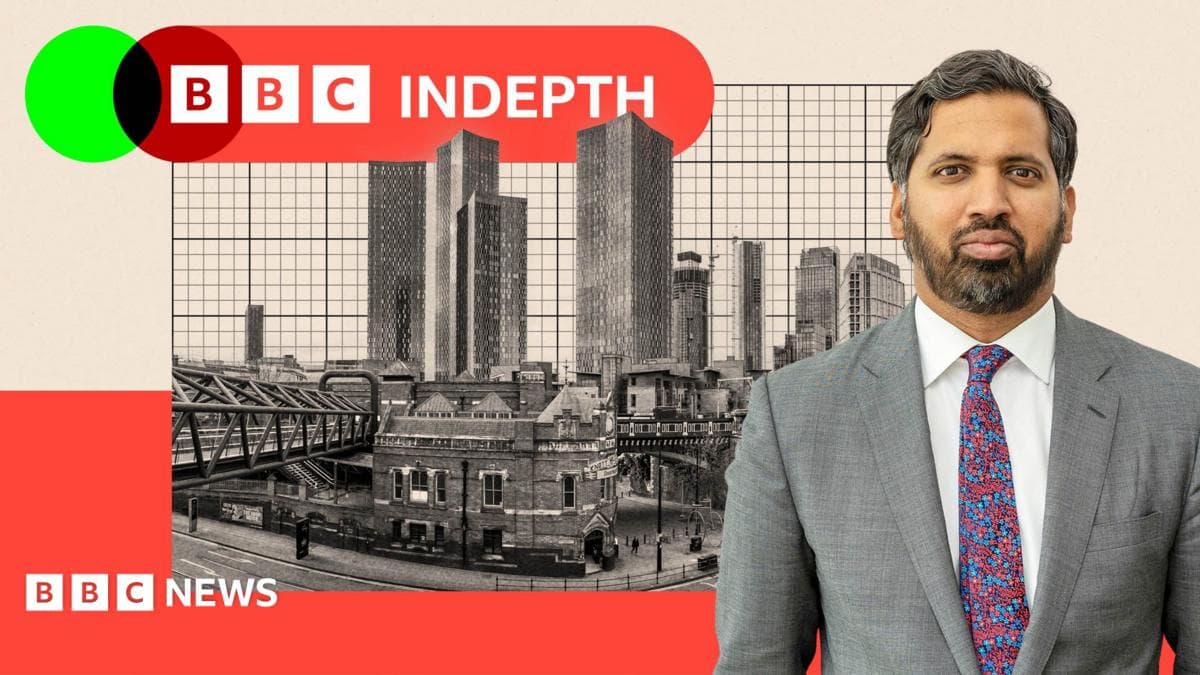
Can 'Manchesterism' Fix Britain? Burnham's Model Faces National Test
Intra-Party Split Detected
Labour left is reportedly revolting against Burnham's rumored choice of Shabana Mahmood as chancellor, questioning her economic views, while others on the party's right welcome the pick as reassuring to markets.
Left says
- •Manchester's growth under Burnham reflects a genuine alternative to London-centric governance, blending devolved decision-making with strong civic institutions and social solidarity.
- •Burnham's willingness to bring in figures from Labour's right, such as a potential chancellor pick, shows a pragmatic approach to reassuring markets while still pursuing reform of welfare and public services.
- •His rise represents a rejection of an overly centralized British state that has failed to address regional inequality, offering hope that his model of city-region empowerment could be scaled nationally.
- •Tackling entrenched problems like the disability benefits system requires humane reform rather than the punitive cuts previously attempted, which triggered backlash from disability advocates and Labour MPs.
Right says
- •Burnham arrives in Downing Street unelected by the public and largely untested on the national stage, raising legitimate questions about his mandate to govern.
- •His ascent was driven by panic within Labour ranks over Reform UK's local election surge rather than a coherent policy vision, suggesting reactive rather than strategic leadership.
- •Skepticism exists that a model built around one prosperous city can address national-scale problems like a £58bn welfare bill, sluggish growth, and high debt.
- •Choosing a chancellor with no economics background, even one seen as market-friendly, raises doubts about the seriousness of Burnham's economic strategy at a moment of real fiscal pressure.
Common Take
High Consensus- Andy Burnham became UK prime minister on Monday after Keir Starmer's resignation, following Labour's local election losses to Reform UK.
- Burnham inherits serious economic challenges including high government debt, low growth, and a rapidly rising welfare bill projected to hit £78bn by 2030.
- Manchester has seen notable economic and cultural growth under Burnham's mayoralty, including winning major events like the Brit Awards.
- The choice of chancellor, with Shabana Mahmood as a leading contender, is seen as a significant signal of the new government's economic direction.
The Arguments
Left argues
Manchester's growth under Burnham demonstrates that devolved civic institutions combined with social solidarity can produce genuine regional renewal, offering a proven alternative to London-centric governance that has left much of Britain behind.
Right counters
One prosperous city region succeeding under favorable conditions is not evidence that the same approach can solve a £58bn welfare bill, sluggish national growth, and high debt at the scale of an entire country facing very different structural pressures.
Right argues
Burnham arrives in Downing Street having never faced a national electorate, propelled into power by Labour MPs' panic over Reform UK's local election surge rather than any coherent mandate or vision, raising legitimate questions about his legitimacy to govern.
Left counters
Under Britain's parliamentary system no prime minister is directly elected, and Burnham's decisive by-election win against Reform, followed by overwhelming backing from Labour MPs, gives him a stronger internal mandate than many past leadership transitions.
Right argues
Selecting a chancellor with no economics background, even one who might reassure markets in the short term, signals a lack of seriousness about tackling Britain's real fiscal pressures, from high debt to ballooning disability benefit costs.
Left counters
Markets themselves rallied on the prospect of Mahmood's appointment, and her reputation for standing firm on difficult, humane policy choices may matter more for delivering welfare reform than formal economic credentials.
Left argues
Burnham's willingness to bring in figures from Labour's right shows pragmatic bridge-building that could reassure markets and unions alike, allowing him to pursue welfare and public service reform without repeating the punitive approach that triggered backlash against Starmer's government.
Right counters
This pragmatic pivot is already provoking a revolt from Burnham's own left-wing base, suggesting his coalition may be too internally contradictory to deliver consistent policy on the very issues, like welfare, that most urgently need resolution.
Right argues
Burnham's ascent was driven primarily by reactive fear of Reform UK rather than a deliberate, tested policy platform, meaning his government risks improvising national strategy under crisis conditions rather than executing a considered plan.
Left counters
Burnham's 'Manchesterism' has been developing as a coherent philosophy for years, rooted in a specific critique of over-centralization, so his rapid rise reflects timing meeting readiness rather than pure improvisation.
Challenge Questions
These questions target genuine internal contradictions — meant to provoke honest reflection.
Right asks Left
“If Manchester's success depended heavily on specific local conditions, civic institutions, and Burnham's personal relationships built over a decade as mayor, what is the actual evidence that this model is transferable to national governance rather than being a product of unique local circumstances?”
Left asks Right
“If critics argue Burnham lacks a national mandate because he wasn't directly elected PM, how do they reconcile that objection with Britain's long-standing parliamentary tradition in which no prime minister is ever directly elected by the public?”
Outlier Report
Left Fringe
American urbanist commentators and YIMBY-adjacent figures (e.g., writers at outlets like The Atlantic or Vox who cover devolution and city-led growth) represent a small (~10%) but vocal fringe that would enthusiastically embrace 'Manchesterism' as a model for U.S. cities.
Right Fringe
Populist commentators aligned with figures like Tucker Carlson or JD Vance-style economic nationalists would go further than mainstream conservatives, framing Burnham's rise as proof of establishment panic and elite failure, representing perhaps 15-20% of the right who'd tie this narrative into broader anti-globalist rhetoric.
Noise Assessment
High noise ratio - this story is UK-specific and receives minimal genuine engagement from the American public; most reactions are filtered through partisan lenses applied reflexively to any story about elite succession or economic policy, rather than informed views on British devolution specifically.
Sources (13)
Economics editor Faisal Islam examines whether the north-west city can be a template for the entire country.
He is set to replace Sir Keir Starmer as the UK's PM on Monday after winning Labour's leadership race.
Andy Burnham will be moving into Downing Street next week, and a question remains over who will be his neighbour in Number 11.
From defence spending to housing - the next UK leader has a series of challenges to deal with.
The IMF gives a "spending warning to Burnham" and England eyes the Euros after its World Cup loss - Friday's front pages.
What will Andy Burnham do when he becomes Prime Minister?
Andy Burnham got to the top through a mix of patience and risk-taking.
Andy Burnham is set to officially become the next prime minister on Monday, but a number of things have to happen before then. Here’s how everything is expected to play out.
For the country, Andy Burnham looks a lot like more of the same.
Van Heel, known as Frankie, is a marketing executive who has been in a relationship with Burnham since their university days.
The man replacing U.K. Prime Minister Keir Starmer is Andy Burnham, known as the "King of the North."
Andy Burnham was officially declared leader of Britain's governing Labour Party, clearing his final hurdle to taking office as prime minister next week.
A plain-spoken politician from a modest background in northwest England, Mr. Burnham became Labour leader — and Britain’s incoming prime minister — on Friday.