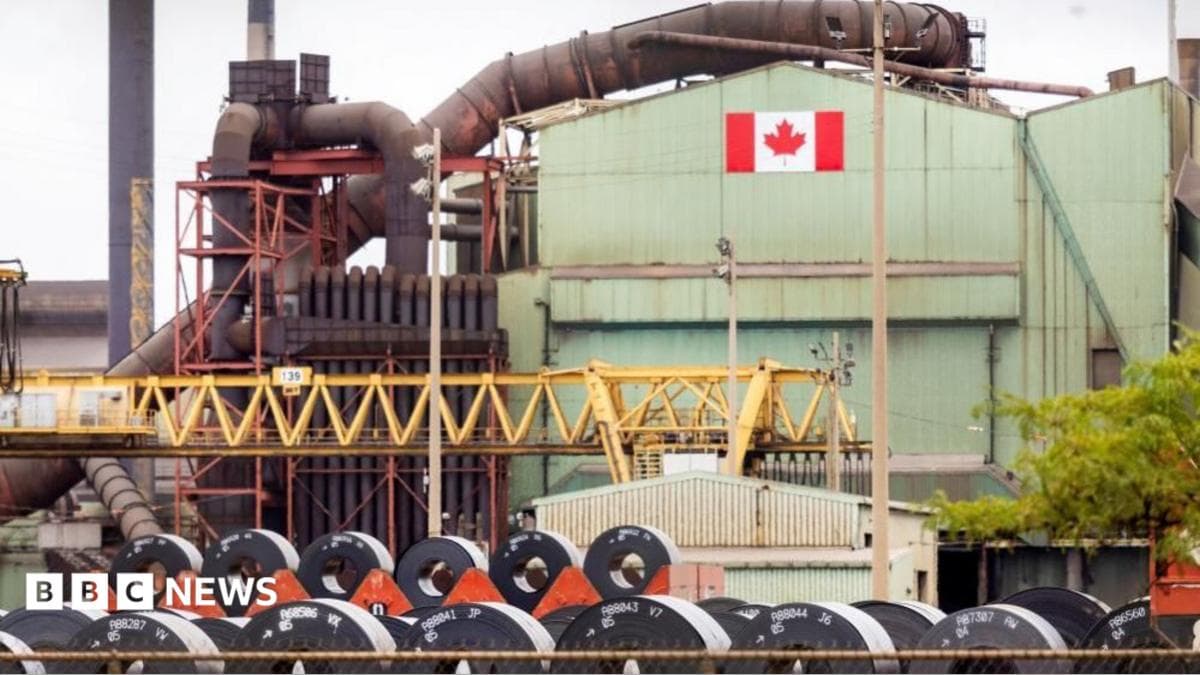
Canada Hits Back at Trump with Up to 50% Tariffs
Left says
- •Prime Minister Mark Carney frames the U.S. demands as an attempt to 'destroy our major industries' and subordinate Canadian sovereignty, justifying a firm response.
- •Trump's rhetoric, including calling Carney 'Governor Carney' and floating renaming Lake Ontario 'Lake America' or making Canada a U.S. state, is seen as disrespectful and provocative toward a longtime ally.
- •The $7.5 billion support package for affected workers and businesses reflects a commitment to protecting Canadian jobs and industries from the fallout of Trump's tariffs.
- •Canada's response is portrayed as measured and proportionate, matching U.S. tariffs 'dollar for dollar, rate for rate' rather than escalating further.
Right says
- •Trump's tariffs are framed as a response to decades of what he describes as Canada 'ripping off' the U.S. through unfair trade practices and high tariffs on American farmers and dairy products.
- •The breakdown in talks is attributed to Canada's unreasonable last-minute demands, with Trump denying claims that U.S. proposals threatened French language protections in Quebec.
- •Trump's tough stance, including threats of tariffs on Canadian autos and steel, reflects his broader strategy of using tariffs as leverage to force trading partners into fairer deals.
- •Canada remains one of the few major U.S. trading partners without a finalized trade deal, suggesting long-standing unresolved friction predates this specific escalation.
Common Take
High Consensus- Trade talks between the U.S. and Canada collapsed on Friday after both sides said the other made unreasonable last-minute demands.
- Canada's retaliatory tariffs of 15%, 25%, and 50% on roughly $20 billion in U.S. goods take effect September 8 and target sectors including steel, aluminum, dairy, appliances, and agricultural equipment.
- The tariffs follow the U.S. imposing 50% duties on about $20 billion in Canadian goods over the weekend.
- Officials on both sides acknowledge the dispute will raise costs for businesses and consumers in both countries.
The Arguments
Left argues
Carney frames the U.S. demands as an attempt to 'destroy our major industries' and subordinate Canadian sovereignty, arguing that a firm, proportionate retaliation was necessary to defend Canadian workers and businesses.
Right counters
Trump's team would argue Canada's own long-standing tariffs on dairy and agriculture were themselves protectionist and unfair to American farmers, so Canada is not a passive victim but a party that has long shielded its industries at U.S. expense.
Right argues
Trump's tariffs are a response to decades of asymmetric trade practices, including high Canadian tariffs on dairy and agriculture, and are meant as leverage to force a fairer deal rather than mere aggression.
Left counters
Critics note that abrupt 50% tariffs and last-minute demands during negotiations undermine the credibility of 'leverage' as a strategy, instead destabilizing a decades-long trading relationship and provoking retaliation that hurts consumers and businesses on both sides.
Left argues
Trump's personal rhetoric—calling Carney 'Governor Carney,' floating renaming Lake Ontario 'Lake America,' and suggesting Canada become a U.S. state—is seen as a genuine affront to Canadian sovereignty and a needlessly provocative approach toward a longtime ally.
Right counters
Supporters would argue this rhetoric, while blunt, reflects Trump's broader negotiating style of applying maximum pressure, and shouldn't distract from the substantive trade grievances driving the tariff dispute.
Right argues
Trump denies that U.S. proposals threatened Quebec's French-language protections, suggesting Carney invoked this issue for domestic political gain rather than because it reflected the actual terms on the table.
Left counters
Carney's suspension of talks citing 'unfair' and 'uneconomic' last-minute changes suggests genuine substantive disagreements existed beyond any single cultural issue, and Canada's move to protect its negotiating position shouldn't be reduced to a domestic political ploy.
Left argues
Canada's $7.5 billion support package for affected workers and businesses, combined with a strictly 'dollar for dollar, rate for rate' retaliation, demonstrates restraint and a commitment to protecting its economy without needlessly escalating the conflict.
Right counters
From the right's perspective, matching tariffs dollar-for-dollar still escalates a trade war that harms consumers in both countries, and government subsidies to cushion the blow simply mask the deeper economic costs of retaliatory protectionism rather than resolving the underlying trade imbalance.
Challenge Questions
These questions target genuine internal contradictions — meant to provoke honest reflection.
Right asks Left
“If Canada portrays its tariffs as strictly 'proportionate' and defensive, how does matching the U.S. rate-for-rate on politically sensitive sectors like dairy and steel avoid becoming its own form of protectionism against American producers?”
Left asks Right
“If tariffs are meant to fix 'decades' of unfair Canadian trade practices, why did the administration escalate to 50% tariffs and threaten even harsher measures in the middle of active negotiations, rather than allowing the deal-making process to resolve those specific grievances?”
Outlier Report
Left Fringe
Progressive internationalists and some Democratic officials (e.g., commentary from figures like Robert Reich) who frame this as Trump destroying alliances entirely and call for reversing all tariffs immediately represent maybe 15-20% of the left, more extreme than the median Democrat who is more moderately critical.
Right Fringe
Tariff-maximalist Trump allies like Peter Navarro and some MAGA commentators who fully endorse escalating tariffs regardless of consumer cost represent roughly 20-25% of the right, more extreme than free-trade-leaning Republicans (e.g., some in the Chamber of Commerce wing) who are uneasy with tariff wars.
Noise Assessment
High noise ratio: much of the loudest discourse (Trump's Truth Social posts, Carney's dramatic 'war' rhetoric, renaming Lake Ontario) is performative political theater that generates outsized media attention but likely has limited direct bearing on how average Americans, who are more focused on prices and jobs, actually feel about the underlying trade dispute.
Sources (11)
The latest escalation in an ongoing trade war between the US and Canada will see new levies on goods from steel to furniture, fresh tuna and makeup.
Following the failure of talks over the weekend, U.S. and Canadian leaders have traded barbs over the deal.
Canada retaliated against President Trump’s tariffs by raising rates on steel and adding new duties on $20 billion worth of U.S. products exported to Canada.
Canada said the higher levies, on items from aluminum foil to dishwashers to fish, would help protect workers, producers and manufacturers harmed by new Trump tariffs.
The measures come after President Trump imposed 50% tariffs on many Canadian goods and threatened more after trade talks broke down on Friday.
Canada struck back at the United States on Tuesday with retaliatory tariffs on about $20 billion worth of American goods, including steel, dairy products, appliances and farm equipment, as the trade war between the once-friendly neighbors escalated sharply.
<p>Move by Canada comes after US president spent morning railing against the country, calling it the ‘most difficult’ nation he deals with</p><ul><li><p><a href="https://www.theguardian.com/world/2026/aug/25/canada-retaliatory-tariffs-on-range-of-us-goods">Canada announces retaliatory tariffs on wide range of US goods</a></p></li><li><p><a href="https://www.theguardian.com/news/2026/feb/17/sign-up-for-the-breaking-news-us-email-to-get-newsletter-alerts-direct-to-your-inbox?utm_medium=ACQUISITIONS_STANDFIRST&utm_campaign=BN22326&utm_content=signup&utm_term=standfirst&utm_source=GUARDIAN_WEB">Sign up for the US Breaking News email</a></p></li></ul><p>On Truth Social, however, <strong>the president <a href="https://truthsocial.com/@realDonaldTrump/117155941181023687">shot down</a> assertions that the US talks with Canada collapsed in part due a proposed trade deal that <a href="https://www.theguardian.com/us-news/2026/aug/24/canada-trade-deal-trump-mark-carney-french-language">would have weakened </a>French language protections</strong>.</p><p><strong>“I would never interfere with Canadians speaking French!”</strong> he wrote. <strong>“In fact, I have never even thought of doing such a stupid thing. This lie was made up by a weak and ineffective Prime Minister in an attempt to gain political support, which he has totally lost, from the people of Quebec.”</strong></p> <a href="https://www.theguardian.com/us-news/live/2026/aug/25/donald-trump-tariffs-canada-midterms-primary-south-carolina-iran-ukraine-voting-rights-latest-news-updates">Continue reading...</a>
<p>Announcement of tariffs on $20bn worth of US goods follows through on Mark Carney's vow to match US tariffs 'dollar for dollar'</p> <a href="https://www.theguardian.com/world/video/2026/aug/25/canada-tariffs-us-goods-mark-carney">Continue reading...</a>
Canada announced retaliatory tariffs on hundreds of American products as high as 50 percent Tuesday, just days after the collapse of negotiations between the two countries. Canadian Finance Minister François-Philippe Champagne said Canada will match the U.S.’s tariffs “dollar for dollar, rate for rate.” The tariffs would take effect Sept. 8. He said the 15…
Defiant Canadian leaders announced tariffs against nearly $28 billion in U.S. products on Tuesday, saying President Trump's levies required a "dollar for dollar" response as they refused to relent to his demands.