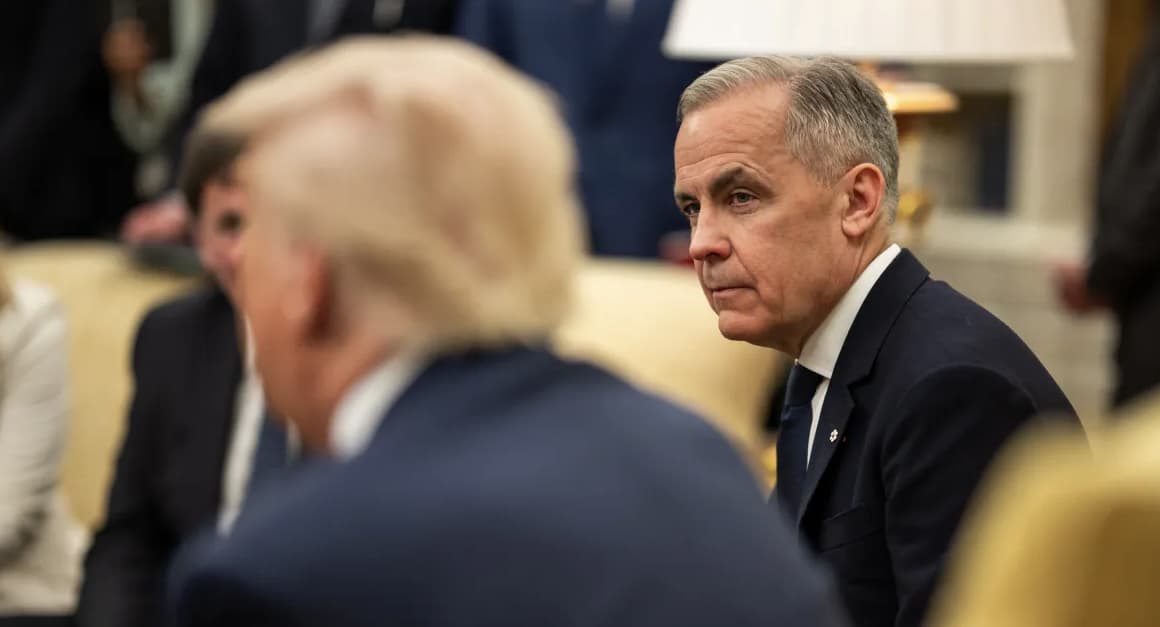
Canada Says 'Kiss My A**' as Trump Trade War Escalates
Intra-Party Split Detected
Canada's progressive NDP (Avi Lewis) argues Carney's Liberal government, while correctly channeling public anger at Trump, still favors international investors and fossil fuel interests rather than genuinely restructuring the economy to reduce U.S. dependence—revealing a left-of-center critique of the Liberal response distinct from unified anti-Trump sentiment.
Left says
- •Trump's decision to reignite tariffs against a close ally is portrayed as reckless and strategically incoherent, escalating economic pain for both countries without a clear objective.
- •Carney's refusal to weaken French language protections or bow to demands is framed as a principled defense of Canadian sovereignty against an untrustworthy U.S. administration.
- •Progressive voices argue the Liberal government's response, while popular, still prioritizes investors and fossil fuel interests over policies that would truly insulate everyday workers from Trump's trade agenda.
- •Trump's inflammatory rhetoric, including renaming Lake Ontario and insulting Doug Ford, is depicted as juvenile and a sign of desperation as he loses leverage in a fight he started.
Right says
- •Longstanding U.S. grievances about Canadian trade practices, including agricultural tariffs and market access barriers for products like Gulfstream jets, are cited as legitimate reasons for pursuing tougher terms.
- •Trump's team frames the tariffs as necessary correction for a trade relationship that has cost the U.S. tens of billions annually and driven American companies out of business.
- •Doug Ford's crude public remarks toward the U.S. president are seen by critics as an unnecessarily hostile and undiplomatic escalation that could further damage negotiations.
- •Even some conservative commentators, including the Wall Street Journal editorial board, warn that the tariff strategy lacks coherent economic or political logic and risks backfiring on Republicans ahead of midterms.
Common Take
High Consensus- Trade talks between the U.S. and Canada collapsed over the weekend, triggering a new round of 50% U.S. tariffs on roughly $20 billion in Canadian goods.
- Canada responded with retaliatory tariffs of equal value on U.S. products set to take effect September 8.
- The escalating trade war is expected to raise consumer prices and cause economic pain in both countries, including job losses in Canadian provinces like Ontario, Quebec and B.C.
- Canadians across the political spectrum show strong national unity and support for a coordinated 'Team Canada' response rather than capitulation to U.S. demands.
The Arguments
Left argues
Trump's decision to reignite tariffs against a top trading partner and ally is strategically incoherent, imposing costs on U.S. consumers and exporters just weeks before midterms without a clear negotiating endpoint.
Right counters
The Trump administration argues that decades of asymmetric trade practices, from dairy quotas to jet certification delays, justify a forceful correction even if it causes short-term pain, and that Canada has never faced real consequences for these barriers before.
Right argues
Longstanding U.S. grievances about Canadian trade practices, including high agricultural tariffs and market access barriers for products like Gulfstream jets, represent legitimate and well-documented complaints that predate Trump and justify seeking better terms.
Left counters
Trade experts note the U.S.-Canada relationship has historically been roughly balanced, and that Trump's specific figures, like the claim of 400% farm tariffs or $60 billion in annual losses, are exaggerated or false, undermining the credibility of the stated rationale.
Left argues
Carney's refusal to weaken French language protections or capitulate to Trump's demands is a principled stand for Canadian sovereignty against a U.S. administration that Carney says has proven unreliable, 'signing in pencil' on past commitments.
Right counters
Critics on the right counter that refusing to negotiate and instead escalating with matching retaliatory tariffs guarantees prolonged economic pain for both sides, and that provincial leaders like Doug Ford inflaming tensions with crude insults undermines any chance of a diplomatic resolution.
Right argues
Even conservative voices like the Wall Street Journal editorial board argue the tariff strategy lacks coherent economic or political logic, risking inflation and backlash against Republicans just before midterms, suggesting this is bad policy on its own terms, not just a partisan complaint.
Left counters
Progressive critics agree the strategy is incoherent but go further, arguing the entire framework of trade war brinkmanship distracts from deeper structural issues, since neither Trump's tariffs nor Carney's retaliatory response meaningfully protects workers on either side of the border.
Left argues
Progressive voices like NDP leader Avi Lewis argue that while Carney's tough posture is popular, the Liberal government's underlying policies still prioritize investors and fossil fuel interests, meaning the fight with Trump isn't being used to build a more resilient, worker-centered Canadian economy.
Right counters
Defenders of Carney's approach would argue that maintaining investor and market confidence during a trade war is itself necessary to fund the $25 billion in tariff relief already earmarked, and that pursuing radical economic restructuring mid-crisis would add instability rather than protection.
Challenge Questions
These questions target genuine internal contradictions — meant to provoke honest reflection.
Right asks Left
“If Canadians overwhelmingly reject any deal that would soften retaliation or accept U.S. terms, how is Carney's approach 'principled sovereignty' rather than simply a politically popular hardline stance that avoids the harder tradeoffs of actually resolving the dispute?”
Left asks Right
“If the Wall Street Journal and other conservative voices concede the tariffs lack coherent economic logic and will hurt Republicans politically, what is the actual evidence that this strategy will achieve the market access and trade concessions the administration claims to want?”
Outlier Report
Left Fringe
Figures like Avi Lewis (NDP) and trade critic Lori Wallach represent a further-left faction (~15-20% of the left) who argue Carney's response is still too favorable to investors and fossil fuel interests, rather than simply opposing Trump's tariffs.
Right Fringe
Trump loyalists and some MAGA commentators (~20-25% of the right) fully back the tariff escalation and rhetoric (e.g., renaming Lake Ontario, insulting Doug Ford) as deserved toughness, diverging from more mainstream conservative economists and outlets like the WSJ editorial board who call the strategy self-defeating.
Noise Assessment
High noise ratio: much of the coverage centers on colorful rhetoric (Ford's 'kiss my ass' comment, Trump's 'Lake America' threat) that generates viral attention but doesn't reflect the more measured, pocketbook-focused concerns most Americans have about inflation and trade stability.
Sources (9)
Beware the angry Canadian. Famous for their mild-mannered, earnest perseverance, Canadians have united in protest against US President Donald Trump's latest trade war escalation.
<p>[wpcode id="85502"]</p> <p>The post <a href="https://angusreid.org/anger-frustration-worry-tariff-storm/">Anger, frustration, worry and disappointment: Canadians describe their feelings about the latest wave of the tariff storm</a> appeared first on <a href="https://angusreid.org">Angus Reid Institute</a>.</p>
<p>[wpcode id="85405"]</p> <p>The post <a href="https://angusreid.org/trump-carney-50-percent-threat/">As most Canadians rebuke Trump tariff threat and call for retaliation, confidence in PM to get a good deal declines</a> appeared first on <a href="https://angusreid.org">Angus Reid Institute</a>.</p>
The U.S.-Canada trade war is deepening after talks collapsed without a deal on Friday. Canadian Prime Minister Mark Carney accused the Trump administration of issuing demands that would compromise Canada’s sovereignty and undermine key industries. On Saturday, the United States slapped 50% tariffs on around $20 billion worth of imports from Canada, and Carney announced retaliatory tariffs on $20 billion of U.S. products set to go into effect on September 8.</p> <p>“Canadians are sick of this,” says Avi Lewis, leader of Canada’s progressive New Democratic Party. He says that while the Liberal government has correctly identified voters’ anger, its policies still favor international investors and the fossil fuel industry rather than truly “Trump-proofing” the economy.</p> <p>We also speak with trade expert Lori Wallach, who says the U.S.-Canada trade war is pitting Trump’s vision of “oligarchic trade grift” against a dead neoliberal consensus represented by Carney. The two countries have balanced trade, and Wallach says the United States is being far more lenient with China despite Beijing’s much more serious threat to the U.S. and wider global economy through its “beggar-thy-neighbor” policies.
Six months into a real war he cannot seem to get out of, Trump has now picked another unwinnable fight, this time with America’s second-largest trading partner.
A lot of people aren’t fond of the president’s idea to change the name of Lake Ontario to “Lake America.”
The president, clearly running out of leverage, is now threatening to rename Lake Ontario to “Lake America.”
“Voters believe Mr. Trump is waging blunderbuss wars without a strategy, and on trade they’re right,” The Wall Street Journal’s editorial board wrote Sunday.
“Your own people, President Trump, don’t even like you,” the Canadian leader said, as the president continues to threaten more tariffs.