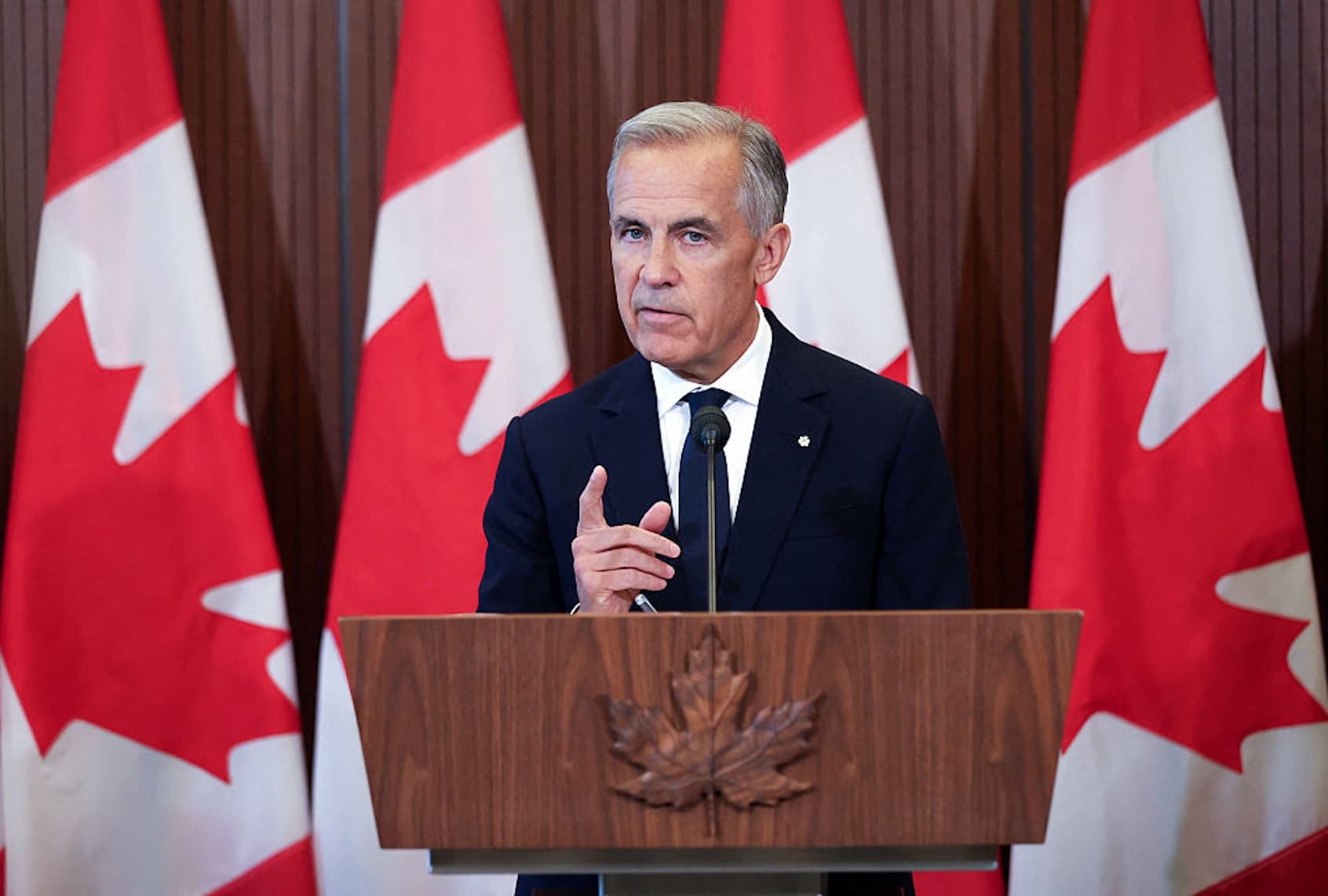
 Canadian PM Mark Carney speaks at podium in front of Canadian flags.
Carney Declares Canada 'At War' After Trump Trade Talks Collapse
Left says
- •Carney's firm stance reflects genuine public anger at being treated as a junior partner rather than a sovereign nation, with last-minute US demands touching on cultural policy, French-language protections, and Canada's ability to pursue trade deals with other countries seen as unacceptable overreach.
- •Canada's refusal to fold contrasts favorably with other US trading partners like the EU that made concessions, suggesting smaller nations can push back against Trump-era coercive tactics if they're willing to accept short-term pain.
- •Carney's measured, central-banker temperament combined with his willingness to hold the line has earned him broad cross-partisan support at home, including from conservative premiers, showing unity in the face of what many Canadians view as bullying.
- •The dispute is framed as part of a broader pattern of the Trump administration using economic leverage against allies, including annexation rhetoric about Canada becoming the '51st state,' which has fused trade policy with questions of national sovereignty.
Right says
- •Carney's declaration that Canada is 'at war' is inflammatory rhetoric from a leftist prime minister exaggerating a trade dispute over tariffs into a conflict, when the US is simply seeking fairer terms in a relationship where Canada sends about 70% of its exports southward.
- •The US position is that it was Canadian negotiators, not American ones, who introduced last-minute sticking points, and the administration denies making the culture and language demands Carney says derailed the deal.
- •Trump's push for Canada to 'fall in line' reflects a broader effort to correct trade imbalances and reassert American economic leverage in its own hemisphere rather than an attempt to dominate or annex Canada.
- •Canada's threatened retaliatory tariffs and talk of leveraging energy exports risk economic self-harm for Canadian industry and workers, given how dependent Canada's economy is on US trade.
Common Take
High Consensus- Trade talks between the US and Canada collapsed just before 50% US tariffs were set to take effect on Canadian goods.
- Carney has proposed dollar-for-dollar retaliatory tariffs on goods including steel, dairy, appliances, and electronics, set to begin after Labor Day.
- The two sides disagree over which country introduced last-minute changes that derailed the negotiations.
- Canada's economy is heavily dependent on the US market, with about 70% of its exported goods going to the United States, making the standoff economically consequential for both nations.
The Arguments
Left argues
Carney's refusal to accept last-minute US demands touching on French-language protections, cultural policy, and Canada's freedom to pursue other trade deals reflects legitimate resistance to sovereignty-infringing overreach, not mere trade posturing.
Right counters
The US denies making these specific cultural and language demands, and Canadian ambassador Mark Wiseman's own account suggests the breakdown stemmed from ambiguous interpretations of negotiated text rather than a clear-cut American attempt to control Canadian culture.
Right argues
Trump's push for Canada to 'fall in line' is a legitimate effort to correct trade imbalances given that Canada sends roughly 70% of its exports to the US, making this fundamentally a negotiation over fairer terms rather than an act of aggression.
Left counters
Framing a lopsided trading relationship as justification for coercive last-minute demands ignores that Trump has also mixed in explicit '51st state' annexation rhetoric, fusing trade leverage with sovereignty threats that go well beyond ordinary negotiation.
Left argues
Carney's calm, central-banker temperament combined with firm resolve has produced rare cross-partisan unity at home, with conservative premiers like Doug Ford and social democrats like Wab Kinew both backing his stance, suggesting a genuinely broad national consensus against being bullied.
Right counters
Political unity in the moment doesn't change the economic reality that Canada is far more dependent on US trade than vice versa, and Carney's tough rhetoric risks real job losses in sectors like steel and autos that will test this unity once the pain sets in.
Right argues
Canadian negotiators, not American ones, reportedly introduced last-minute sticking points according to the US position, meaning Carney's 'at war' framing may be dramatizing a routine negotiating breakdown into an exaggerated conflict for domestic political benefit.
Left counters
Even Canada's own ambassador acknowledges ambiguity about what exactly caused the collapse, but Carney's declining trust in US commitments is grounded in a real pattern of the administration unilaterally imposing tariffs on allies despite prior agreements.
Left argues
Canada's willingness to walk away, unlike the EU's concessions, demonstrates that smaller trading partners can resist Trump-era coercive tactics if they accept short-term economic pain, offering a model for other nations facing similar pressure.
Right counters
This 'model' comes at a steep cost: Canada's proposed retaliatory tariffs and energy surcharge threats risk self-inflicted economic harm to its own workers and industries that are structurally dependent on the US market in ways the US is not dependent on Canada.
Challenge Questions
These questions target genuine internal contradictions — meant to provoke honest reflection.
Right asks Left
“If Canada champions itself as a defender of free trade and open economic partnerships, how does demanding immunity from any US input on its external trade deals square with expecting the US to accept terms favorable to Canada in their own bilateral deal?”
Left asks Right
“If the US goal is simply 'fairer trade terms' rather than domination, why did negotiators reportedly introduce demands—regardless of who raised them first—that touched on cultural policy, language protections, and veto power over Canada's other trade relationships, none of which are standard components of tariff negotiations?”
Outlier Report
Left Fringe
Figures like Salon commentators and some progressive pundits explicitly frame this as part of a Trump 'Monroe Doctrine' imperialist annexation project akin to authoritarian expansionism; roughly 10-15% of the left holds this maximalist framing versus the more moderate 'ally being bullied' narrative most Democrats espouse.
Right Fringe
Some Breitbart-aligned commentators and MAGA-world figures dismiss Carney's 'at war' comments as hysterical and frame Canada as an ungrateful free-rider that should simply capitulate to US terms; this hardline dismissiveness represents maybe 20-25% of the right, with most conservatives taking a more measured 'fair trade' stance rather than open contempt for Canada.
Noise Assessment
High noise ratio — this is largely an elite/media-driven narrative in the US, as most Americans pay limited attention to Canada trade specifics; social media amplification (X posts on 'Trump annexing Canada' or '51st state' jokes) vastly overstates how much ordinary Americans are emotionally invested compared to Canadians themselves.
Sources (7)
Canadian Prime Minister Mark Carney has revealed the paradox of his nation's asymmetrical position: if the United States asks for too much, saying no becomes its own victory. The collapse of US-Canadian trade talks was meant to demonstrate Washington's leverage and ability to dominate smaller neighbors. Instead, it has given Ottawa something rarer than tariff relief: political clarity.
<p>Canadian Prime Minister Mark Carney has turned his decision to hold firm against President Trump's <a href="https://www.axios.com/economy/tariffs" target="_blank">tariff</a> threats into a rallying point for Canadians as their trade clash escalates.</p><p><strong>Why it matters: </strong>The mild-mannered former Bank of Canada and Bank of England governor is <a href="https://www.axios.com/2026/08/24/canada-trade-inflation" target="_blank">holding firm</a> against Trump despite the threat of further economic pain for Canadians.</p><hr /><p><strong>Context:</strong> Carney campaigned on <a href="https://www.axios.com/2025/03/09/canada-liberal-party-leader-election-mark-carney-trudeau" target="_blank">standing up to Trump</a> but has generally dealt with the unpredictable U.S. president with the measured temperament of his central banking days.</p><ul><li>That combination of <a href="https://www.axios.com/2026/08/22/us-canada-tariffs-trade-trump-carney" target="_blank">restraint and resolve</a> has made Carney Canada's "man for the moment," Andrea Lawlor, an associate professor of political science at McMaster University in Ontario, tells Axios.</li></ul><p><strong>Driving the news: </strong>Carney walked away from trade talks with the <a href="https://www.axios.com/politics-policy/donald-trump" target="_blank">Trump </a>administration Friday and vowed to match new 50% U.S. tariffs "dollar for dollar," winning broad support at home.</p><ul><li>Corpay chief market strategist Karl Schamotta said Monday that Carney appears to be betting that November's <a href="https://www.axios.com/politics-policy/2026-midterm-elections" target="_blank">midterms</a> will blunt Trump's tariff drive, "opening the way to a mutually beneficial deal."</li></ul><p><strong>State of play:</strong> Lawlor notes Carney has enjoyed a "very extended political honeymoon" since his long-governing Liberal Party was <a href="https://www.axios.com/2025/04/29/canada-election-results-carney-poilievre-trump" target="_new">re-elected last year</a>.</p><ul><li>Carney was already popular before his latest clash with Trump. His approval rating <a href="https://press.liaisonstrategies.ca/federal-tracker-liberals-lead-by-11-as-carney-approval-reaches-60" target="_blank">rose</a> 3 points to 60% last week, while a <a href="https://leger360.com/in-the-news-canada-us-trade-negotiations-august-2026" target="_blank">poll </a>conducted during the same period showed most Canadians wanted a tougher approach to U.S. trade talks, days before the talks collapsed.</li><li>He has also won broad support from provincial premiers across party lines, including Ontario conservative <a href="https://www.axios.com/2025/10/27/ford-trump-canada-ontario-reagan-tariffs" target="_blank">Doug Ford</a>, who has aggressively pushed back against Trump's tariff threats, and Manitoba social democrat Wab Kinew, who <a href="https://www.youtube.com/watch?v=FWuaPPMUFys" target="_blank">said</a> he's "100%" behind Carney.</li></ul><p><strong>Threat level:</strong> Carney is under pressure to deliver on his <a href="https://www.pm.gc.ca/en/news/speeches/2026/08/22/prime-minister-carney-delivers-remarks-canada-us-trade-negotiations" target="_blank">promise</a> that Canadians "are already giving ourselves more than they can take away."</p><ul><li>He'll have to show how Canada can "give more to ourselves," Lawlor says, including through major projects that create jobs for people facing less stable employment prospects.</li><li>The risk for Carney is that economic pain could test that support. Canada's unemployment <a href="https://www.statcan.gc.ca/o1/en/plus/9280-weekly-review-august-3-7-2026" target="_blank">rate</a> is already 6.4%, and Lawlor says it could rise if the trade fight drives more steel and auto manufacturing out of industrial hubs such as southwestern Ontario.</li></ul><img src="https://images.axios.com/WPlbo-BLr3Z57ISi0AOh1wmLz7M=/2026/08/24/1787607111272.jpeg" /> <div>Screenshot: Ontario Premier Doug Ford/X</div><p><strong>Between the lines: </strong>It's not all about Carney. Trump's <a href="https://truthsocial.com/%40realDonaldTrump/posts/117151799569745572" target="_blank">continued</a> threats over tariffs and to make Canada the "<a href="https://www.axios.com/2026/06/03/trump-rubio-greenland-canada-takeover-talk" target="_blank">51st state</a>" have generated a powerful anti-Trump response among Canadians.</p><ul><li>The trade standoff has become a matter of sovereignty, not merely tariffs.</li><li>Carney's central banking background, however, gives him "a skill set of handling extraordinarily difficult situations" requiring responses that are "economically sound and fiscally prudent," Lawlor says.</li><li>His combination of knowledge and temperament makes him "a really well-suited figure for this moment," she adds.</li></ul><p><strong>Zoom out:</strong> Canada's refusal to accept Trump's terms contrasts with other major U.S. trading partners that have made concessions to avert steeper tariffs, like <a href="https://www.washingtonpost.com/world/2025/07/28/trump-eu-trade-tariffs-concessions" target="_blank">the EU</a>.</p><ul><li>Consulting firm Kearney's Drew DeLong says Canada is testing whether "greater strategic autonomy is worth increased trade friction."</li><li>That test is becoming starker. Trump on Monday <a href="https://apnews.com/article/canada-trade-trump-ontario-53c4f83c8365c14b372b314396ae8179" target="_blank">told</a> Canada to "fall in line," while Carney said Canada would not accept being treated as a "subsidiary of the United States."</li></ul><p><strong>What we're watching:</strong> Lawlor say Canadians have little choice but to continue backing Carney's stance, even if the dispute drags on, because Trump's proposed terms are "patently unfair and not sustainable" for Canadian industry.</p><ul><li>Canada is beginning a long-term effort to shift some of its trade away from the U.S., bringing "short, medium, and long-term pain," she says.</li></ul><p><strong>Go deeper: </strong><a href="https://www.axios.com/2026/08/24/canada-trade-inflation" target="_blank">Escalated U.S.-Canada trade talks threaten fallout</a></p>
What leverage does Canada, which sells about 70% of its goods to the US, actually have in this spiralling trade dispute?
<p>Canadian Prime Minister Mark Carney told reporters on Saturday that his country was “at war” with the United States after trade talks collapsed.</p> <p>The post <a href="https://www.breitbart.com/economy/2026/08/24/mark-carney-says-canada-war-after-failed-u-s-trade-talks/" rel="nofollow">Mark Carney Says Canada ‘at War’ After Failed U.S. Trade Talks</a> appeared first on <a href="https://www.breitbart.com" rel="nofollow">Breitbart</a>.</p>
Tired of the president's coercive tactics, the Canadian prime minister puts his country's economy on the line
<p>A fundamental rupture in the values that have united North America is not a problem that can be wished away: this is a warning to the western alliance</p><p>The Canadians are exceedingly angry. I realise this can sometimes be difficult for foreigners to deduce, given our national struggle to express the full range of human emotion outside ice hockey riots. However, let me assure you that the prime minister Canadians saw take the stage on Saturday morning in the wake of the collapse in trade negotiations with the US was a Mark Carney practically vibrating with fury.</p><p>“You’re at war when you get attacked. We got attacked,” <a href="https://nationalpost.com/news/canada/carney-press-conference-trade-talks-collapse">he said</a>, in a <a href="https://www.cp24.com/video/2026/08/22/weve-got-the-reserves-weve-got-the-resilience-weve-got-the-plan-weve-got-the-focus-carney/">rare press conference</a> that was as candid and clear as he ever tends to be. “That’s fine … We’ve got the reserves, we’ve got the resilience, we’ve got the plan, we’ve got the focus. We’re gonna respond, we’re going to focus on what we can control and what we’re going to build.”</p><p>Jen Gerson is a Canadian commentator and co-founder of <a href="https://www.readtheline.ca/">The Line</a>. She lives in Calgary, Alberta</p> <a href="https://www.theguardian.com/commentisfree/2026/aug/25/canadians-trade-war-bullied-donald-trump-alliance-rupture">Continue reading...</a>
And what it could mean for the American economy.