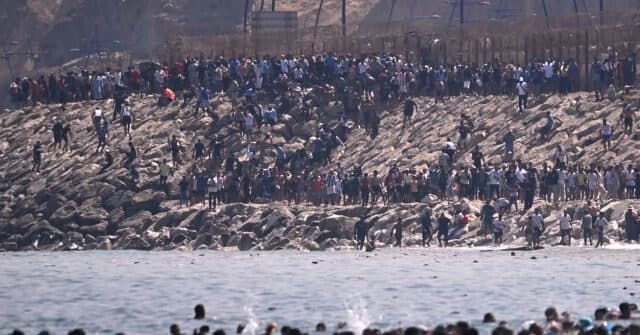
 Massive crowd of migrants gathers on rocky shoreline near Ceuta border crossing.
Ceuta Migrant Crisis: 'Invasion' or Humanitarian Tragedy?
Intra-Party Split Detected
Ceuta's conservative mayor-president criticized Spain's Socialist national government for a slow, insufficient response, while other conservative/right-leaning coverage (Breitbart) frames the event primarily as an 'invasion' requiring stronger border enforcement, reflecting differing emphases within right-leaning perspectives on assigning blame versus security response.
Left says
- •Decades of hardening border enforcement around Ceuta since the 1990s have pushed desperate people toward increasingly dangerous crossing attempts, including swimming, rather than reducing migration itself.
- •Economic inequality in Morocco and shifting Spanish entry policies created powerful incentives for people, many of them young and impoverished, to risk their lives for a chance at opportunity in Europe.
- •The scale of the death toll, with estimates ranging from dozens to over 140, represents a humanitarian catastrophe that deserves mourning and systemic reform rather than framing centered on border security threats.
- •Some sub-Saharan African migrants fleeing conflicts like the Sudan war were also part of this crossing, underscoring that broader forced-displacement crises, not just economic migration, are at play.
Right says
- •Spanish Civil Guard intelligence assessments point to organized, coordinated calls circulating on social media for mass border crossings, suggesting premeditated action rather than spontaneous desperation.
- •Tens of thousands of people, estimated at 72,000 to 78,000, overwhelmed a small city of roughly 87,000 residents in a matter of hours, straining public services and creating a genuine public order emergency.
- •Moroccan authorities have prosecuted dozens of individuals, including on charges of rebellion and organizing illegal crossings, indicating that organized facilitation played a role in the surge.
- •Local leaders in Ceuta have criticized the national Spanish government's response as slow and inadequate, arguing that warnings about the risk of mass crossings were ignored beforehand.
Common Take
High Consensus- A large-scale, rapid crossing of migrants from Morocco into the Spanish enclave of Ceuta occurred, involving tens of thousands of people in a short span of time.
- People died during the crisis, though exact death toll figures vary widely across sources, from around 11 to over 140.
- Nearly all of the migrants who crossed were returned to Morocco within days, according to Spain's Interior Ministry.
- The event created significant strain on Ceuta's resources and prompted a response from both Spanish and EU authorities, including deployment of armed forces and financial aid for migrant minors.
The Arguments
Left argues
Decades of hardening border enforcement since the 1990s have not reduced migration but instead pushed desperate people toward increasingly dangerous crossing methods, including swimming, turning routine migration pressure into a death trap.
Right counters
Border hardening exists precisely because past leniency and porous enforcement invited larger and more chaotic crossing attempts; loosening security further would likely increase, not decrease, the death toll by encouraging even more people to attempt dangerous crossings.
Right argues
Civil Guard intelligence found coordinated social media campaigns with specific dates, logistical details, and reach into hundreds of thousands of people, indicating the mass crossing was organized and premeditated rather than a spontaneous humanitarian emergency.
Left counters
The existence of organizing networks does not negate the underlying desperation driving people to respond to those calls; social coordination and genuine economic desperation are not mutually exclusive, and focusing only on 'invasion' framing obscures the human suffering that made people receptive to such calls in the first place.
Right argues
A city of roughly 87,000 residents was overwhelmed by 72,000-78,000 people in a matter of hours, straining public services to the breaking point and creating a legitimate public order crisis that local officials say was met with an inadequate and slow national government response.
Left counters
Framing the event primarily around strain on Ceuta's services risks minimizing that this was foremost a mass-casualty tragedy, with death toll estimates reaching over 140, that calls for systemic reform of border policy rather than a security-first response.
Left argues
The presence of sub-Saharan African migrants fleeing conflicts like the Sudan war shows this crisis involves genuine forced displacement, not simply economic opportunism, meaning border security framing misses the humanitarian dimension of who was actually crossing.
Right counters
Moroccan prosecutions of individuals on rebellion and organizing charges suggest that facilitation networks, not solely individual refugee flight, played a substantial role in mobilizing the crossing, complicating a narrative centered purely on forced displacement.
Right argues
Ceuta's mayor-president, a local official directly responsible for the territory, publicly criticized the national government for ignoring prior warnings about mass crossing risks, indicating a real governance failure independent of ideological framing.
Left counters
Even if warnings were mishandled, the deeper failure is a decades-long European border policy that criminalizes and militarizes migration routes instead of creating safe, legal pathways, making any single government's response secondary to systemic reform.
Challenge Questions
These questions target genuine internal contradictions — meant to provoke honest reflection.
Right asks Left
“If border hardening is blamed for pushing migrants toward deadlier routes, what specific border policy changes would the left propose that could reduce both mass unauthorized crossings and death tolls simultaneously, without simply shifting the danger elsewhere?”
Left asks Right
“If the crossing was organized and premeditated as intelligence assessments suggest, how does that explain the participation of tens of thousands of ordinary people, including minors, and does labeling it an 'invasion' risk overlooking why so many were receptive to such calls in the first place?”
Outlier Report
Left Fringe
Commentators like those at Jacobin and some academics (e.g., Miriyam Aouragh in Democracy Now) who frame border enforcement itself as the primary cause of death and reject any 'invasion' framing entirely, representing roughly 15-20% of the left that takes this most absolutist anti-border-enforcement position.
Right Fringe
Figures like those at Breitbart and European nationalist commentators (echoing rhetoric similar to Eric Zemmour or Vox Spain's Santiago Abascal) who frame the crossings explicitly as a coordinated 'invasion' with conspiratorial undertones about organized destabilization, representing about 15-20% of the right holding this most extreme framing.
Noise Assessment
High noise ratio: this is a niche European story for American audiences, so most US public reaction is superficial, driven by algorithmic amplification of dramatic images/videos rather than deep engagement with the underlying policy debate.
Sources (6)
At least 141 people died after Moroccan authorities opened the border gates into the Spanish enclave of Ceuta, triggering what appears to be Morocco's deadliest migration disaster in recent history. Migrant rights organisation Caminando Fronteras said hospitals in northern Morocco had received 63 bodies recovered from Moroccan waters by Tuesday. The Moroccan government has not officially confirmed this.
The Spanish territory's mayor-president also says 100 deaths occurred as a result of 78,000 migrants crossing from neighbouring Morocco.
<p>Spain’s Civil Guard is investigating a possible new invasion of Ceuta by illegal migrants that could materialize the coming days, a report states. The Spanish newspaper ABC reports it obtained a copy of a preliminary Civil Guard assessment warning on</p> <p>The post <a href="https://www.breitbart.com/europe/2026/08/06/report-spanish-civil-guard-warns-of-potential-new-aug-15-invasion-of-ceuta/" rel="nofollow">Spanish Civil Guard Warns of Possible New Illegal Migrant Invasion of Ceuta</a> appeared first on <a href="https://www.breitbart.com" rel="nofollow">Breitbart</a>.</p>
<p>Moroccan prosecutors have charged at least 86 individuals over their involvement in last week's migrant invasion of the Spanish city of Ceuta, multiple outlets reported.</p> <p>The post <a href="https://www.breitbart.com/europe/2026/08/06/reports-dozens-charged-in-morocco-over-ceuta-invasion/" rel="nofollow">Reports: Dozens Arrested, Charged in Morocco over Ceuta Invasion</a> appeared first on <a href="https://www.breitbart.com" rel="nofollow">Breitbart</a>.</p>
An estimated 60,000 people from Morocco crossed into the Spanish enclave of Ceuta, on the African side of the Strait of Gibraltar, in an unprecedented mass movement last week. At least 72 people died during the attempt. The sudden influx of migrants overwhelmed the city’s residents, leading to a humanitarian crisis while border police deployed water cannons, tear gas and warning shots to deter people from crossing. According to Spain’s Interior Ministry, nearly all of the migrants returned to Morocco just a day later.</p> <p>Miriyam Aouragh, an anthropologist and the daughter of Moroccan immigrants to Europe, says the driving factors for the mass movement are a combination of shifting entry policies to Spain and increasing economic inequality in Morocco that “has given a sort of empowering incentive to people to try to go to Spain” via Ceuta. The city, which is surrounded by Morocco along a five-mile-long border, dates back to the Phoenician era and has been under Portuguese or Spanish control since 1415. The Moroccan government claims that Ceuta is occupied and colonized territory, while Spain considers it an integral part of the Spanish state.
When 50,000 people briefly crossed into Ceuta in North Africa, many pundits damned the lax Spanish line on migration. In truth, the hardening of the border around Ceuta since the 1990s has made such desperate attempts to storm the barrier more common.