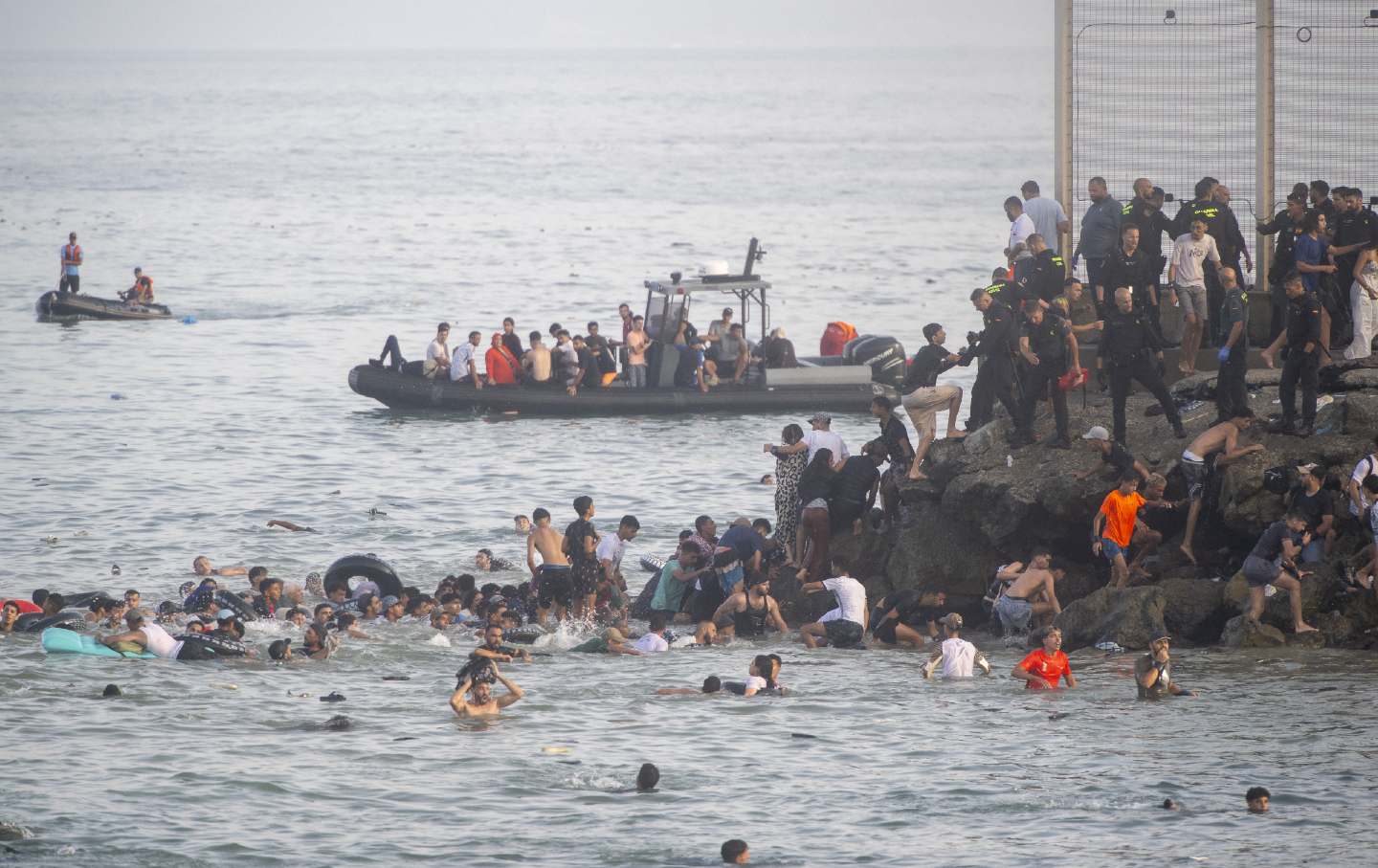
 Migrants swim past a boat as police gather at the Ceuta border fence.
Ceuta Migrant Surge: 'Invasion' Crisis or Manufactured Provocation?
Intra-Party Split Detected
The Intercept and The Nation criticize liberal outlets (like NYT) and centrist/left governments for adopting border-security framing similar to the right, while other left-leaning sources (Democracy Now, NYT) focus more on humanitarian and geopolitical explanations without that critique.
Left says
- •Economic disparity between Morocco and Spain, along with shifting entry policies, created powerful incentives for people to attempt the crossing, and this should be understood as a structural migration issue rather than an 'invasion.'
- •Evidence suggests Moroccan authorities may have organized or facilitated the surge, including footage of trucks ferrying young men to the border and guards waving them through, indicating a geopolitical provocation possibly tied to tensions over Western Sahara, Algeria, and US/Israeli relations with Spain rather than a spontaneous refugee crisis.
- •Disinformation spread online amplified and distorted the crisis, and framing the event purely around 'invasion' rhetoric plays into far-right narratives that dehumanize migrants and obscure the real geopolitical dynamics at play.
- •Liberal and centrist responses that emphasize border security and treat migrants primarily as a threat concede too much ground to far-right framing instead of centering the humanitarian needs of vulnerable people, including unaccompanied children left without adequate shelter.
Right says
- •Around 70,000 people crossed in a single day in a coordinated storming of the border, an unprecedented scale that residents and officials describe as overwhelming and unsustainable for a small city of 83,000.
- •Local hospital staff reported multiple cases of underage migrant girls being raped after being left living on the streets due to a lack of shelter space, a consequence directly tied to the surge and the inability to house so many people, especially unaccompanied minors.
- •Thousands of Ceuta residents publicly protested, demanding the government address the crisis and criticizing what they see as abandonment by Madrid, with chants directly calling for the prime minister's resignation.
- •The composition of the surge, made up largely of young, able-bodied men rather than families or the elderly, undercuts the notion that this was purely a humanitarian refugee movement and raises legitimate questions about intent and organization.
Common Take
High Consensus- Tens of thousands of people crossed from Morocco into Ceuta within a short period, with estimates ranging from roughly 50,000 to 72,000.
- Dozens to nearly 100 people died during the crossing, most from drowning.
- The vast majority of migrants were returned to Morocco within days, though more than 1,300 migrant children remained in Ceuta afterward.
- Ceuta's limited infrastructure was overwhelmed, creating a genuine humanitarian and logistical crisis for both migrants and residents.
The Arguments
Right argues
The sheer scale and speed of roughly 70,000 people crossing in a single day overwhelmed a city of 83,000, creating a genuine humanitarian and security emergency that the term 'crisis' understates rather than exaggerates.
Left counters
Describing this as an 'invasion' ignores that most crossers were unarmed civilians responding to economic desperation and shifting policy incentives, and the framing itself imports dehumanizing military language into a migration policy problem.
Left argues
Video evidence of Moroccan trucks ferrying young men to the border and guards waving them through suggests state-level orchestration tied to geopolitical disputes over Western Sahara and Algeria, meaning this was a manufactured provocation rather than a spontaneous refugee flow.
Right counters
Whether or not Morocco facilitated the surge, that doesn't change the on-the-ground reality Spain had to manage: tens of thousands of people at its border in 24 hours, which required an emergency response regardless of who orchestrated it.
Right argues
Local hospital staff documented multiple cases of underage girls being raped after being left unsheltered on Ceuta's streets, a direct and tragic consequence of the surge overwhelming the city's capacity to protect vulnerable minors.
Left counters
These horrific outcomes are themselves evidence of a failure of humanitarian planning and shelter capacity, not proof that the migrants are threats — using assault victims' suffering to justify 'invasion' rhetoric risks weaponizing tragedy against the very people it victimized.
Left argues
Centrist and liberal responses that frame the crossings mainly through border-security language concede the far right's premise that migrants are primarily a threat, rather than centering the humanitarian crisis facing unaccompanied children and desperate people.
Right counters
Acknowledging security concerns isn't the same as dehumanizing migrants; a government's basic duty to control its borders and protect residents like those who protested in Ceuta's central square is a legitimate governing function, not far-right capitulation.
Right argues
The demographic composition of the surge—overwhelmingly young, able-bodied men rather than families, children, or the elderly—raises legitimate questions about organized intent that undercut a purely humanitarian refugee narrative.
Left counters
Young men are also the demographic most physically able to survive a dangerous crossing involving fences, rocks, and open water, so their overrepresentation is consistent with either an organized push or ordinary migration risk-selection, not proof of either on its own.
Challenge Questions
These questions target genuine internal contradictions — meant to provoke honest reflection.
Right asks Left
“If the Moroccan government did orchestrate this surge as a geopolitical provocation, as some on the left argue, doesn't that undermine the parallel claim that framing it as an organized 'invasion'-style event is merely far-right dehumanization?”
Left asks Right
“If the composition of mostly young, able-bodied men is cited as evidence undermining a humanitarian narrative, how does that square with also citing the suffering of unaccompanied minors and young girls as central evidence of the crisis's severity?”
Outlier Report
Left Fringe
The Intercept and writers like those featured there represent a fringe (~10-15% of the left) explicitly arguing centrist/liberal border-security concerns themselves concede too much to the far right; this framing is more radical than mainstream Democratic officials like Pedro Sanchez's own government, which still deployed water cannons and border enforcement.
Right Fringe
Figures like Donald Trump and Breitbart commentators who use terms like 'invasion' and 'illegals' represent a more inflammatory framing than mainstream Republican officials; roughly 20-25% of the right pushes this maximalist rhetorical framing versus more measured concerns about border control shared by the broader right.
Noise Assessment
High noise ratio: much of the 'organized provocation by Morocco' theory and the 'liberals ceding ground' critique are elite/activist-driven narratives with limited traction among ordinary Americans, who likely process this story through a simpler lens of 'large migrant surge overwhelmed a small city' without engaging deeply with Western Sahara geopolitics or media-disinformation angles.
Sources (7)
<p>The mass invasion of illegals from Morocco into the Spanish exclave of Ceuta allegedly coincided with at least five young girls being raped.</p> <p>The post <a href="https://www.breitbart.com/europe/2026/08/11/at-least-five-underage-girls-allegedly-raped-in-ceuta-following-migrant-invasion/" rel="nofollow">At Least Five Underage Girls Allegedly Raped in Spanish Ceuta Following Migrant Invasion</a> appeared first on <a href="https://www.breitbart.com" rel="nofollow">Breitbart</a>.</p>
After more than 70,000 African migrants crossed into the Spanish territory of Ceuta in a border surge late last month, Spaniards are decrying their government’s handling of the chaos. Thousands of residents of the Spanish exclave gathered on Sunday in the Plaza de la Constitución, chanting “Enough is enough” and “Ceuta will not surrender,” according to Reuters. ...
An estimated 60,000 people from Morocco crossed into the Spanish enclave of Ceuta, on the African side of the Strait of Gibraltar, in an unprecedented mass movement last week. At least 72 people died during the attempt. The sudden influx of migrants overwhelmed the city’s residents, leading to a humanitarian crisis while border police deployed water cannons, tear gas and warning shots to deter people from crossing. According to Spain’s Interior Ministry, nearly all of the migrants returned to Morocco just a day later.</p> <p>Miriyam Aouragh, an anthropologist and the daughter of Moroccan immigrants to Europe, says the driving factors for the mass movement are a combination of shifting entry policies to Spain and increasing economic inequality in Morocco that “has given a sort of empowering incentive to people to try to go to Spain” via Ceuta. The city, which is surrounded by Morocco along a five-mile-long border, dates back to the Phoenician era and has been under Portuguese or Spanish control since 1415. The Moroccan government claims that Ceuta is occupied and colonized territory, while Spain considers it an integral part of the Spanish state.
A wave of disinformation online contributed to a surge of migrants in the Spanish enclave of Ceuta who were trying to reach Europe, resulting in about 90 deaths.
Rumors swirled that Morocco, perhaps spurred by Israel and the United States, organized a recent border disaster. That unproven speculation, experts said, was exacerbated by the region’s complicated history.
<p>From the New York Times to the EU, liberals defending Spain from far-right fearmongering are regurgitating the right’s anti-immigrant premise.</p> <p>The post <a href="https://theintercept.com/2026/08/03/ceuta-spain-morocco-refugee-border/">Liberals Are Ceding Ground to the Far Right on Ceuta Border Crossings</a> appeared first on <a href="https://theintercept.com">The Intercept</a>.</p>
<p>Stephen Zunes</p> <div><img alt="" src="https://www.thenation.com/wp-content/uploads/2026/08/ceuta.jpg" /></div> <div> <div class="wp-block-the-nation-dek article-title__dek"> <p>Did the Israeli and US hostility toward Spain embolden Morocco to think it could get away with creating a border control crisis?</p> </div> </div> <p>The post <a href="https://www.thenation.com/article/world/ceuta-spain-morocco-border-crisis-western-sahara-geopolitics/">The Real Story Behind the Human Wave That Entered Ceuta</a> appeared first on <a href="https://www.thenation.com">The Nation</a>.</p>