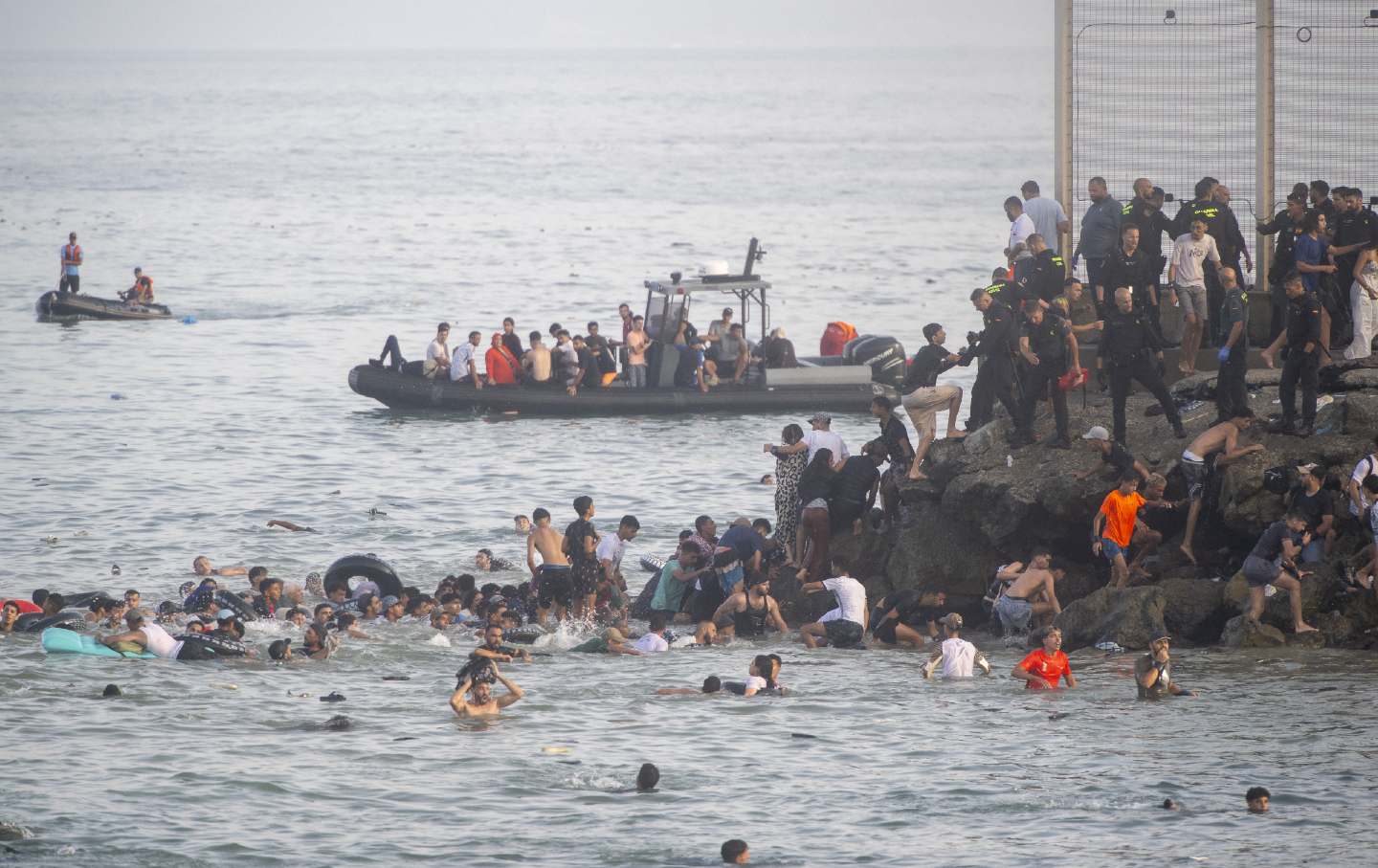
 Migrants swim toward rocks as Spanish police intervene near Ceuta border fence.
Ceuta Migrant Surge: Moroccan Provocation or Spain's Policy Failure?
Intra-Party Split Detected
Most left-leaning sources frame the crisis as Moroccan geopolitical provocation and right-wing exploitation defending Sánchez, but The Nation and Guardian focus more on Morocco's manipulation while Democracy Now emphasizes humanitarian/economic root causes and colonial history, reflecting differing emphases rather than direct conflict.
Left says
- •Morocco appears to have deliberately orchestrated the mass crossing, using border guards to wave migrants through and possibly deploying intelligence agents, as retaliation for Spain's outreach to Algeria and its treatment of the Polisario leader.
- •Decades of militarized border security at Ceuta — drones, sensors, and cooperation with Moroccan forces — have paradoxically given Rabat leverage to destabilize Spain whenever it wants to send a political message.
- •The European far right, along with the Trump administration and Israeli officials, seized on the crisis opportunistically to attack Spain's left-leaning government and push a broader anti-immigration agenda unrelated to the actual causes.
- •Economic desperation in Morocco, combined with shifting entry policies, gave ordinary people real incentive to attempt the crossing, and the humanitarian toll — including drowned children and separated families — deserves as much attention as the geopolitics.
Right says
- •Spain's own high court ruling and lax border enforcement functioned as a de facto invitation that predictably drew tens of thousands of mostly military-age men across the border.
- •Firsthand video evidence shows migrants behaving disrespectfully, including defacing Spanish graves and threatening journalists with violence, undermining claims that this was purely a humanitarian influx.
- •Multiple EU leaders, including Italy's prime minister, viewed the images from Ceuta as proof that uncontrolled immigration is a genuine security threat requiring stronger, coordinated European border enforcement rather than accommodation.
- •Spain's socialist government's broader migration and foreign policy choices, including its overtures to Algeria and friction with allies over Gaza and Israel, invited this crisis and now the government is being let off the hook too easily.
Common Take
High Consensus- Roughly 70,000 to 72,000 people crossed into Ceuta from Morocco over a two-day period, and nearly all were returned to Morocco within days.
- At least 75 to 86 people died during the crossing, mostly by drowning or being crushed at the breakwater, with additional deaths reported on the Moroccan side.
- Hundreds of unaccompanied migrant children were left stranded in Ceuta, creating a genuine humanitarian emergency for the enclave's 86,000 residents.
- Morocco's role and possible motives in facilitating or allowing the mass crossing are central to understanding why it happened, regardless of how each side assigns blame.
The Arguments
Left argues
Evidence of Moroccan border guards waving migrants through, organized truckloads of young men, and possible intelligence agents in the crowd suggests this was a state-orchestrated provocation timed to punish Spain for warming ties with Algeria and hosting the Polisario leader, echoing a nearly identical 2021 incident.
Right counters
Even if Morocco facilitated the crossing, that only underscores that Spain's border policy and legal environment were porous enough to be exploited on demand — a well-secured, well-governed border shouldn't be able to be 'switched on' by a neighboring government at will.
Right argues
Spain's high court ruling and visibly lax enforcement created a predictable pull factor, and firsthand video evidence of migrants defacing war graves and threatening journalists with knives shows real security and social order concerns that can't be waved away as pure humanitarian necessity.
Left counters
Isolated incidents of bad behavior by a handful of individuals among tens of thousands do not characterize an entire population fleeing economic desperation, and fixating on viral videos of misconduct distracts from the 75-plus people, including children, who died in the crossing.
Left argues
The European far right, the Trump administration, and Israeli officials seized on the crisis opportunistically to attack a left-leaning Spanish government, using the images for a preexisting anti-immigration and anti-Sánchez agenda rather than engaging with the actual geopolitical causes.
Right counters
Regardless of political motive, 22 EU leaders and figures like Meloni responded to what they actually saw on camera — an overwhelmed border and a security failure — and using the crisis to argue for coordinated EU enforcement is a legitimate policy response, not mere opportunism.
Right argues
Spain's broader foreign policy choices — courting Algeria, friction with allies over Gaza and Israel, and its migration stance — arguably invited this crisis, yet Sánchez's government is being let off the hook by EU solidarity statements rather than held accountable for provoking it.
Left counters
Blaming Spain's diplomacy for Morocco's alleged manufactured crisis inverts responsibility: if a neighboring state can weaponize migrants as retaliation for a country's independent foreign policy choices, the accountability lies with the government doing the weaponizing, not the victim of it.
Left argues
Decades of militarizing the Ceuta border with drones, sensors, and reliance on Moroccan cooperation have paradoxically handed Rabat leverage to destabilize Spain whenever it wants to send a political message, making the 'security' apparatus itself a vulnerability.
Right counters
That paradox is an argument for even stronger, more independent EU-controlled border enforcement rather than dependence on Moroccan goodwill, not an argument for relaxing enforcement or downplaying the security implications of mass uncontrolled crossings.
Challenge Questions
These questions target genuine internal contradictions — meant to provoke honest reflection.
Right asks Left
“If Morocco truly orchestrated this crossing as retaliation against Sánchez's diplomacy, why does the left simultaneously argue that economic desperation and Spain's own shifting entry policies were major independent drivers — can both be the primary cause, or does emphasizing Moroccan state coordination undercut the humanitarian-influx framing?”
Left asks Right
“If the crossing was substantially a Moroccan state operation involving orchestrated transport and border guards waving people through, how does that square with blaming Spain's domestic court ruling and 'lax enforcement' as the primary cause, rather than acknowledging that no domestic policy change can fully secure a border against a neighboring government actively facilitating mass crossings?”
Outlier Report
Left Fringe
Writers like Ruben Andersson (Guardian) and Stephen Zunes (The Nation) who frame this primarily as Moroccan state-orchestrated provocation and downplay Spain's enforcement gaps entirely; this framing likely represents about 15-20% of the left, with most Democratic-leaning Americans still acknowledging some border control failure.
Right Fringe
Commentators like Nick Shirley and accounts amplifying his footage (e.g., Eric Daugherty) who frame migrants as 'savages' and 'third-world invaders,' representing an extreme dehumanizing rhetoric that only about 10-15% of the right would endorse in those exact terms, though many more share the underlying security concerns.
Noise Assessment
High noise ratio: much of the loudest discourse (viral videos, inflammatory tweets, EU leader posturing) is performative signaling for domestic political audiences in Europe and the US, disconnected from how most ordinary Americans process a distant European border story, which they likely view briefly and through a generic 'border security good or bad' lens rather than deep geopolitical analysis.
Sources (7)
About 70,000 of the 72,000 people who came to Ceuta illegally last week have been returned to Morocco, Spain says.
An estimated 60,000 people from Morocco crossed into the Spanish enclave of Ceuta, on the African side of the Strait of Gibraltar, in an unprecedented mass movement last week. At least 72 people died during the attempt. The sudden influx of migrants overwhelmed the city’s residents, leading to a humanitarian crisis while border police deployed water cannons, tear gas and warning shots to deter people from crossing. According to Spain’s Interior Ministry, nearly all of the migrants returned to Morocco just a day later.</p> <p>Miriyam Aouragh, an anthropologist and the daughter of Moroccan immigrants to Europe, says the driving factors for the mass movement are a combination of shifting entry policies to Spain and increasing economic inequality in Morocco that “has given a sort of empowering incentive to people to try to go to Spain” via Ceuta. The city, which is surrounded by Morocco along a five-mile-long border, dates back to the Phoenician era and has been under Portuguese or Spanish control since 1415. The Moroccan government claims that Ceuta is occupied and colonized territory, while Spain considers it an integral part of the Spanish state.
<p>The EU’s panic and the lack of solidarity emboldens smugglers and the far right – and makes Spain even more vulnerable</p><p>For the European hard right and the White House, it seemed almost too good to be true: left-liberal Spain punished with a migration crisis of its own making.</p><p>The histrionics came right on cue. As thousands of mainly Moroccan citizens <a href="https://www.theguardian.com/world/2026/jul/31/ceuta-spain-eu-border-africa">streamed into the tiny Spanish enclave of Ceuta</a> at the tip of north Africa, Spain’s far-right party Vox decried a migrant “invasion”, blaming Spanish prime minister Pedro Sánchez’s <a href="https://www.chathamhouse.org/2026/07/ceuta-border-crisis-heaps-pressure-spains-sanchez-government-and-european-unity">regularisation</a> and leftist politics. The Trump administration did the same. A senior Israeli diplomat goaded Madrid over its “colonial” territories while Italy’s prime minister, Giorgia Meloni, called for Spain to be suspended from the Schengen area. Denmark and Finland <a href="https://www.bbc.co.uk/news/articles/cx2v91xn1z9o">backed Italy’s move</a> and, by the weekend, 22 EU leaders had penned a <a href="https://www.ft.com/content/1b3f09b5-897e-4b7a-9949-2c4d9a32929e?syn-25a6b1a6=1">letter</a> pointing an implicit finger at Madrid over its presumed failure to “relentlessly combat illegal migration”.</p> <a href="https://www.theguardian.com/commentisfree/2026/aug/03/right-exploitation-ceuta-migrant-crisis-happen-again-eu">Continue reading...</a>
<p>Stephen Zunes</p> <div><img alt="" src="https://www.thenation.com/wp-content/uploads/2026/08/ceuta.jpg" /></div> <div> <div class="wp-block-the-nation-dek article-title__dek"> <p>Did the Israeli and US hostility toward Spain embolden Morocco to think it could get away with creating a border control crisis?</p> </div> </div> <p>The post <a href="https://www.thenation.com/article/world/ceuta-spain-morocco-border-crisis-western-sahara-geopolitics/">The Real Story Behind the Human Wave That Entered Ceuta</a> appeared first on <a href="https://www.thenation.com">The Nation</a>.</p>
Spanish Prime Minister Pedro Sanchez's migration policies faced fierce criticism as leaders from across the European Union met Tuesday following last week's rush of migrants to the Spanish territory of Ceuta in North Africa.
The teenage girl made it through the waves to Spanish territory. Her little brother did not, drowning in the Mediterranean, while their mother disappeared in the chaos when tens of thousands of people surged through the breakwater, trying to leave Morocco behind.