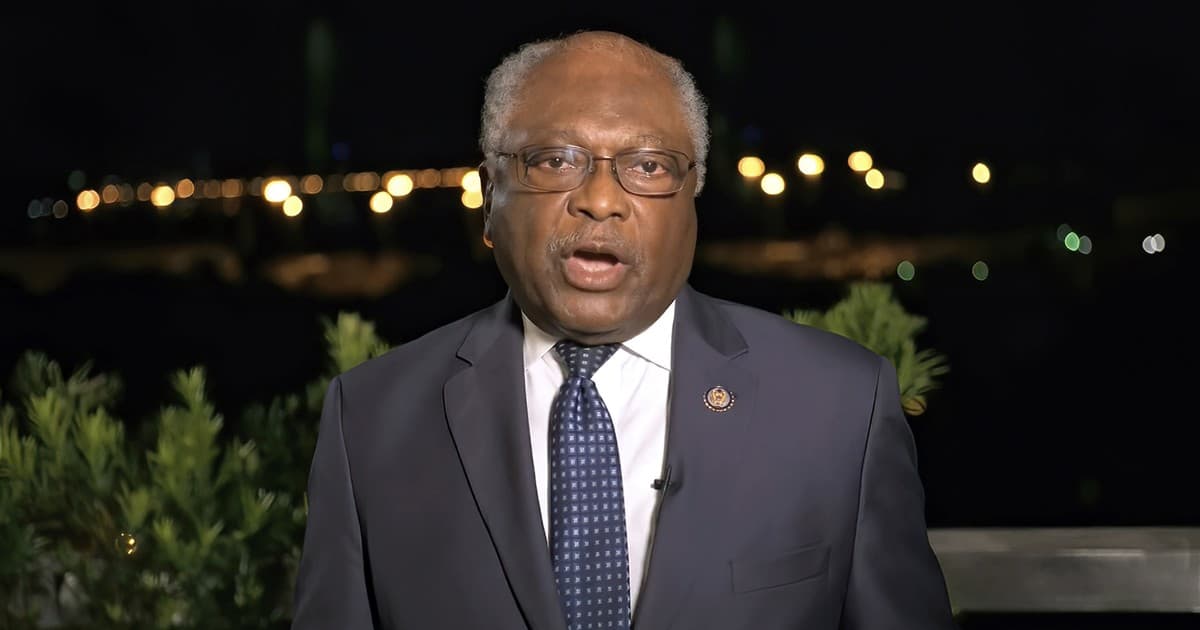
 Rep. James Clyburn speaking during a nighttime television interview.
Clyburn: Backing Clarence Thomas in 1991 'Was a Mistake'
Left says
- •Thomas's record on the bench, including votes to overturn Roe v. Wade and end affirmative action, represents a betrayal of the civil-rights advances that shaped his own upbringing in Pin Point, Georgia.
- •Clyburn's regret reflects broader Democratic frustration that a justice once vouched for as fair-minded has instead become one of the Court's most reliably hard-right votes.
- •Unresolved ethics questions about Thomas's undisclosed gifts and travel from a GOP megadonor compound concerns about his fitness and independence as a justice.
- •Expanding the Supreme Court to 13 seats is framed as a structural remedy to what Democrats see as a Court that has drifted dangerously out of step with constitutional protections for civil rights.
Right says
- •Clyburn's comments amount to policing Thomas's Blackness by suggesting he is obligated to rule a certain way because of his race and upbringing, echoing Ted Cruz's charge of 'real bigotry' against conservatives of color.
- •Comparing the current Supreme Court to the Dred Scott decision is seen as inflammatory rhetoric used to justify a partisan push to pack the Court with additional justices.
- •Democrats' renewed attacks on Thomas are viewed as politically timed and self-serving, surfacing only because Democrats dislike recent rulings rather than reflecting genuine constitutional concern.
- •Republicans largely defend the Court's ability to handle internal matters, including any ethics questions, without congressional intervention or expansion of the bench.
Common Take
High Consensus- Clyburn testified in support of Clarence Thomas's confirmation in 1991, calling him a personal and professional friend.
- Clyburn now says that support was a mistake, citing Thomas's rulings on the bench.
- Both sides recognize Thomas's upbringing in Pin Point, Georgia, and his early civil-rights-era record as central to the original case made for his confirmation.
- Kamala Harris and other Democrats have proposed expanding the Supreme Court to 13 justices, a policy debate that remains contested along party lines.
The Arguments
Left argues
Clyburn's disappointment reflects a legitimate concern that Thomas, once vouched for as a fair-minded jurist shaped by civil-rights-era experiences, has instead voted to dismantle protections like Roe and affirmative action that many believe are consistent with that history.
Right counters
Judging Thomas's legitimacy as a justice by whether his rulings match expectations tied to his race and upbringing is itself a form of racial essentialism—Thomas is entitled to interpret the Constitution according to his judicial philosophy regardless of his biography.
Right argues
Clyburn's comments—expecting Thomas's 'background and experiences' to dictate his jurisprudence and calling his independence 'rebellion'—amount to policing Thomas's Blackness, implying Black justices owe allegiance to a particular ideological outcome rather than their own legal reasoning.
Left counters
Pointing out that Thomas's rulings diverge sharply from the civil-rights legacy that shaped his own life isn't a demand for ideological conformity based on race—it's a values-based critique of how his jurisprudence has affected the very communities and protections he once benefited from.
Left argues
Unresolved reports of undisclosed gifts, luxury travel, and real estate dealings with GOP megadonor Harlan Crow raise legitimate questions about Thomas's independence and adherence to disclosure laws, justifying congressional scrutiny.
Right counters
The Supreme Court is a co-equal branch capable of policing its own ethics, and Democrats' sudden urgency on this issue—paired with vague, unformed investigative plans—suggests political theater rather than a serious, good-faith inquiry.
Right argues
Invoking Dred Scott to describe the current Court is inflammatory hyperbole that conflates a decision denying Black Americans' basic humanity with disagreement over abortion or affirmative action rulings, cheapening a uniquely horrific historical injustice for political effect.
Left counters
The comparison is meant to highlight a pattern—an activist Court reversing decades of established civil-rights protections—not to equate the rulings themselves, and strong historical analogies have long been a legitimate part of political rhetoric.
Right argues
Democrats' court-packing push, floated only after a string of rulings they dislike, reveals the effort as an attempt to entrench favorable outcomes rather than a principled structural reform, since their enthusiasm for expansion is entirely contingent on which party would fill the new seats.
Left counters
Structural reform proposals often emerge in response to specific crises—just as court expansion was debated during FDR's era—and the argument for 13 seats rests on a broader claim that the Court's current composition no longer reflects a fair, non-partisan check on power.
Challenge Questions
These questions target genuine internal contradictions — meant to provoke honest reflection.
Right asks Left
“If Clyburn's critique of Thomas is about jurisprudence and not race, why does his stated disappointment center specifically on Thomas failing to honor his grandfather's community and 'background and experiences' rather than on the legal reasoning in specific opinions?”
Left asks Right
“If Republicans believe the Supreme Court should handle ethics matters internally without congressional intervention, what internal mechanism currently exists to compel a justice to testify or disclose gifts, and why has it not already resolved the Thomas-Crow allegations?”
Outlier Report
Left Fringe
Progressive activists and figures like Rep. Ilhan Omar who compare the current Court to Dred Scott-era jurisprudence represent a vocal but minority (~20%) faction; most Democrats focus on ethics/abortion rather than such historical analogies.
Right Fringe
Commentators like those at PJ Media and RedState framing this as Thomas 'ain't Black' rhetoric, and figures amplifying Ted Cruz's 'real bigotry' charge, represent a more combative ~30% of the right; many mainstream conservatives simply defend judicial independence without racial framing.
Noise Assessment
High noise ratio — the 'race traitor' angle and Dred Scott comparison are outrage-driving frames pushed by media on both sides, while most Americans' actual views on Thomas are shaped more by general partisanship and vague awareness of ethics questions than by this specific Clyburn exchange.
Sources (6)
<p>During an appearance on NBC's "Meet the Press," Rep. James Clyburn (D-SC) made the extraordinary statement that the Supreme Court was working to restore components of the 1857 Dred Scott v. Sandford decision.</p> <p>The post <a href="https://www.breitbart.com/clips/2026/08/30/clyburn-scotus-seeking-to-return-to-dred-scott-era-when-no-black-man-has-any-rights-that-a-white-man-must-respect/" rel="nofollow">Clyburn: SCOTUS Seeking to Return to Dred Scott Era When ‘No Black Man Has Any Rights that a White Man Must Respect’</a> appeared first on <a href="https://www.breitbart.com" rel="nofollow">Breitbart</a>.</p>
Senate Democrats railed against Justice Clarence Thomas on Tuesday amid reports that the Supreme Court conservative failed to disclose luxury travel, gifts and a real estate transaction involving a GOP megadonor, but their plan to investigate the conservative jurist remains unclear.
On Monday, the GOP-controlled House Judiciary Committee — chaired by Donald Trump ally Rep. Jim Jordan — is set to hold a field hearing in New York City called "Victims of Violent Crime in Manhattan." A statement bills the hearing as an examination of how, the Judiciary Committee says, Manhattan District Attorney Alvin Bragg's policies have "led to an increase in violent crime and a dangerous community for New York City residents."
<p>Congressman says Thomas abandoned his principles to become an extremist, hard-right member of bench</p><p>The senior Democratic congressman James Clyburn said his decision to support <a href="https://www.theguardian.com/us-news/clarence-thomas">Clarence Thomas</a> for a US supreme court seat “was a mistake” and called for the expansion of the nation’s highest legal panel to 13 justices.</p><p>Clyburn, of South Carolina, spoke up for Thomas at his <a href="https://www.washingtonpost.com/lifestyle/style/it-was-just-awful-the-clarence-thomas-hearings-in-the-words-of-those-who-were-there/2016/04/07/662eda1a-f120-11e5-85a6-2132cf446d0a_story.html">fiery 1991 confirmation hearings</a>, calling him “a personal and professional friend” who would use their shared experiences lifting minorities and advancing civil rights to become a respected and accomplished jurist.</p> <a href="https://www.theguardian.com/us-news/2026/aug/31/james-clyburn-clarence-thomas-supreme-court">Continue reading...</a>