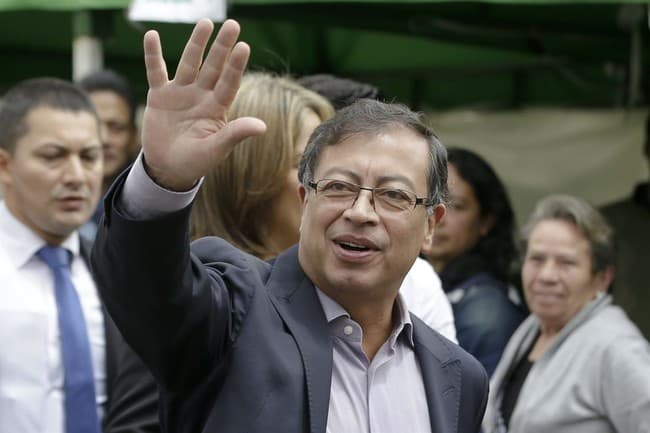
 Colombian President Gustavo Petro waves to supporters during public appearance
Colombia's Outgoing President Questions Election Results After Pro-Trump Candidate Leads
Left says
- •Colombia's electoral system is independent and trustworthy, with the National Civil Registry achieving 99.8% precision in recent elections
- •Petro's unfounded claims about vote manipulation undermine democratic institutions and mirror dangerous rhetoric that threatens electoral integrity
- •De la Espriella's hardline approach risks escalating violence and abandoning peace negotiations that could address root causes of conflict
- •International observers and human rights organizations have called for respecting the election results and supporting Colombia's democratic processes
Right says
- •De la Espriella's victory represents Colombian voters rejecting four years of failed leftist policies that allowed crime and drug trafficking to flourish
- •Petro's 'total peace' strategy of negotiating with cartels and guerrillas emboldened criminal organizations rather than reducing violence
- •De la Espriella's tough-on-crime platform, modeled after successful crackdowns in El Salvador, offers a proven path to restore security
- •The election outcome reflects growing regional support for conservative leaders who prioritize law and order over accommodation with criminal groups
Common Take
High Consensus- Neither candidate achieved the 50% threshold needed to avoid a runoff election scheduled for June 21
- Colombia faces serious security challenges with high levels of organized crime, drug trafficking, and violence
- The election results were close, with de la Espriella leading at 44% and Cepeda trailing at 41%
- Both candidates and their supporters want to improve security and reduce violence in Colombia
The Arguments
Left argues
Colombia's electoral system has demonstrated exceptional reliability with 99.8% precision in recent elections, and international human rights organizations confirm its independence and trustworthiness. Petro's unfounded claims about vote manipulation without evidence mirror dangerous anti-democratic rhetoric that undermines institutional legitimacy.
Right counters
The same electoral establishment oversaw four years of failed policies that allowed cocaine production to reach record highs and armed groups to expand territory. Questioning results when violence against candidates included assassination attempts shows legitimate concern about electoral integrity under a system that enabled such chaos.
Right argues
De la Espriella's victory represents Colombian voters decisively rejecting Petro's 'total peace' strategy that emboldened criminal organizations through negotiations rather than enforcement, leading to over 50 massacres this year and the assassination of a presidential candidate. His tough-on-crime platform mirrors El Salvador's successful model of using overwhelming force to dismantle criminal networks.
Left counters
Military-first approaches risk escalating violence and abandoning peace negotiations that address root causes of conflict, potentially repeating cycles of violence that have plagued Colombia for decades. El Salvador's model involves significant human rights concerns that may not translate effectively to Colombia's complex multi-actor conflict.
Right argues
Four years of leftist governance allowed drug trafficking and organized crime to flourish under policies that prioritized dialogue over decisive action, with cocaine production hitting record levels and tens of thousands displaced by border violence. De la Espriella's hardline approach offers proven solutions through maximum-security prisons and military strikes against cartel encampments.
Left counters
Colombia's violence stems from decades-long structural issues that require comprehensive peace-building rather than purely punitive measures, and abandoning negotiated solutions could destabilize fragile progress made with some armed groups. Military escalation risks civilian casualties and may drive criminal organizations to more extreme tactics.
Left argues
De la Espriella's alignment with Trump and promise of military force against armed groups threatens to destabilize Colombia's democratic institutions and international relationships. His rhetoric about eliminating resisters and building megaprisons raises serious concerns about human rights and rule of law under his potential presidency.
Right counters
Democratic institutions failed to protect Colombians from record violence and drug trafficking under current leadership, with a presidential candidate literally assassinated during the campaign. Strong leadership that prioritizes citizen security over accommodating criminal groups represents a return to effective governance, not authoritarianism.
Challenge Questions
These questions target genuine internal contradictions — meant to provoke honest reflection.
Right asks Left
“If Colombia's electoral system is so trustworthy and independent, why are you simultaneously defending Petro's right to question results while condemning similar behavior from Trump supporters in the U.S. - doesn't this suggest your position on electoral integrity is more about partisan outcomes than consistent principles?”
Left asks Right
“If military force and maximum-security prisons are the solution to Colombia's violence, how do you explain why decades of similar approaches failed to resolve the conflict before Petro, and what makes you confident that escalating state violence won't simply create more grievances that fuel future insurgencies?”
Outlier Report
Left Fringe
Progressive activists like those in Democratic Socialists of America who might defend Petro's questioning of election results as legitimate resistance to right-wing authoritarianism, representing roughly 15% of the left coalition.
Right Fringe
MAGA hardliners like Steve Bannon or Tucker Carlson who might call for direct U.S. military intervention in Colombia to support de la Espriella, representing about 20% of the right coalition.
Noise Assessment
Moderate noise level - most discourse reflects genuine policy preferences about crime and security rather than performative positioning, though some amplification occurs around Trump comparisons and election integrity claims.
Sources (8)
Colombia’s outgoing president sowed doubt Sunday about his country’s elections, which showed his preferred candidate, Iván Cepeda, headed to a runoff next month against right-wing opponent Abelardo de la Espriella
Abelardo de la Espriella has pledged closer cooperation with the U.S. and to crack down on organized crime.
Tough-on-crime outsider Aberaldo de la Espriella took the lead in Colombia's presidential race on Sunday night, setting up a runoff with Iván Cepeda, an ally of outgoing President Gustavo Petro.
Lawyer Abelardo de la Espriella and peace-builder Iván Cepeda were leading the vote counts in the first round of Colombia's presidential elections on Sunday, and are to face off in a presidential runoff in the South American nation later in June.
Colombia's government rejected a move by Ecuador's president to eliminate tariffs on Colombian imports because of a tariff commitment made to an opposition candidate, calling it "deliberate interference" in the ongoing electoral process.