Communities revolt against AI data centers as tech giants face growing resistance
Intra-Party Split Detected
Some progressives oppose AI data center moratoria as potentially harmful to AI governance and equity, while most support community resistance efforts
Left says
- •AI data centers disproportionately harm marginalized communities, with companies like Elon Musk's xAI operating polluting gas turbines without permits in majority-Black Memphis neighborhoods
- •Tech companies are engaging in 'data colonialism' by targeting Indigenous lands and rural communities for over 100 proposed data center projects, continuing a pattern of environmental racism and resource exploitation
- •These facilities consume massive amounts of energy and water while providing few local jobs, operating in secrecy without meaningful community engagement or democratic oversight
- •A moratorium is essential leverage to force democratic control over AI development and prevent further environmental damage to vulnerable communities
Right says
- •Opposition to data centers is economically irrational and self-defeating, blocking important technological infrastructure that drives innovation and competitiveness
- •These facilities represent significant economic opportunities and technological advancement that communities should embrace rather than resist
- •The backlash against data centers is misguided and could harm America's position in the global AI race by creating unnecessary regulatory barriers
Common Take
High Consensus- Data centers consume enormous amounts of energy and water resources, with single large facilities using as much power as 2 million households
- Many data center projects have proceeded with limited transparency and community input, creating tensions between developers and local residents
- The rapid expansion of AI infrastructure is creating new challenges for local governments trying to balance economic development with environmental and community concerns
- There is growing bipartisan concern about the need for better oversight and regulation of data center development
The Arguments
Left argues
AI data centers represent a modern form of environmental racism, with companies like Elon Musk's xAI operating polluting gas turbines without permits in majority-Black Memphis neighborhoods while targeting Indigenous lands for over 100 proposed projects. These facilities consume massive amounts of energy and water while providing few local jobs, continuing a pattern of exploitation where marginalized communities bear the environmental costs of technological development.
Right counters
Data centers represent critical technological infrastructure that drives innovation and economic competitiveness, and opposition based on environmental concerns ignores the significant economic opportunities these facilities create. The focus on environmental racism deflects from the broader economic benefits and technological advancement that communities should embrace rather than resist.
Right argues
Opposition to data centers is economically irrational and could seriously harm America's position in the global AI race by creating unnecessary regulatory barriers that slow technological progress. These facilities represent important infrastructure investments that communities should welcome for their economic potential and contribution to national competitiveness.
Left counters
The economic benefits are largely illusory, as these facilities operate with minimal local employment while consuming vast resources and operating in secrecy without meaningful community engagement. A moratorium provides essential leverage to force democratic oversight and prevent further environmental damage to vulnerable communities who see costs but not benefits.
Left argues
Data center developers operate in complete secrecy, refusing to engage with community stakeholders while making decisions that fundamentally impact local resources, energy grids, and public health. Democratic control requires transparency and community input, which a moratorium would force by creating space for proper regulatory frameworks and genuine public participation.
Right counters
Regulatory delays and moratoria create uncertainty that discourages investment and innovation, potentially driving technological development to other countries or regions with more business-friendly policies. The focus should be on streamlined approval processes rather than blanket restrictions that harm economic development.
Right argues
The backlash against data centers misunderstands their role as essential infrastructure for technological advancement and economic growth. Rather than blocking these developments, communities should focus on ensuring proper regulatory frameworks that allow beneficial projects to proceed while addressing legitimate concerns.
Left counters
Current regulatory frameworks are inadequate, as evidenced by companies operating without proper permits and targeting vulnerable communities without meaningful consultation. The breakneck pace of development prevents proper assessment of environmental and social impacts, making a pause necessary to establish genuine democratic oversight.
Left argues
These facilities consume energy equivalent to millions of households while contributing to ecological collapse, water depletion, and public health crises, with children in affected areas showing the highest rates of emergency room visits for respiratory illnesses. The environmental costs far outweigh any claimed economic benefits, particularly for frontline communities.
Right counters
Modern data centers can be designed with environmental safeguards and energy efficiency measures, and blanket opposition prevents the development of cleaner, more advanced facilities. The solution is better regulation and technology standards, not stopping development entirely.
Challenge Questions
These questions target genuine internal contradictions — meant to provoke honest reflection.
Right asks Left
“If AI development is crucial for national security and economic competitiveness, how do you reconcile calls for moratoria with the risk that other countries will advance their AI capabilities while America delays, potentially leaving the U.S. more vulnerable to authoritarian regimes that don't face similar grassroots resistance?”
Left asks Right
“If data centers provide genuine economic benefits and technological advancement, why do developers consistently operate in secrecy, avoid community engagement, and target the most politically powerless communities rather than areas that would enthusiastically welcome such economic opportunities?”
Outlier Report
Left Fringe
Activists like Krystal Two Bulls using terms like 'data colonialism' and calling for complete moratoria represent about 15-20% of the left who take the most absolutist anti-tech positions. Bernie Sanders and AOC's national moratorium proposal, while progressive, has broader left support.
Right Fringe
Tech accelerationists and libertarian commentators who dismiss all environmental concerns as 'economically irrational' represent about 10-15% of the right. Most conservatives would support some environmental protections while favoring economic development.
Noise Assessment
Moderate noise level. The environmental justice framing generates genuine grassroots concern, but some activist language about 'colonialism' may be more inflammatory than what typical Americans would use, while pro-tech dismissiveness understates real community concerns.
Sources (9)
<p>Anthropic is both a risk and a necessity to <a href="https://www.axios.com/technology/automation-and-ai" target="_blank">AI</a> progress, at least in the White House's telling.</p><p><strong>Why it matters:</strong> That tension is shaping AI policy in real time, as the White House <a href="https://www.axios.com/2026/04/29/trump-anthropic-pentagon-ai-executive-order-gov" target="_blank">realizes</a> it needs the company it's been fighting.</p><hr /><p><strong>Driving the news:</strong> The White House is inching toward welcoming Anthropic back into the government fold after months of <a href="https://www.axios.com/2026/02/27/anthropic-pentagon-supply-chain-risk-claude" target="_blank">animosity</a> and <a href="https://www.axios.com/2026/03/09/anthropic-sues-pentagon-supply-chain-risk-label" target="_blank">legal</a> battles with the <a href="https://www.axios.com/2026/03/13/ai-policy-power-center-pentagon-anthropic" target="_blank">Pentagon</a> because its most advanced models are too powerful to ignore.</p><p><strong>The big picture: </strong>The Trump administration's <a href="https://www.axios.com/pro/tech-policy/2025/07/23/white-house-releases-ai-action-plan" target="_blank">goal</a> on AI has been to be as hands-off and pro-innovation as possible. But as models get more powerful, that stance is breaking down.</p><ul><li>Washington is stepping in, shaping policy around who gets access to the most advanced systems and how they're deployed, driven by growing urgency over what the technology can do.</li></ul><p><strong>Flashback: </strong>The standoff started earlier this year when talks broke down over how the Pentagon could use Anthropic's AI in classified settings. </p><ul><li>That led to public spats, lawsuits, new deals struck with other frontier AI companies, and the unprecedented move to label Anthropic as a supply chain risk, a designation usually reserved for foreign adversaries.</li><li>The White House at one point considered an executive order meant to weed out Anthropic from government systems entirely, as Axios previously <a href="https://www.axios.com/2026/03/09/trump-white-house-anthropic-executive-order" target="_blank">reported</a>.</li></ul><p><strong>Yes, but:</strong> The government couldn't ice Anthropic out for long. </p><ul><li>That realization sank in as its powerful model <a href="https://www.axios.com/2026/04/07/anthropic-mythos-preview-cybersecurity-risks" target="_blank">Mythos</a> rolled out and agencies — despite the Pentagon spat — started <a href="https://www.axios.com/2026/04/19/nsa-anthropic-mythos-pentagon" target="_blank">testing</a> it along with other AI companies' most advanced cyber models.</li><li>As the Pentagon and Anthropic continued to battle in court, the White House kicked off a <a href="https://www.axios.com/2026/04/17/anthropic-white-house-wiles-bessent-amodei" target="_blank">thaw</a> with the company.</li></ul><p><strong>What they're saying: </strong>"When you're regulating by contract, it's basically creating a huge amount of power in the agency that's negotiated that contract and then becomes effectively the de facto policy of the administration," Jessica Tillipman, associate dean for government procurement law studies at George Washington University, told Axios.</p><ul><li>"When other agencies don't like that decision, that's when you start to see these carve-outs because they don't want to be bound by what was effectively a failed negotiation by the Pentagon."</li></ul><p><strong>Responding to a Wall Street Journal </strong><a href="https://www.wsj.com/tech/ai/white-house-opposes-anthropics-plan-to-expand-access-to-mythos-model-dc281ab5" target="_blank">report</a> that said the government opposed Anthropic's plans to expand access to Mythos to more companies due to a lack of compute, an Anthropic spokesperson said in a statement: </p><ul><li>"We are working closely with the US government to quickly advance shared priorities, including cybersecurity and America's lead in the AI race."</li><li>"Compute is not a constraint ... and we are engaged in collaborative conversations with the government on bringing additional parties in. We appreciate the administration's continued partnership as cyber capabilities advance."</li></ul><p><strong>The White House is mulling an</strong> executive action that could address both government use of advanced AI systems and carve a path forward in its dispute with Anthropic, Axios <a href="https://www.axios.com/2026/04/29/trump-anthropic-pentagon-ai-executive-order-gov" target="_blank">scooped</a> earlier this week.</p><ul><li>Talks are in flux, per sources familiar with meetings with the White House this week, and no draft guidance addressing these issues is final. </li><li>Tech and cyber companies, along with trade groups, have been participating in meetings broadly touching on these topics.</li></ul><p><strong>What we're watching:</strong> It's unclear whether any executive action will resolve the standoff with the Pentagon, which hasn't dropped its disdain for the company.</p><ul><li>Defense Secretary Pete Hegseth on Thursday said Anthropic is "run by an ideological lunatic who shouldn't have a sole decision-making over what we do" during testimony on Capitol Hill.</li></ul><p><em>Maria Curi contributed to this report.</em></p>
<p>The White House is developing guidance that would allow agencies to get around <a href="https://www.axios.com/2026/04/23/anthropic-openai-showdown" target="_blank">Anthropic's</a> supply chain risk designation and onboard new models including its most powerful yet, <a href="https://www.axios.com/2026/04/07/anthropic-mythos-preview-cybersecurity-risks" target="_blank">Mythos</a>, according to sources<strong> </strong>familiar with the matter. </p><p><strong>Why it matters: </strong>The <a href="https://www.axios.com/politics-policy/donald-trump" target="_blank">Trump</a> administration appears to be performing a 180 on a company it previously claimed was such a grave security risk that it had to be ripped out of the federal government.<strong> </strong></p><hr /><p><strong>Behind the scenes: </strong>A draft executive action that is currently in the works could, among other steps related to the government's use of <a href="https://www.axios.com/technology/automation-and-ai" target="_blank">AI</a>, give the administration a way to dial down the Anthropic fight, two sources said.</p><ul><li>One source described the White House efforts as a way to "save face and bring em back in."</li><li>Earlier this month, White House chief of staff Susie Wiles and Treasury Secretary Scott <a href="https://www.axios.com/2026/04/17/anthropic-white-house-wiles-bessent-amodei" target="_blank">Bessent met with Anthropic</a> CEO Dario Amodei for what both sides called a productive introductory meeting on how the company and government can work together. </li><li>The White House is convening companies across various sectors this week to inform the potential executive action and best practices for deploying <a href="https://www.axios.com/2026/04/19/nsa-anthropic-mythos-pentagon" target="_blank">Mythos</a>. Those meetings include "table reads" of possible guidance that could walk back the Office of Management and Budget's directive on not using Anthropic in the government.</li></ul><p><strong>What they're saying: "</strong>The White House continues to proactively engage across government and industry to protect our country and the American people, including by working with frontier AI labs," the White House said.</p><ul><li>"The collective effort of all involved will ultimately benefit our economy and country. However, any policy announcement will come directly from the President and anything else is pure speculation."</li><li>Anthropic declined to comment.</li></ul><p><strong>Catch up quick: </strong>The Pentagon and White House were once aligned on blacklisting a company both denounced as "woke." Then along came Mythos, which has demonstrated a frightening ability to automate cyberattacks, but could also be a powerful tool for defenders.</p><ul><li>Agencies across the federal government are clamoring for access to Mythos at the same time the Pentagon is battling <a href="https://www.axios.com/2026/04/22/anthropic-no-kill-switch-ai-classified-settings" target="_blank">Anthropic in court</a>.</li><li>Government agencies including the Pentagon are still able to use Anthropic's models while the legal fight plays out, and the National Security Agency is <a href="https://www.axios.com/2026/04/19/nsa-anthropic-mythos-pentagon" target="_blank">even using Mythos</a>.</li><li>But the feud has made cooperation between Anthropic and the government much more complicated.</li></ul><p><strong>Between the lines: </strong>Multiple sources have told Axios that while key players at the Pentagon are dug in on this issue, other stakeholders believe the fight has been counterproductive and are ready to find an offramp.</p><ul><li>It's unclear if the steps under consideration would resolve the Pentagon fight, or simply make it easier for other government agencies to work with Anthropic.</li></ul><p><strong>Yes, but: </strong>Even if the Pentagon lifts the <a href="https://www.axios.com/2026/02/27/anthropic-pentagon-supply-chain-risk-claude" target="_blank">supply chain risk</a> designation, which some at the Pentagon and within Anthropic believe will happen at some point, the core dispute remains.</p><ul><li>Anthropic refused to sign an agreement allowing the Pentagon to use its model Claude for "all lawful purposes," insisting on banning its use for mass domestic surveillance or to develop fully autonomous weapons. </li><li>The Pentagon said the dispute demonstrated Anthropic was not a reliable partner, and issued the unprecedented supply chain risk designation.</li><li>The Pentagon is currently still able to use Claude, which is integrated into highly sensitive systems, but it is operating on older terms of service that both sides view as overly restrictive, a source familiar said. The Pentagon is also not receiving the latest updates of the model.</li></ul><p><strong>What to watch: </strong>The source said it's possible the sides could end up right back in contentious negotiations.</p><ul><li>OpenAI and Google have both signed agreements to let the Pentagon use their models under the "all lawful purposes" standard in classified settings, though both claim those deals respect the same two red lines Anthropic drew.</li></ul><p><em>Dave Lawler and Sam Sabin contributed reporting.</em></p>
<p><a href="https://www.axios.com/2026/03/31/pope-leo-trump-iran-war-us-policies" target="_blank">The Vatican</a> is racing to build digital defenses for the <a href="https://www.axios.com/technology/automation-and-ai" target="_self">artificial intelligence</a> era — and quietly positioning itself as a global referee of what's real.</p><p><strong>Why it matters: </strong>The Holy See is moving faster than most other legacy institutions to shape rules and guardrails in verifying reality, with urgency that's unfolding amid unusual geopolitical and digital clashes.</p><hr /><ul><li>The Vatican has stepped up <a href="https://www.cybereagle.ai/vatican-collaboration" target="_blank">cybersecurity partnerships</a> and AI oversight efforts, blending defense with diplomacy and ethics. </li><li>It has implemented formal <a href="https://www.usccb.org/news/2025/vatican-city-state-puts-ai-guidelines-place" target="_blank">AI guidelines</a> and monitoring structures inside Vatican City. </li><li>Church leaders are increasingly warning about a "crisis of truth" driven by AI-generated content, something the <a href="https://www.theguardian.com/technology/2025/jan/23/pope-warns-davos-summit-that-ai-could-worsen-crisis-of-truth" target="_blank">late Pope Francis </a>addressed before his passing.</li></ul><p><strong>Zoom in: </strong>In February, Leo XIV told priests not to use AI to write homilies or to seek "likes" on social media platforms like TikTok, per the <a href="https://www.ncronline.org/vatican/pope-leo-tells-priests-not-use-ai-write-homilies-or-seek-likes-tiktok" target="_blank">National Catholic Reporter</a>.</p><ul><li>"To give a true homily is to share faith," and AI "will never be able to share faith," the pope said during a question-and-answer session with clergy from the Diocese of Rome.</li><li>The Vatican last year also issued one of the world's first state-level AI frameworks, requiring systems to be ethical, transparent and human-centered.</li><li>The policy explicitly states technology must "never overtake or replace human beings" and must serve human dignity.</li></ul><p><strong>The guidelines </strong>also prohibit AI uses that could manipulate people, discriminate or threaten security, and require safeguards around data and institutional integrity.</p><p><strong>State of play: </strong>The push has fueled speculation — especially online — that the Vatican could build a kind of "truth engine," a system to authenticate information or arbitrate reality.</p><ul><li>There's no public evidence that such a tool exists.</li><li>But the idea reflects something real: the Vatican is emerging as a moral and institutional counterweight to AI-driven misinformation, even as it moves cautiously on the technology itself.</li></ul><p><strong>What they're saying: </strong>"Insofar as (AI) promotes and uplifts humans, it's good. But it also has the potential for degrading human dignity," Thomas Ryan, a theology professor at Loyola University New Orleans, tells Axios.</p><ul><li>Ryan said the Vatican is concerned about what AI is doing to humans and to creation, like the divide between the haves and have-nots.</li><li>"Obviously, they're very worried about fake news … the degree of faking people's voices and videos has increased exponentially," <a href="https://worldstudies.vcu.edu/directory/chesnut.html" target="_blank">Andrew Chesnut</a>, Virginia Commonwealth University's Catholic studies chair, tells Axios.</li><li>Chesnut said the Vatican's approach is cautious and a deliberate effort to set limits despite the buzz.</li></ul><p><strong>The bottom line: </strong>The Vatican can't control AI, but it's trying to shape who controls truth in an AI-driven world.</p><ul><li>As governments and tech companies struggle to keep up, the Vatican is betting moral authority can still compete with machine power.</li></ul>
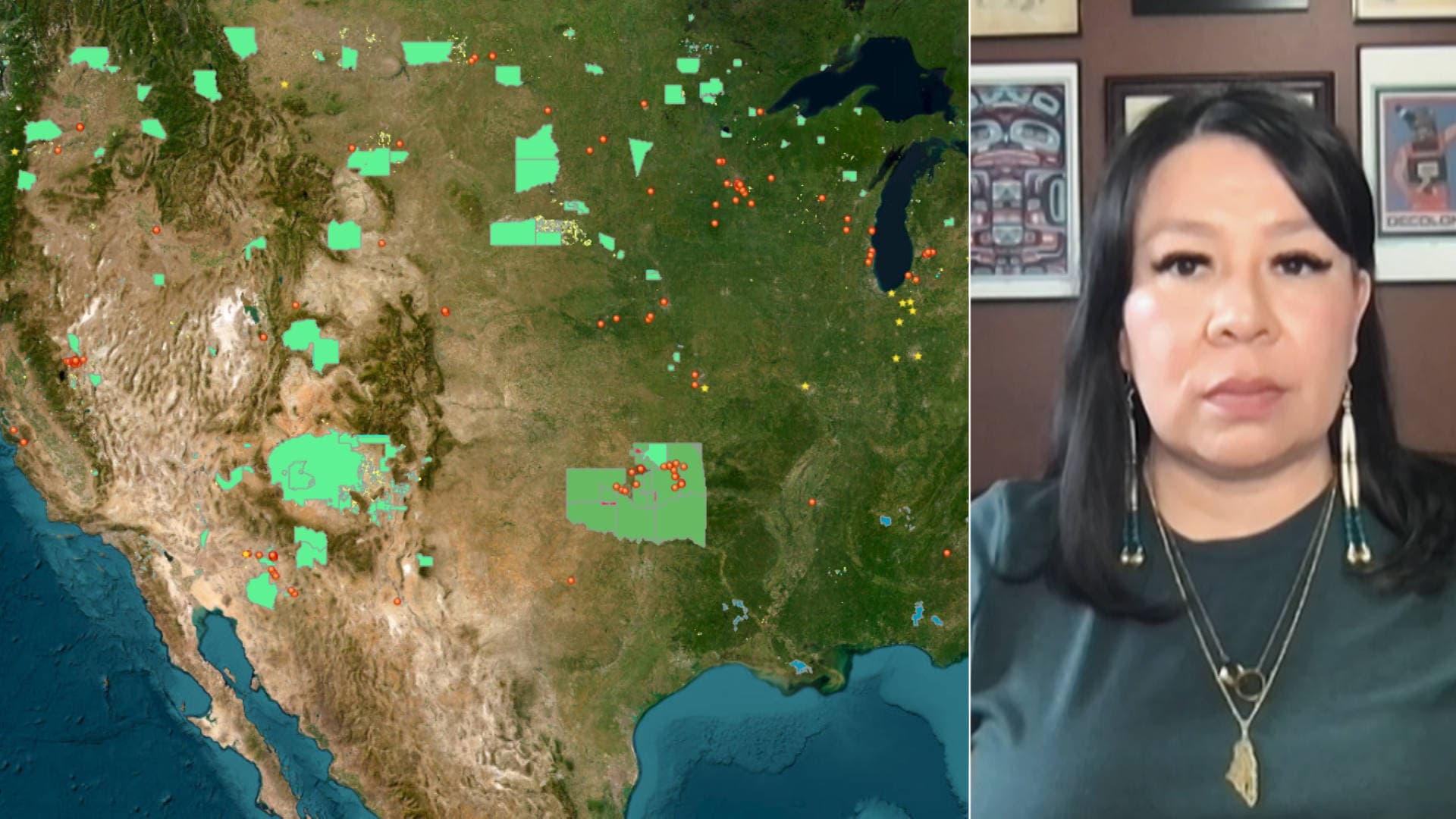
The artificial intelligence industry’s data center boom is the latest chapter in a long history of environmental racism and resource exploitation in vulnerable Native communities, says Oglala Lakota and Northern Cheyenne activist Krystal Two Bulls, the executive director of Honor the Earth, an Indigenous-led environmental justice organization that is tracking over 100 proposed data center projects on tribal and rural lands. We speak to Two Bulls about the myriad impacts of what she calls a “modern-day iteration” of “settler colonialism,” including noise pollution, cancers and respiratory illnesses, water depletion, energy grid overload and even “ecological collapse.” As tech companies set their sights on Indigenous lands, Two Bulls says, “We’re always the one that ends up having to sacrifice our relationship to land, air, water, our communities and our nonhuman relatives.”
As tech companies scramble to build massive new data centers to power artificial intelligence, marginalized communities are bearing the brunt of the environmental harms. In Memphis, Tennessee, Elon Musk’s xAI operates over two dozen methane gas-burning turbines without legal permits to power its data centers, Colossus 1 and Colossus 2, polluting the nation’s largest majority-Black city with toxic emissions. The <span class="caps">NAACP</span> is suing xAI for violating the Clean Air Act. “We are, unfortunately, a cautionary tale about what will and possibly can happen if you don’t have the right rules and guardrails in place,” says KeShaun Pearson, the executive director of Memphis Community Against Pollution. Pearson says pollution from xAI’s energy generation is already “at a level even higher than our Memphis International Airport.” Meanwhile, the company has created far fewer jobs than it initially promised. “This has been terrible for our region, and it’s terrible for our future, because our community is going to continue to suffer. Our children have the highest rate of ER visits for respiratory illnesses and issues in the state of Tennessee, and it’s only going to continue to get worse.”
Communities across the United States are pushing back against resource-draining data centers being built to fuel artificial intelligence and crypto ventures. In Maine, state legislators recently passed a first-in-the-country statewide moratorium on large data centers. “Maine residents are concerned about the impacts of data centers on both their electric rates and other utility rates, as well as on our wonderful environment,” says Democratic state Representative Melanie Sachs, who sponsored the bill designed to give legislators time to develop regulations around new data center construction. Sachs says developers have been operating in “complete secrecy,” refusing to engage with community stakeholders, while their plans appear to provide “limited economic opportunity with very few local jobs.” The bill goes to Maine Governor Janet Mills’s desk next.
Across the country, working-class communities are rising up against Big Tech’s data center boom. A moratorium isn’t the end goal — it’s the only leverage we have to force real democratic control over artificial intelligence.
What is to be gained by railing against them?
But don’t blame them for higher electricity bills—at least, not yet