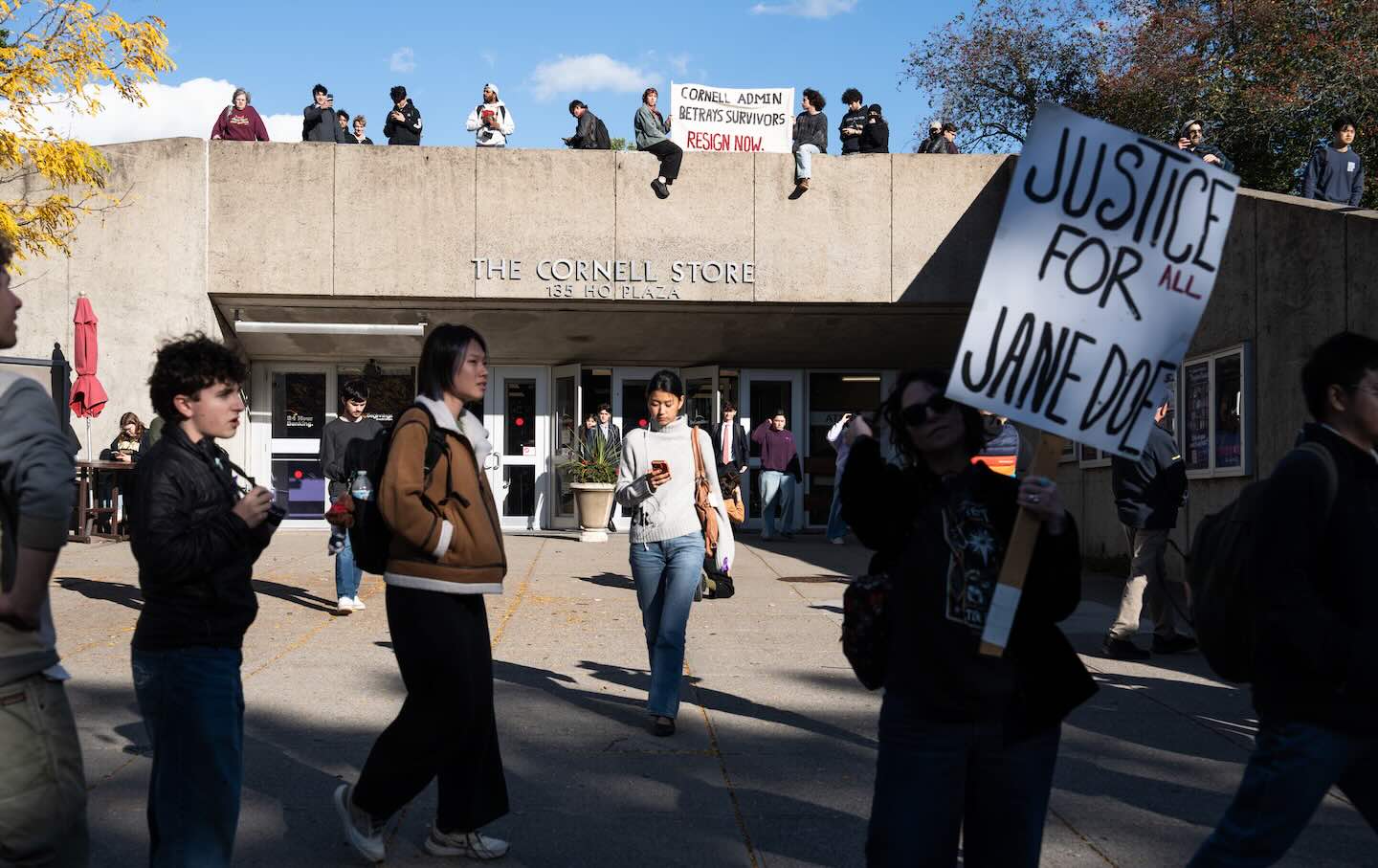
 Cornell students protest with 'Justice for Jane Doe' sign on campus.
Cornell Faces No-Confidence Vote Over Handling of Gang Rape Case
Intra-Party Split Detected
Most left-leaning coverage and campus activists demand Kotlikoff's resignation/no-confidence and systemic punitive accountability, while some voices (e.g., The Nation's conversation with Solnit and Ruttenberg) push back on punitive/criminal-legal approaches, arguing for restorative or non-carceral accountability instead.
Left says
- •Jane Doe's case exposes a systemic pattern where universities and local prosecutors fail survivors by treating allegations with inadequate investigation and institutional self-protection rather than accountability.
- •Cornell's president acknowledged he never followed up on the outcome of the investigation into a 'deeply disturbing' assault he publicly addressed, revealing a disconnect between performative statements and genuine oversight.
- •Fraternity and athletic culture fosters environments where bystanders—friends and peers of the accused—fail to intervene even when they have clear opportunities to stop harm, reflecting a broader crisis of complicity.
- •True accountability requires more than punishment or expulsion; it demands systemic cultural change, survivor-centered healing processes, and leadership that proactively prioritizes prevention rather than reacting only under public pressure.
Right says
- •The case highlights real institutional failures in Cornell's investigation and the local prosecutor's office, which admitted it never independently investigated before declining to bring charges, raising legitimate due process and competence concerns for all parties involved.
- •Effectiveness of campus sexual assault prevention and education programs is under scrutiny nationwide, suggesting the problem may lie in poorly designed institutional policy rather than any single administration's malice.
- •A no-confidence vote risks becoming a symbolic gesture driven by campus political pressure rather than a measured response grounded in a complete understanding of what the investigations ultimately found.
- •Removing university leadership in response to public outcry, as Kotlikoff himself noted, does not by itself guarantee cultural change or better outcomes for future cases without sustained structural reform.
Common Take
High Consensus- A former Cornell student filed a lawsuit alleging she was gang-raped by seven Chi Phi fraternity members in October 2024.
- Cornell expelled two students and imposed lesser discipline on others following its investigation, and later shut down the fraternity chapter.
- The Tompkins County District Attorney's office did not independently investigate the case before initially declining to bring charges, and the case has since been reopened with a special prosecutor named by the governor.
- Cornell's president did not follow up on the outcome of the Title IX or criminal investigations after publicly acknowledging the allegations in 2024, a gap both sides agree raises questions about institutional follow-through.
The Arguments
Left argues
Cornell's president publicly addressed the assault as 'deeply disturbing' yet admitted he never followed up to learn the outcome of either the criminal or Title IX investigation, revealing that institutional statements of concern were performative rather than backed by genuine oversight.
Right counters
A university president overseeing thousands of students and dozens of ongoing disciplinary matters cannot personally track every case outcome, and delegating to task forces and investigative bodies is standard administrative practice, not evidence of malicious indifference.
Right argues
The Tompkins County DA's own admission that his office never independently investigated before declining to prosecute shows the failure was distributed across multiple institutions, not simply a matter of one administration's culpability.
Left counters
Distributing blame across institutions doesn't absolve Cornell specifically; the university controlled its own Title IX process and still failed to ensure consequences matched the severity of what multiple investigations ultimately substantiated.
Right argues
A no-confidence vote driven by campus outrage risks being a symbolic political gesture disconnected from a full accounting of what investigations actually found, and removing leadership doesn't guarantee the systemic reforms survivors actually need.
Left counters
Faculty and students aren't asking for symbolism alone — the no-confidence resolution is a direct response to concrete, admitted failures of oversight, and continued trust in leadership that didn't follow up on its own public commitments is itself an unreasonable risk.
Left argues
The bystander failures — dozens of fraternity members aware via Snapchat messages who did nothing to intervene — reflect a broader culture of complicity that disciplinary action against a handful of individuals cannot fix.
Right counters
Holding an entire social culture responsible for the inaction of specific bystanders risks diffusing accountability away from the individuals who actually committed assault and those with direct institutional authority to act, which is precisely the kind of unfocused blame that undermines due process.
Right argues
Nationwide scrutiny of the effectiveness of sexual assault prevention programs suggests this is a systemic, structural problem with campus policy design generally, not evidence that any single administration acted in bad faith.
Left counters
Acknowledging the problem is structural doesn't excuse Cornell's specific failure to act on information it already had; systemic reform has to start with institutions being honest about where their own oversight broke down, which Cornell's leadership only did under pressure.
Challenge Questions
These questions target genuine internal contradictions — meant to provoke honest reflection.
Right asks Left
“If true accountability requires moving beyond punishment toward systemic cultural change and survivor-centered healing, how does a no-confidence vote targeting one individual leader actually deliver that systemic change rather than simply replacing one administrator with another operating under the same institutional structures?”
Left asks Right
“If the prosecutor's admitted failure to independently investigate and the effectiveness problems with prevention programs are genuinely systemic rather than any single actor's fault, doesn't that argument equally support holding Cornell's president accountable for a systemic failure he was in a unique position to correct and didn't?”
Outlier Report
Left Fringe
Groups like Students for a Democratic Cornell and commentators such as Katha Pollitt (The Nation) who frame this explicitly through a 'rape culture' and systemic patriarchy lens, calling for abolition-adjacent accountability models outside the criminal legal system; this represents roughly 15-20% of the left, as most mainstream Democrats support reform without such explicitly anti-carceral framing.
Right Fringe
Commentators in conservative media (e.g., some National Review or Daily Wire contributors) who might frame this primarily as evidence of due-process erosion from Title IX overreach or skepticism toward uncorroborated accusations, representing a small but vocal 10-15% of the right; most conservatives still broadly condemn the alleged assault and institutional failures.
Noise Assessment
High — national day-of-action protests, hashtag activism ('I Am Jane Doe'), and no-confidence vote drama generate significant media amplification that outpaces how most ordinary Americans, who are largely sympathetic but not deeply engaged, actually process this story.
Sources (8)
University students across the United States held a national day of action in solidarity with “Jane Doe,” the anonymous former student whose lawsuit alleging she was gang-raped by seven Cornell University Chi Phi fraternity members in 2024 has reignited outrage over how campuses and local law enforcement mishandle sexual assault cases and fail survivors. We go to Cornell’s campus in Ithaca, New York, where faculty have introduced a no-confidence resolution against the university administration.</p> <p>“The number one message that Cornell students have is that Jane Doe’s ordeal is the tip of the iceberg, that there have been many, many other cases where women have been sexually assaulted and raped at Cornell University, and they’re afraid of coming forward. They’re afraid of going to the authorities because the investigation may be botched or they may be shamed,” says Paul Ortiz, a professor of labor history and the lead sponsor of the resolution.</p> <p>“Rape culture and sexual assault culture thrives on campus,” adds Saya Taylor, a Cornell sophomore and a member of the group Students for a Democratic Cornell. “The true outrage in this case doesn’t just come from what happened to Jane Doe. It comes from the fact that it could have happened to anybody, and they still would have not received any justice.”
Revelations of sexual assault at a Cornell University fraternity in 2024 and how the university responded have sparked national outrage, reigniting a public debate about “the extent to which fraternities, the extent to which athletics really support this kind of culture that allows perpetrators to escape with little or no accountability,” says law professor Deborah Tuerkheimer.</p> <p>In 2024, seven male students avoided criminal prosecution after allegedly drugging and gang-raping a female student at the Chi Phi fraternity house. Cornell is now under intense scrutiny for its handling of the original investigation, which found that the student identified as Jane Doe was sexually assaulted by two of seven men, resulting in expulsions for two and lesser consequences for the other five. Tompkins County District Attorney Matthew Van Houten has admitted that his office at the time did not independently investigate the case when it declined to bring charges. The DA has now reopened the case, and New York Governor Kathy Hochul has named Attorney General Letitia James as special prosecutor to investigate how the case was handled.</p> <p>“Around the country, we see a pattern of investigators, police officers and even prosecutors deciding at the outset that the allegations are not worth pursuing, and dismissing the case before any kind of investigation gets off the ground,” says Tuerkheimer.
Michael Kotlikoff’s admission comes a day before Cornell’s Faculty Senate was set to begin debating a no-confidence resolution in his administration.
Cornell University’s president was met with scrutiny and sharp questions from its faculty senate Wednesday, when the group convened to discuss a no-confidence vote over the university’s handling of an alleged 2024 sexual assault at a fraternity house, according to an audio recording obtained by NBC News.
The alleged Cornell University gang rape has put a spotlight on programs and education at colleges that address sexual violence.   But as Cornell’s president promises more student education on the issue after uproar on campus, the effectiveness of these efforts has come under nationwide scrutiny. Cornell President Michael Kotlikoff said the university wants to…
<p>Katha Pollitt</p> <div><img alt="" src="https://www.thenation.com/wp-content/uploads/2026/10/GettyImages-2299090907.jpeg" /></div> <div> <div class="wp-block-the-nation-dek article-title__dek"> <p>Everything that Jane Doe went through could have been stopped, if someone had bothered to intervene. But no one did.</p> </div> </div> <p>The post <a href="https://www.thenation.com/article/society/cornell-jane-doe-masculinity/">What Didn’t Happen at Cornell</a> appeared first on <a href="https://www.thenation.com">The Nation</a>.</p>
<p>Andrea Arroyo</p> <div><img alt="" src="https://www.thenation.com/wp-content/uploads/2026/10/10-13_FEAT_1440.jpg" /></div> <div>Allegations of gang rape and sex trafficking at Cornell University highlight persistent concerns about rape culture, even years after the #MeToo movement.</div> <p>The post <a href="https://www.thenation.com/article/politics/jane-doe-courage-and-dignity/">Jane Doe: Courage and Dignity</a> appeared first on <a href="https://www.thenation.com">The Nation</a>.</p>
<p>Marina Sitrin</p> <div><img alt="" src="https://www.thenation.com/wp-content/uploads/2026/10/GettyImages-2298765437.jpeg" /></div> <div> <div class="wp-block-the-nation-dek article-title__dek"> <p>A discussion with Rebecca Solnit and Rabbi Danya Ruttenberg about what accountability should look like for survivors of sexual assault and rape.</p> </div> </div> <p>The post <a href="https://www.thenation.com/article/society/accountability-after-cornell/">“We Can’t Punish Our Way Out of This”: A Conversation on Meaningful Accountability After Cornell</a> appeared first on <a href="https://www.thenation.com">The Nation</a>.</p>