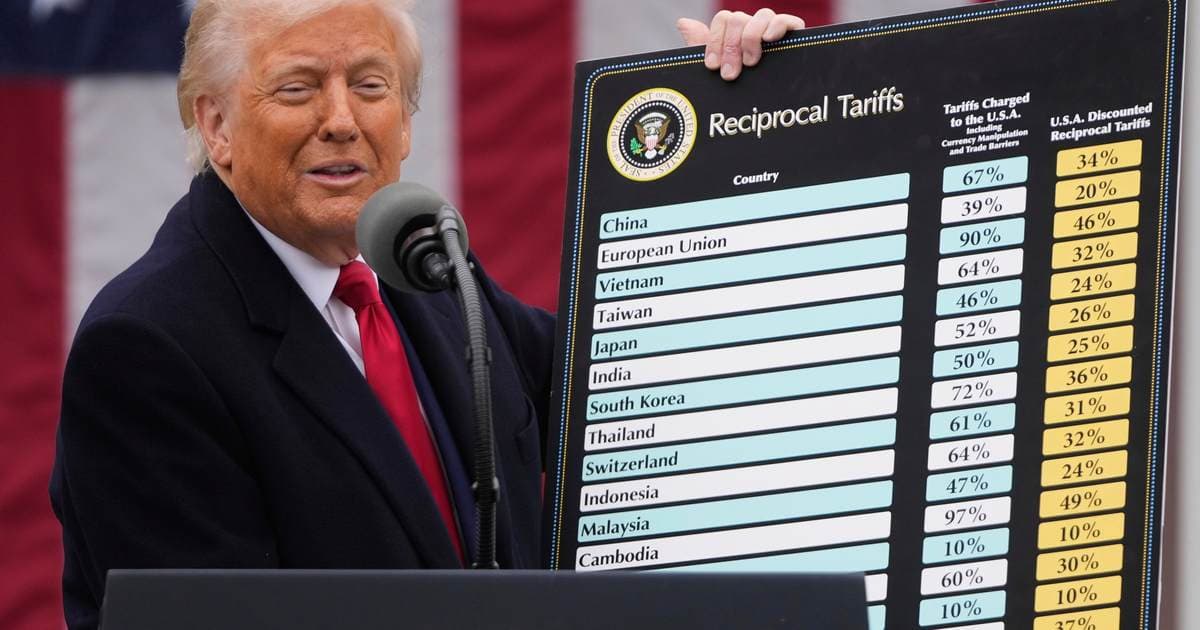
 Trump presents tariff chart showing reciprocal tariffs by country
Court Strikes Down Trump's Second Attempt at Global Tariffs
Left says
- •The ruling represents another judicial rebuke of Trump's overreach of executive authority, with courts consistently finding his tariff justifications legally insufficient
- •These tariffs function as an illegal tax on American consumers and businesses, forcing them to pay higher prices while the administration searches for new legal workarounds
- •The decision protects small businesses like spice importers and toy retailers from unauthorized government levies that harm their competitiveness and damage supply chains
Right says
- •The court's narrow interpretation undermines legitimate presidential tools to address America's massive trade deficits and protect domestic manufacturing jobs
- •Trump's tariff strategy has successfully revitalized American manufacturing, particularly in Rust Belt states that were devastated by job losses to China
- •The administration retains multiple legal pathways to impose tariffs through other statutes, ensuring trade protection measures can continue despite judicial obstacles
Common Take
High Consensus- The Court of International Trade ruled 2-1 that Trump's 10% global tariffs under Section 122 of the Trade Act of 1974 were legally invalid
- The tariffs were imposed in February as a replacement after the Supreme Court struck down earlier tariffs, and are set to expire in July anyway
- Small businesses including a spice company and toy retailer successfully challenged the tariffs, represented by the Liberty Justice Center
- The administration is expected to appeal the decision and has already signaled plans for replacement tariffs using different legal authorities
The Arguments
Left argues
The court correctly found that Trump's interpretation of Section 122 would give him unlimited tariff power, as he could always find some sub-account deficit to justify tariffs, effectively usurping Congress's constitutional authority over trade policy.
Right counters
The administration has multiple legal pathways remaining through Section 301 investigations and other statutes, demonstrating that courts are applying overly narrow interpretations that hamstring legitimate presidential trade tools needed to address unfair foreign practices.
Right argues
Trump's tariff strategy has successfully revitalized American manufacturing, particularly in Rust Belt states devastated by job losses to China, with manufacturing data showing significant growth since his election.
Left counters
These tariffs function as an illegal tax on American consumers and businesses, forcing companies like toy retailers and spice importers to pay billions in unauthorized levies that damage their competitiveness and disrupt supply chains.
Left argues
The ruling represents another judicial rebuke of executive overreach, with courts consistently finding Trump's tariff justifications legally insufficient under multiple statutes, requiring the government to refund over $166 billion to importers.
Right counters
These narrow judicial interpretations undermine America's ability to address massive trade deficits and protect domestic industries from unfair foreign competition, weakening tools that previous administrations used to defend American economic interests.
Right argues
The current account deficit of 4% of GDP and $1.2 trillion annual goods trade deficit represent serious economic imbalances that justify temporary tariff measures to protect American manufacturing jobs and reduce dependence on foreign supply chains.
Left counters
The law requires 'balance-of-payments deficits' in the traditional monetary sense, not trade deficits, and such crises haven't existed since the U.S. left the gold standard in the 1970s, making this statute inapplicable to current conditions.
Challenge Questions
These questions target genuine internal contradictions — meant to provoke honest reflection.
Right asks Left
“If courts consistently strike down tariffs regardless of the legal mechanism used, how can any administration legitimately use trade policy tools to address unfair foreign practices or protect strategic industries, and doesn't this judicial pattern effectively transfer trade policy authority from the executive branch to the courts?”
Left asks Right
“If manufacturing has genuinely increased and jobs have returned to the Rust Belt under Trump's trade policies, how do you reconcile opposing these measures with the economic benefits they appear to have generated for American workers in previously devastated industrial communities?”
Outlier Report
Left Fringe
Progressive economists like Dean Baker and trade policy activists who want complete elimination of all tariff authority represent about 15% of the left, going beyond mainstream Democratic positions that accept some targeted trade protection.
Right Fringe
Economic nationalists like Steve Bannon and some America First Policy Institute figures who advocate for permanent 25%+ across-the-board tariffs represent roughly 20% of the right, exceeding even Trump's current proposals.
Noise Assessment
Moderate noise level - most discourse reflects genuine policy disagreement rather than performative positioning, though some partisan legal commentary amplifies beyond typical public engagement with trade court rulings.
Sources (10)
<p>The Court of International Trade on Thursday ruled that President <a href="https://www.axios.com/politics-policy/donald-trump" target="_blank">Trump's</a> newest round of tariffs were illegal, though the duties are likely to stay in effect while the administration appeals. </p><p><strong>Why it matters: </strong>It is yet another legal setback for the White House's trade policy — this time ruling against the suite of tariffs that officials imposed to replace those <a href="https://www.axios.com/2026/02/20/trump-tariffs-supreme-court-illegal" target="_blank">struck down by the Supreme Court</a>.</p><hr /><p><strong>State of play: </strong>Trump <a href="https://www.axios.com/2026/02/20/trump-tariff-plan-section-122-trade-act" target="_blank">turned to Section 122</a> — a never-before-used provision of the <a href="https://www.govinfo.gov/content/pkg/COMPS-10384/pdf/COMPS-10384.pdf" target="_blank">Trade Act of 1974</a> — the same day the Supreme Court struck down the bulk of his tariffs in February, imposing a 10% across-the-board surcharge set to expire July 24.</p><ul><li>The trade statute allows the president to impose a temporary <a href="https://www.axios.com/economy/tariffs" target="_blank">tariff</a> of as much as 15% for up to 150 days to address "large and serious" balance-of-payments deficits.</li><li>The small businesses that brought the suit, a spice company and a toy retailer,<strong> </strong>are represented by the Liberty Justice Center, the same group that helped argue the last successful tariff challenge before the Supreme Court.</li><li>The Court of International Trade tossed the claims of 23 of the 24 state attorneys general, ruling their harms from the tariffs were too indirect to establish standing.</li></ul><p><strong>What they're saying: </strong>In a 2-1 <a href="https://www.cit.uscourts.gov/sites/cit/files/26-47.pdf" target="_blank">ruling</a>, the trade court said that if the president can decide what counts as a "balance-of-payments deficit," he can always find one — essentially allowing the law to be triggered at any moment.</p><ul><li>"[I]f the President has the ability to select among the sub-accounts to identify a balance-of-payments deficit, unless every sub-account is balanced, the President would always be able to identify a balance-of-payments deficit," the court said in its ruling. </li><li>"Such an expansive reading of the statute" would give Trump unlimited tariff power that belongs to Congress, the court said. </li></ul><p><strong>Flashback</strong>: Much of last month's hearing dealt with <a href="https://www.axios.com/2026/04/10/trump-tariffs-trade-court" target="_blank">how to define such a crisis</a> — and whether the nation is in one now.</p><ul><li>The government argued that the current account deficit — the broadest measure of what the U.S. pays out to the rest of the world versus what it takes in, of which the trade deficit is a large part — is the modern stand-in for what Congress meant. </li><li>Plaintiffs said the type of monetary crisis the law was designed to address hasn't existed since the U.S. left the gold standard in the 1970s.</li></ul><p><strong>What to watch</strong>: "This decision will surely be appealed by the administration, and there is already a 'plan C' in place: <a href="https://www.axios.com/2026/03/11/trump-tariffs-trade-301" target="_blank">the section 301 investigations</a> that are already underway," Tim Brightbill, co-chair of the law firm Wiley Rein's international trade practice, tells Axios.</p><ul><li>A White House spokesperson did not immediately respond to a request for comment.</li></ul><p><strong>The bottom line: </strong>Tariffs are at the center of Trump's economic agenda. The courts keep telling Trump that the tools he uses to impose them are<strong> </strong>illegal.</p><ul><li>But these duties are set to expire in July anyway — and the administration has signaled that replacement tariffs will likely be enacted before then — so the administration may not need to win in court to keep high tariffs in place. </li></ul>
NEW YORK, May 7 (Reuters) – The U.S. trade court on Thursday ruled against President Donald Trump’s latest 10% global tariffs, finding across-the-board tariffs were not justified under a 1970s trade law. The U.S. Court of International Trade ruled in favor of small businesses that challenged the tariffs, which took effect on February 24. The ...
Also, the U.S. and Iran exchange fire. Here’s the latest at the end of Thursday.
A panel of federal judges found that President Trump could not legally impose the tariff on most imports.
The Court of International Trade has struck down a second round of global tariffs ordered by President Trump, after his earlier import taxes were outlawed by the U.S. Supreme Court.
A federal court ruled Wednesday against the new global tariffs President Donald Trump imposed after a stinging loss at the Supreme Court.
The appellate court ruling sets up a showdown at the Supreme Court
A federal trade court on Thursday struck down tariffs President Trump imposed to replace import taxes that the Supreme Court struck down earlier this year. A three-judge panel of the U.S. Court of International Trade (CIT) imposed a permanent injunction on the 10 percent tariff Trump imposed on nearly all U.S. imports in February. Judges…
A federal trade court on Thursday invalidated President Trump's attempt to impose a global tariff of 10% after he faced a loss at the Supreme Court over a separate set of broad levies.