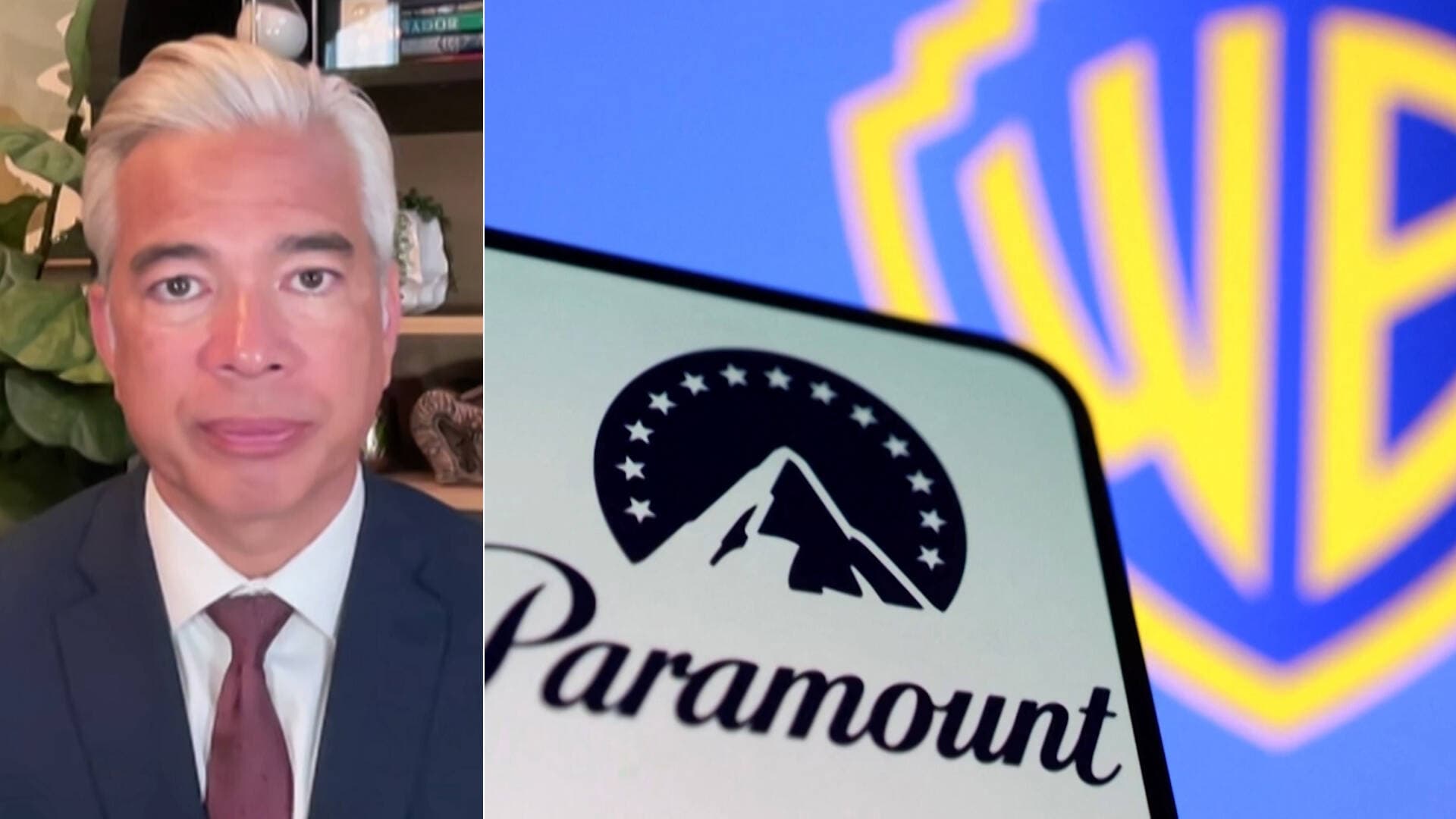
Democratic AGs Sue to Block Merger Trump's DOJ Already Approved
Left says
- •The merger would consolidate control of theatrical and cable distribution among a shrinking handful of companies, potentially raising prices and reducing content variety and quality for consumers.
- •David Ellison's father Larry Ellison, a major Trump ally and financial backer, would gain control over CNN, CBS News, HBO Max, and Paramount+, raising concerns about media concentration and political influence.
- •Writers Guild leaders and theater trade groups call the deal one of the worst proposed mergers in Hollywood history, warning of harm to entertainment workers, local theaters, and journalism.
- •State attorneys general argue they must step in to enforce antitrust law because federal regulators under the Trump administration failed to properly scrutinize the deal, echoing similar state-led actions against Live Nation-Ticketmaster and Nexstar-Tegna.
Right says
- •The Justice Department's Antitrust Division reviewed the deal and concluded it would increase competition across the media and entertainment ecosystem rather than harm consumers.
- •Paramount argues the merger creates a stronger, better-capitalized competitor against Netflix and other streaming and tech platforms that have already disrupted theatrical exhibition and cost entertainment jobs.
- •A coalition of exclusively Democratic state attorneys general is overriding a federal regulatory approval, raising questions about whether state lawsuits are being used to relitigate settled federal antitrust decisions for political reasons.
- •Delaying or blocking the deal could itself harm entertainment workers who have already suffered from industry disruption, according to Paramount's own defense of the transaction.
Common Take
High Consensus- Twelve Democratic-led state attorneys general, led by California's Rob Bonta, sued to block the $110-111 billion Paramount Skydance-Warner Bros. Discovery merger.
- The Trump administration's Justice Department approved the merger in June before the states filed suit.
- The merger would combine major studios, cable networks, and streaming services including CNN, CBS News, HBO Max, and Paramount+ under one company.
- A federal judge in Oakland held hearings on a temporary restraining order and planned to rule by July 22.
The Arguments
Left argues
The merger would concentrate control of theatrical and cable distribution among a shrinking handful of companies—giving the combined entity and three rivals up to 86-90% of wide theatrical releases—which the states argue will raise prices and reduce content variety for consumers.
Right counters
Paramount argues these market-share figures ignore the real competitive threat: dominant streaming and tech platforms like Netflix that have already disrupted theatrical exhibition, meaning the merger creates a stronger competitor rather than a monopolist within a shrinking industry.
Right argues
The Justice Department's Antitrust Division—the federal body with primary jurisdiction and expertise—reviewed the deal and concluded it would increase competition across the media ecosystem, and that considered judgment shouldn't be casually overridden.
Left counters
State attorneys general have independent statutory authority to enforce antitrust law, and history shows federal approval isn't infallible—juries and judges have already sided with states over federal regulators in the similar Live Nation-Ticketmaster and Nexstar-Tegna cases.
Left argues
Beyond antitrust economics, the deal would hand David Ellison—and by extension his father Larry Ellison, a major Trump financial backer—control over CNN, CBS News, HBO Max and Paramount+, raising legitimate concerns about media concentration and political influence over journalism.
Right counters
This argument conflates ownership concentration with an assumed political motive that isn't itself an antitrust violation; the lawsuit is nominally about consumer prices and market share, not about who owns the outlets or their politics, and using antitrust law as a proxy for those separate concerns risks turning enforcement into a political weapon.
Right argues
All twelve suing states are led by Democratic attorneys general, which raises a fair question about whether this is principled antitrust enforcement or an attempt to relitigate a settled federal decision along partisan lines, especially given the timing tied to Trump-administration approval and Ellison's ties to Trump.
Left counters
Partisan composition doesn't disprove the legal merits—state AGs act within their jurisdiction regardless of party, and if Republican-led states saw no need to join doesn't mean the antitrust concerns raised about market concentration and consumer harm aren't real and independently verifiable in court.
Left argues
Writers Guild leaders and independent theater trade groups—entities with direct stakes in the entertainment ecosystem, not just prosecutors—warn this is one of the worst proposed mergers in Hollywood history, threatening jobs, local theaters, and journalistic independence.
Right counters
Paramount counters that blocking or delaying the deal itself harms entertainment workers who have already suffered mass job losses from streaming disruption, and that a better-capitalized combined company is more likely to preserve jobs than two weaker separate ones struggling against Netflix.
Challenge Questions
These questions target genuine internal contradictions — meant to provoke honest reflection.
Right asks Left
“If federal antitrust review is inadequate whenever a Democratic-led coalition disagrees with its outcome, would you accept the same principle applied by Republican state AGs to override a federal approval reached under a Democratic administration?”
Left asks Right
“If the DOJ's antitrust approval is presumptively correct here because it's the expert federal body, does that same deference apply when federal regulators approve mergers or policies your side opposes on other grounds, or only when it's politically convenient?”
Outlier Report
Left Fringe
Figures like Robert Reich or Warren-aligned progressives who view this as emblematic of oligarchic capture (Larry Ellison-Trump ties) and would push for aggressive trust-busting regardless of consumer price analysis; roughly 15-20% of the left holds this more radical anti-concentration stance.
Right Fringe
Commentators like Ben Shapiro or free-market absolutists who view any antitrust intervention as government overreach into private business decisions, dismissing consumer protection rationale entirely; roughly 15-20% of the right holds this more libertarian, anti-regulation extreme.
Noise Assessment
High noise ratio - most Americans have not closely followed this specific merger's antitrust details and lack strong opinions; the vocal discourse (Democracy Now interviews, WGA statements, Bonta press conferences) is amplified by industry insiders, media reporters, and political actors far more invested than the general public, who likely have only a diffuse 'mergers are probably bad' instinct.
Sources (8)
<p>State attorneys general from a dozen states, including California, New York and Washington, filed a lawsuit to block <a href="https://www.axios.com/2026/04/14/paramount-skydance-antitrust-hollywood" target="_blank">Paramount Skydance's</a> $110 billion takeover of Warner Bros. Discovery. </p><p><strong>Why it matters:</strong> The <a href="https://oag.ca.gov/system/files/attachments/press-docs/Redacted%20Paramount%20Warner%20complaint%20%20-%20file%20stamped.pdf" target="_blank">lawsuit</a> could derail or delay the closing of the deal, which could cost Paramount hundreds of millions of dollars. </p><hr /><ul><li>The coalition of states said they asked the two companies not to close their merger until after the judicial process concludes, adding it will file a temporary restraining order.</li><li>The coalition is composed of California, Arizona, Colorado, Connecticut, Massachusetts, Minnesota, Nevada, New Jersey, New Mexico, New York, Oregon and Washington.</li></ul><p><strong>Zoom in: </strong>The states argue the deal is anticompetitive on three grounds:</p><ol><li><strong>Wide release theatrical distribution: </strong>They argue after the merger, "only three distributors will control 75% of these films and only four distributors (Defendants, Disney, Universal, and Sony) will control 86% of them."</li><li><strong>Top-grossing theatrical distribution:</strong> They say after the deal "Defendants will control more than 30% of these films, and four distributors (Defendants, Disney, Universal, and Sony) will control more than 90% of them."</li><li><strong>Cable reach:</strong> "Warner Bros. is the second largest and Paramount is the third largest in this market, and they would combine for a 27% share," the states attorneys general note.</li></ol><p><strong>What they're saying: </strong>"The unlawful merger of these two entertainment behemoths would lead to higher prices, lower quality, and less content for film and television, harming movie theaters, basic cable distributors, and ultimately, audiences on every sofa and movie theater seat in the U.S.," California Attorney General Rob Bonta said in a <a href="https://oag.ca.gov/news/press-releases/attorney-general-bonta-files-lawsuit-block-110-billion-warner-brosparamount" target="_blank">statement</a>.</p><ul><li>Writers Guild of America West and Writers Guild of America East commended the states in a joint statement. WGAW president Michele Mulroney called the deal "one of the worst proposed mergers we've seen." </li><li>WGAE president Tom Fontana said, "The damage this deal would do to America's entertainment and news industries would be an absolute, unmitigated disaster. This merger must be blocked."</li><li>Theater trade group Cinema United also welcomed the state attorneys general's lawsuit, saying, "The ramifications of further movie studio consolidation will be significant and lasting, not just in Hollywood, but on Main Streets across this nation where local movie theaters serve as cultural and financial cornerstones for communities of all sizes."</li></ul><p><strong>The other side:</strong> Paramount criticized the lawsuit, arguing it "distorts settled antitrust law and is based on a misrepresentation of competition in the entertainment industry today"</p><ul><li>The company reiterated its stance that it believes the deal "creates a stronger competitor against dominant streaming and technology platforms who have harmed the market for theatrical exhibition and jobs in the entertainment industry."</li><li>A spokesperson said the company will defend the transaction and argued, "Delaying this transaction will only harm entertainment workers who have already suffered over recent years as technology has disrupted their livelihood and cost California tens of thousands of entertainment jobs."</li></ul><p><strong>Catch up quick:</strong> The Justice Department in June approved <a href="https://www.axios.com/2026/04/23/warner-bros-discovery-approve-paramount-skydance-deal" target="_self">Paramount's</a> takeover of WBD.</p><ul><li>While that approval was expected, regulators abroad and in the U.S. continued to probe the deal. </li><li>The U.K. Competition and Markets Authority <a href="https://assets.publishing.service.gov.uk/media/6a27d79ff56856fd11c0b1cc/Commencement_notice_9_June_2026.pdf" target="_blank">said</a> last month it will formally launch an investigation into the deal. </li><li>European Union regulators seem more open to approving the deal with remedies. Bloomberg <a href="https://www.bloomberg.com/news/articles/2026-06-06/paramount-open-to-divest-kids-tv-assets-in-eu-probe-of-110-billion-warner-deal" target="_blank">reported</a> that Paramount is open to selling some of its children's TV network assets to help win EU approval. </li></ul><p><strong>The big picture:</strong> State attorneys general are <a href="https://www.axios.com/2026/03/10/live-nation-ticketmaster-state-antitrust" target="_blank">moving aggressively</a> to sue corporate giants in an attempt to fill a void they argue is being left by federal antitrust regulators.</p><ul><li>Earlier this year, more than two dozen bipartisan state attorneys general <a href="https://apnews.com/article/livenation-antitrust-ticketmaster-states-95d16c3d8a36adaeff57f400a63227f3" target="_blank">continued</a> an antitrust lawsuit to break up Live Nation and Ticketmaster after the Justice Department's surprise settlement with the combined company. A jury ultimately <a href="https://www.nytimes.com/2026/04/15/arts/music/live-nation-antitrust-trial-verdict-monopoly.html" target="_blank">ruled</a> in their favor. </li><li>A coalition of states sued to block Nexstar and Tegna from merging on antitrust grounds, even though the Justice Department and FCC approved the deal. A federal judge <a href="https://apnews.com/article/nextstar-tegna-merger-lawsuit-antitrust-ec9f2def13e1b31b0e2c0437b635a932" target="_blank">blocked</a> the deal until the lawsuit is sorted out. </li></ul><p><strong>Go deeper:</strong> <a href="https://www.axios.com/2026/03/10/live-nation-ticketmaster-state-antitrust" target="_blank">State AGs play antitrust cops</a></p>
Twelve Democratic-led states led by California sued this week to block Paramount Skydance’s $111 billion acquisition of Warner Bros. Discovery. Paramount is run by David Ellison, whose father, Larry Ellison, is the billionaire founder of Oracle and a prominent ally and financial backer of President Donald Trump. Under the proposed deal, <span class="caps">CNN</span> and <span class="caps">CBS</span> News, streaming services <span class="caps">HBO</span> Max and Paramount+, as well as film and television studios, would all be combined under a single entity controlled by the Ellisons. The states’ lawsuit comes after the Trump administration approved the megamerger last month.</p> <p>“This proposed merger breaks the law,” says California Attorney General Rob Bonta. “It’s anti-competitive. It will raise prices. It will lower quality.”
The deal already cleared federal regulators, but now faces a challenge from a coalition of 12 states.
A dozen states are suing to block Paramount’s merger with Warner Bros
<p>Yet more consolidation means one less studio, inevitable redundancies and a blow to this city’s cultural heritage</p><p>There are simply too many companies in the world. Apple, Google, Amazon, Ryanair. I’m probably forgetting some. How could I not? There are <em>so many companies</em>. Thankfully, here in Hollywood, we’re culling the herd. My memory says thanks. My career, on the other hand, does not.</p><p>After Disney swallowing up 20th Century Fox (which is now just called “20th Century Studios”, making it sound like a company that makes gramophones), Discovery merging with Warner Brothers, and Skydance <a href="https://www.nytimes.com/2025/08/07/business/media/skydance-paramount-merger.html">buying</a> Paramount, you’d think the industry would be done kneecapping itself through strategic acquisitions. Wrong again, friend. Warner Bros Discovery – swimming in debt and loaded up with depreciating cable TV assets – <a href="https://www.cnn.com/2025/10/21/media/warner-bros-wbd-sale-paramount-skydance-suitors">put itself on the market</a> only three years after its last merger. First they went to Netflix, then to Paramount, after Netflix <a href="https://ir.netflix.net/investor-news-and-events/financial-releases/press-release-details/2026/Netflix-Declines-to-Raise-Offer-for-Warner-Bros-/">realized</a> they like profit too much. Now a <a href="https://www.cnbc.com/2026/07/14/paramount-wbd-merger-lawsuit.html">Paramount-WBD merger is progressing</a>. All of this means one less movie studio, inevitable redundancies and more consolidation of vision.</p><p>Dave Schilling is a Los Angeles-based writer and humorist</p> <a href="https://www.theguardian.com/commentisfree/2026/jul/18/paramount-wbd-merger-workers">Continue reading...</a>
<p>Cheerleading by the president, who made $1.2bn last year off uninsured currency, does not bode well for US economy</p><p>The scale of the graft is decidedly off the charts, but the <a href="https://www.theguardian.com/us-news/2026/jun/30/trump-1bn-crypto-businesses-2025">revelation</a> that Donald Trump raked in a personal fortune of <a href="https://www.theguardian.com/us-news/2026/jul/01/trump-earnings-as-president">$2.2bn</a> during his first year in office should come as no surprise. The president didn’t even try to hide his venality. Not only did he refuse to sell businesses and put assets in a blind trust, as other presidents have done to limit opportunities for self-dealing; the quid pro quos with foreign governments and assorted magnates were exposed for all to see.</p><p>It is troubling that the president of the United States would so nonchalantly deploy his official powers to profit from dealings with <a href="https://www.bbc.com/news/articles/cly1qrl9l1qo">money launderers</a> and <a href="https://www.nytimes.com/2026/02/01/us/politics/trump-crypto-uae-world-liberty.html">Middle Eastern princes</a>. It is perhaps more so that the supposedly robust checks and balances upholding American governance proved powerless to stop him. (Here’s waiting for the supreme court to define Trump’s dealings as “<a href="https://www.aclu.org/press-releases/supreme-court-grants-trump-broad-immunity-for-official-acts-placing-presidents-above-the-law">official acts</a>” in order to exonerate him.)</p> <a href="https://www.theguardian.com/business/2026/jul/18/trump-crypto-us-economy">Continue reading...</a>
The judge said there will be a decision on the temporary restraining order by July 22.
States are beefing up their antitrust enforcement