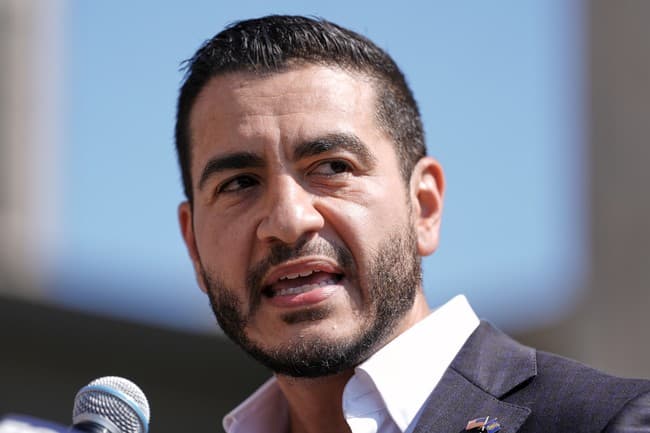
 Abdul El-Sayed speaks at a campaign event, a key figure in Michigan's Senate primary.
Democratic Socialist Upsets Establishment Pick in Michigan Senate Primary
Intra-Party Split Detected
El-Sayed's narrow primary win over establishment-backed Haley Stevens exposed a deep rift between the Democratic Party's progressive/DSA-aligned wing and its moderate establishment, with some Stevens voters and party figures reportedly reluctant to back El-Sayed in the general election.
Left says
- •El-Sayed's win reflects genuine grassroots enthusiasm and a party base energized by anger at Donald Trump and frustration over Israel policy, not just outside meddling by activist groups.
- •The establishment's preferred candidate, Haley Stevens, held progressive positions on abortion, gun control, and other issues herself, undercutting the idea that this was a battle between a true moderate and a radical.
- •El-Sayed is actively working to unify the party by reaching out to moderates and has already won support from party leaders, suggesting the divide is being bridged rather than deepened.
- •The primary demonstrates that voters are rejecting institutional money and endorsements in favor of candidates who speak plainly about their convictions.
Right says
- •El-Sayed's victory signals that the Democratic Socialists of America now wield enough organizing power to defeat a well-funded, institutionally backed candidate even in a critical swing state.
- •El-Sayed has not disavowed DSA's more radical positions, including abolishing ICE and other institutions, raising concerns about his general-election viability in Michigan.
- •Polling and anecdotal reports show a meaningful bloc of Democratic primary voters, including moderates, saying they would cross over to support the Republican nominee rather than back El-Sayed.
- •Michigan hasn't elected a Republican senator in 26 years, but this rift within the Democratic coalition gives the GOP a rare opening to break that streak.
Common Take
High Consensus- Abdul El-Sayed narrowly defeated Rep. Haley Stevens in the August 4 Democratic Senate primary.
- Prominent progressive figures, including Bernie Sanders, AOC, and Rashida Tlaib, campaigned actively on El-Sayed's behalf.
- The result exposed real tension between the Democratic Party's establishment wing and its progressive base.
- Some Democratic and independent voters have expressed reluctance to support El-Sayed in the general election against Republican Mike Rogers.
The Arguments
Left argues
El-Sayed's win reflects genuine grassroots enthusiasm and voter frustration with institutional money and endorsements, not simply outside meddling by activist groups — voters chose the candidate who spoke plainly about his convictions over one backed by establishment donors.
Right counters
That enthusiasm was heavily manufactured by DSA's organizing machine and boosted by national figures like Sanders, AOC, and Tlaib, which is precisely the kind of coordinated activist mobilization the left claims wasn't decisive.
Right argues
El-Sayed hasn't disavowed DSA's more radical positions, including abolishing ICE, raising legitimate concerns about his viability in a general election in a swing state that Trump has contested closely.
Left counters
Haley Stevens herself held progressive positions on abortion, gun control, and other issues, so framing this as a stark radical-versus-moderate choice mischaracterizes how narrow the actual ideological gap was.
Right argues
Polling and on-the-ground reports show a real bloc of Democratic primary voters, including self-described liberals and moderates, saying they'd cross over to vote for the Republican nominee rather than support El-Sayed, which is a genuine warning sign for the party in November.
Left counters
Anecdotal clips and early polling often overstate defection risk before a candidate has had time to consolidate the base; El-Sayed is already actively courting moderates and picking up endorsements from party leaders, suggesting the rift can be bridged.
Left argues
El-Sayed is actively reaching out to moderates and has already won support from some party leaders, showing the party is working to unify rather than fracture heading into the general election.
Right counters
Reconciliation efforts after the fact don't erase the substantive gap between DSA's platform and swing-voter priorities — outreach is easy to promise but the voters who said they'd defect are reacting to his actual positions, not a lack of charm.
Right argues
Michigan hasn't elected a Republican senator in 26 years, but a visibly fractured Democratic coalition and defecting moderate voters give the GOP a rare and concrete opening to finally break that streak.
Left counters
Anger at Trump and frustration with Israel policy are energizing turnout on the left in a way that could offset any moderate defections, meaning the party's underlying coalition may be more motivated, not weaker, than in past cycles.
Challenge Questions
These questions target genuine internal contradictions — meant to provoke honest reflection.
Right asks Left
“If Haley Stevens already held progressive positions on abortion, gun control, and ICE, why is it necessary to insist this primary wasn't really a fight between moderates and the left — and if it wasn't, what exactly was the ideological stake that generated such intense mobilization and moderate voter defection?”
Left asks Right
“If Republicans believe El-Sayed's socialist positions are politically radioactive and will hand them a rare Senate seat, why does the strategy rely on amplifying anecdotal voter defections rather than trusting that his actual policy positions will speak for themselves in the general election?”
Outlier Report
Left Fringe
Figures like Bernie Sanders, AOC, and Rashida Tlaib represent the most enthusiastic pro-El-Sayed fringe, treating this as a national model for DSA-style primary challenges; they represent perhaps 10-15% of the broader Democratic coalition but are highly vocal and media-visible.
Right Fringe
Commentators like Nick Freitas (BlazeTV) and RedState writers frame this as proof the entire Democratic Party is captured by 'radical' socialists who 'hate America,' an exaggerated characterization likely held by 15-20% of the right that discounts any genuine grassroots dynamic.
Noise Assessment
High noise ratio: cherry-picked viral clips of individual Democratic voters threatening to defect, plus sweeping generalizations from both DSA boosters and conservative commentators, amplify narrative extremes beyond what broader survey data on the race would likely show.
Sources (8)
<img src="https://www.theblaze.com/media-library/image.jpg?id=67584073&width=1245&height=700&coordinates=0%2C0%2C0%2C0" /><br /><br /><p>Once again, the Democratic Socialists of America have proven that the Democrat establishment can’t outspend its grassroots army.</p><p>On August 4, progressive candidate Abdul El-Sayed narrowly won the Democratic nomination for U.S. Senate over Rep. Haley Stevens, after many DSA members, local chapters, activists, and progressive figures closely tied to the DSA — including Bernie Sanders, AOC, and Rashida Tlaib — mobilized heavily on his behalf.</p><p>BlazeTV host Nick Freitas says El-Sayed’s victory reveals something deeply unsettling about the direction the Democratic Party is headed.</p><p class="shortcode-media shortcode-media-youtube"> <span class="rm-shortcode" style="display: block; padding-top: 56.25%;"></span></p><p>“The establishment probably could not have picked a better candidate for what we would call establishment-style Democrat politics in Michigan than Haley Stevens,” says Freitas, highlighting her “long history with Michigan” and her work on both Hillary Clinton's and Barack Obama’s 2008 campaigns.</p><p>“She really appealed to the things that you would expect from kind of working-class voters in Michigan … and yet she still lost,” he adds.</p><p>According to Freitas, there are “two things going on here.”</p><p>“One, you see the machine Democrat Party recognizing that it's probably going to be a lot harder to win with [El-Sayed] in a swing state, and then I think what you also see is this resurgence of far-left politics … within the Democratic Party that is absolutely dedicated and willing to walk in lockstep,” he explains.</p><p>Even though Stevens was by no means the “moderate” she was portrayed to be — exemplified by her progressive positions on ICE, abortion, and gun control — Freitas says her classic establishment résumé and deep-pocketed donors made her an easier candidate for the Democrat establishment to get behind.</p><p>But in the end, it didn’t matter how much money the Democrat machine spent on her. El-Sayed still came out on top because the DSA is where the momentum and energy is right now.</p><p>“What this confirms is that the DSA is every bit as strong as we anticipated it to be, and I think what this demonstrates is that at least going into the midterms, DSA is going to be riding this wave of victories that they've had within primaries,” says Freitas.</p><p>“The fact that Abdul Sayed thought this is going to be great for me, and theoretically was, should tell us everything we need to know about where the energy is within the Democratic Party right now,” he continues.</p><p>The Democrat establishment, Freitas explains, is failing to beat the DSA not because D candidates are actually true moderates — on the contrary, they’re usually still far-left on core issues — but because the DSA is “very, very honest” about its objectives, which appeals to voters.</p><p>“And then to the extent that [the DSA is] losing, they're only losing in places where they don't have sufficient groundwork or they haven't had the sufficient time to work in order to build up a new generation of voters that hate America every bit as much as they do. So what do they settle for?” he asks.</p><p>“Well, they settle for candidates who still want to fundamentally change and alter the United States, who still want to allow for mass immigration, who still want to abolish ICE, who still want to abolish prisons or defund the police, but are simply smart enough to not say so out loud,” he answers.</p><p>Add it all up and the conclusion regarding the current Democratic Party is bleak: “You have the DSA … you have progressive candidates who pretty much want the same things, but are smart enough to know that you can't say everything that you want out loud … and then you have this ever-dwindling portion of ‘moderate’ Democrats.”</p><p>To hear more, watch the episode above.</p><p>Start watching Nick Freitas NOW at <a href="http://blazetv.com" rel="noopener noreferrer" target="_blank"><u>blazetv.com</u></a> and use the promo code NICK40 for $40 off your BlazeTV+ subscription.</p>
Plus: Spain’s migrant crisis. <img src="https://i0.wp.com/www.nationalreview.com/wp-content/uploads/2026/08/abdul-el-sayed-2.jpg?fit=617%2C360&ssl=1" />
The winner of the Michigan Senate primary does not disclaim the DSA’s radical politics and has a long list of institutions he’d like to see abolished. <img src="https://i0.wp.com/www.nationalreview.com/wp-content/uploads/2026/08/adbul.jpg?fit=617%2C360&ssl=1" />
Anger at Donald Trump and Israel have given the left an opening
The options are far left, soft left and pure establishment
The upset highlighted how out of touch the power brokers are with the party’s surging left wing as they try to retake control of the Senate.
Progressive Abdul El-Sayed is trying to patch things up with moderates. And some party leaders have already started to file behind him.