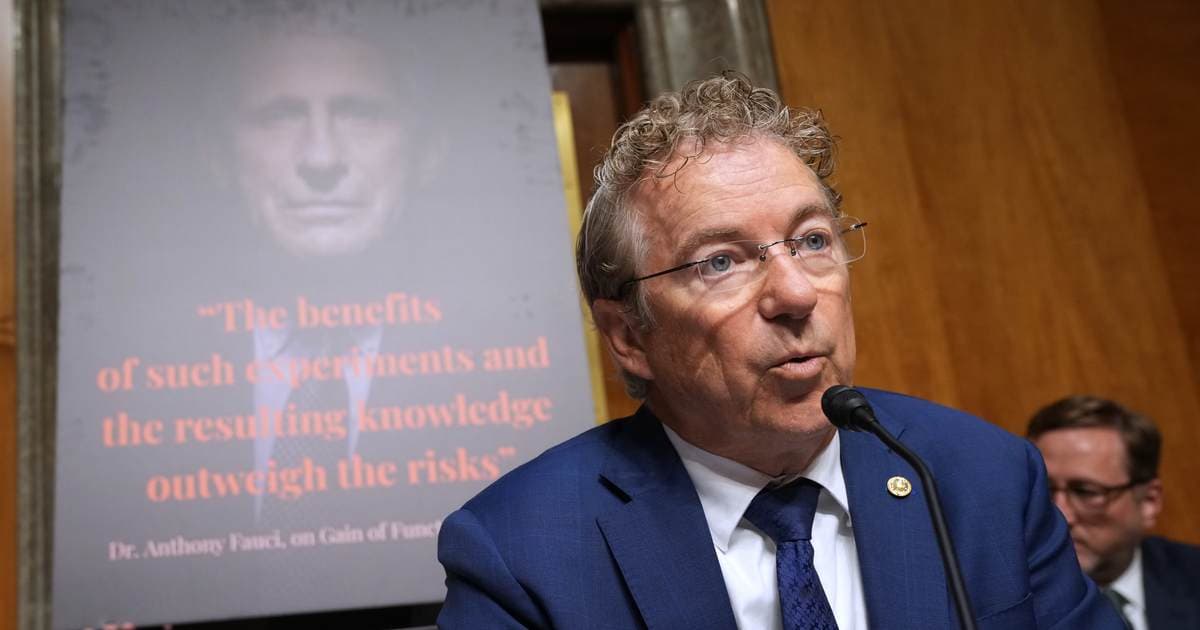
Democrats Block Immunity for Fauci Aide Accused of Destroying Records
Left says
- •A single senator's unilateral characterization of a witness's alleged conduct should not be sufficient grounds to grant blanket immunity from criminal prosecution before the full committee has had time to evaluate the evidentiary record.
- •Senator Hassan's stated reason for opposing the measure was that she lacked sufficient information to make an immunity determination, a legitimate procedural concern given the gravity of granting someone immunity from prosecution.
- •Immunity deals are serious legal tools that permanently bar future prosecution, and rushing such a decision through a politically charged committee process risks shielding wrongdoing rather than exposing it.
- •This effort is part of a broader, years-long Republican campaign to relitigate Fauci's pandemic-era decisions, and Democrats are wary of being used to validate a predetermined narrative.
Right says
- •Granting immunity is a well-established investigative tool used specifically to overcome Fifth Amendment refusals and get direct testimony about who ordered records destroyed and why.
- •The witness already invoked the Fifth Amendment over one hundred times through Fauci himself and repeatedly during her own closed-door session, suggesting there is real substance being hidden from the public.
- •Democratic senators were given the same briefing materials as Republicans ahead of the vote, and six of seven chose to vote no by proxy rather than appear and explain their reasoning in person.
- •Chairman Paul emphasized he does not want the aide prosecuted and is instead focused on holding higher-level officials accountable, framing the immunity offer as protective of the witness rather than punitive.
Common Take
High Consensus- The Senate Homeland Security and Governmental Affairs Committee voted 8-7 along party lines on September 23, 2026, falling short of the two-thirds majority required to pass.
- The unnamed aide worked for Fauci from 2007 until his 2022 departure from NIAID and has invoked her Fifth Amendment right against self-incrimination before the committee.
- Only Senator Maggie Hassan attended the meeting in person among Democrats, with the remaining six voting no by proxy.
- Chairman Rand Paul stated he will refer the matter to the Department of Justice and seek the aide's records from recent years for further investigation.
The Arguments
Right argues
Immunity is a standard investigative mechanism precisely for situations like this one, where a witness invokes the Fifth Amendment and direct testimony is needed to determine who ordered records destroyed and why.
Left counters
The mere availability of a legal tool doesn't obligate its immediate use; granting immunity permanently forecloses prosecution, so the committee should be certain it understands what it's giving up before voting, not rushed into it in one meeting.
Left argues
Senator Hassan's stated reason—that she lacked sufficient information to responsibly grant blanket immunity—is a legitimate procedural safeguard given the permanence and gravity of an immunity decision.
Right counters
Paul says Democrats were given all the same briefing materials as Republicans and had each signed acknowledgment of receiving that information, undermining the claim that more time or information was actually needed.
Right argues
Chairman Paul explicitly said he does not want the aide prosecuted and wants to protect her while pursuing accountability for higher-level officials, framing the immunity offer as protective rather than punitive—undercutting any suggestion this was a partisan trap.
Left counters
A single chairman's stated intentions don't bind how the testimony or immunity grant could later be used politically, and Democrats are reasonably skeptical of a process embedded in a multi-year Republican campaign against Fauci.
Left argues
This vote occurs within a broader, sustained Republican effort to relitigate Fauci's pandemic decisions, making Democrats understandably cautious about being maneuvered into validating a predetermined narrative through a single dramatic committee vote.
Right counters
Skepticism about motives doesn't answer the substantive question of why an aide who worked in the 'flow of communications' during critical early pandemic decisions shouldn't be allowed to testify under legal protection if she has relevant information.
Right argues
Only one Democrat (Hassan) even appeared in person for the vote, with six others voting no by proxy, which raises legitimate questions about whether the committee minority was seriously engaging with the merits versus reflexively blocking the measure.
Left counters
Proxy voting is a routine and permitted committee practice, and physical absence doesn't necessarily reflect a lack of engagement with the substance—senators can review materials and cast informed votes without attending every meeting.
Challenge Questions
These questions target genuine internal contradictions — meant to provoke honest reflection.
Right asks Left
“If Senator Hassan and other Democrats already received the same briefing materials Republicans did, what specific additional information would have been needed to make an informed immunity decision, and why couldn't that be requested rather than simply voting no?”
Left asks Right
“If Chairman Paul says his real goal is holding higher-level officials accountable rather than punishing the aide, why does the resolution grant immunity to the aide specifically rather than pursuing testimony from Fauci or other senior officials directly?”
Outlier Report
Left Fringe
Figures like Democratic strategists and commentators such as those on MSNBC (e.g., segments defending Fauci uncritically) or groups like the Democratic base that view any Fauci investigation as pure partisan harassment represent maybe 15-20% of the left, taking the position that the entire inquiry is illegitimate rather than engaging with the specific immunity question.
Right Fringe
Figures like Steve Bannon, some America First commentators, and parts of the RFK Jr.-aligned health freedom movement treat this as proof of an active bioweapons cover-up conspiracy involving Fauci personally directing a felony scheme, representing perhaps 20-25% of the right who go well beyond the more measured 'we want transparency and accountability' framing offered by Rand Paul.
Noise Assessment
High noise ratio: this is a niche procedural Senate committee vote that gets amplified into a major culture-war flashpoint by partisan media on both sides, while the actual public attention span for the details (immunity procedure, two-thirds vote rules) is low; most public opinion is driven by pre-existing priors about Fauci rather than engagement with this specific vote.
Sources (8)
<p>A federal judge warned Attorney General <a href="https://www.axios.com/2026/08/08/todd-blanche-trump-attorney-general-confirmed" target="_blank">Todd Blanche</a> Wednesday that he could face contempt proceedings if the Department of Justice fails to comply with an order involving the release or review of Epstein files. </p><p><strong>Why it matters:</strong> The case could force the DOJ to release additional Epstein records or <a href="https://www.axios.com/2026/06/26/epstein-files-doj-lawsuit-judge-release-unredacted-july-order" target="_blank">remove redactions</a> that a court determines aren't permitted under the law.</p><hr /><p><strong>What they're saying: </strong>U.S. District Judge Emmet Sullivan wrote in a 20-page <a href="https://storage.courtlistener.com/recap/gov.uscourts.dcd.291779/gov.uscourts.dcd.291779.43.0.pdf" target="_blank">order</a> Wednesday that a civil contempt charge would be "premature" for now, but warned it could become appropriate if Blanche fails to comply with the court's renewed order.</p><ul><li>"[C]ourts have the inherent power to enforce compliance with their lawful orders through civil contempt," Sullivan wrote.</li><li>"A contempt finding is proper where 'the putative contemnor has violated an order that is clear and unambiguous' and the violation of an order is 'proved by clear and convincing evidence.'"</li></ul><p><strong>The other side:</strong> "Our filings will speak for themselves," a DOJ spokesperson told Axios in an emailed statement. </p><ul><li>"We have already shown the Judge proof of redacted victim names and established that the plaintiff in this case seeks to unmask victim names."</li></ul><p><strong>Catch up quick:</strong> Independent journalist Katie Phang brought the lawsuit, alleging the DOJ hasn't released all documents required under the <a href="https://www.axios.com/2025/11/20/trump-epstein-files-bill-signed" target="_blank">Epstein Files Transparency Act</a>, which Congress passed last November.</p><ul><li>Sullivan <a href="https://www.courthousenews.com/feds-struggle-to-explain-redactions-in-epstein-files-compliance-case/" target="_blank">said</a> last month he didn't want to start contempt proceedings, but added that the public "has a right to know what the hell is going on in this case" and the "victims have a right to know and the court has a right to know."</li></ul><p><strong>Zoom in: </strong>Sullivan ruled Wednesday that the DOJ provided adequate documentation showing some email redactions were made to protect survivors' privacy.</p><ul><li>But he said the department hadn't provided enough documentation to justify redactions in other emails and ordered it to provide additional documentation for private "in camera review" — a process in which a judge reviews confidential, sensitive or privileged documents outside public view.</li><li>The judge rejected the DOJ's assertion that handwritten FBI notes were "properly withheld because they are 'substantially similar to' and therefore duplicative of the typewritten reports." He said the DOJ's review protocol does not require withholding "substantially similar" records.</li><li>Sullivan also rejected the DOJ's argument for not reviewing foreign-language materials related to Epstein because it was "not practicable for a first-level reviewer to determine the responsiveness of a foreign-language document."</li></ul><p><strong>Yes, but: </strong>Sullivan acknowledged that some redactions covered the names and email addresses of a government attorney and law enforcement personnel, which the DOJ's review protocol requires to be redacted.</p><p><strong>State of play:</strong> The lawsuit is <a href="https://www.washingtonpost.com/world/2026/09/09/europeans-investigating-epstein-say-doj-has-not-agreed-requests-help/" target="_blank">one</a> of <a href="https://www.cnn.com/2026/03/27/us/epstein-survivors-sue-doj-google-hnk" target="_blank">several</a> seeking <a href="https://www.axios.com/2026/08/05/new-mexico-sues-doj-epstein-files" target="_blank">additional transparency</a> or alleging DOJ errors related to the Epstein files, which have generated legal and political scrutiny of the Trump administration.</p><ul><li>Congress has held U.S. attorneys general in contempt before, including <a href="https://www.axios.com/2025/08/11/eric-holder-house-democrats-redistricting" target="_blank">Eric Holder</a> during the Obama administration and <a href="https://www.axios.com/2019/05/08/house-judiciary-bill-barr-contempt-vote-mueller-report" target="_blank">William Barr</a> during Trump's first administration.</li><li>The DOJ did not respond to Axios' request for comment.</li></ul><p><strong>What we're watching:</strong> A House discharge petition is <a href="https://www.axios.com/2026/09/15/house-republicans-epstein-files-thomas-massie" target="_blank">two signatures shy</a> of forcing a vote on the Epstein Files Transparency Act II, which would enforce and expand the release of remaining DOJ files.</p><ul><li>Outgoing GOP Rep. <a href="https://www.axios.com/2025/09/24/epstein-files-discharge-petition-signatures" target="_blank">Thomas Massie</a> (R-Ky.) is leading the effort, as he did with Act I.</li></ul><p><strong>Go deeper:</strong> <a href="https://www.axios.com/2026/09/15/house-republicans-epstein-files-thomas-massie" target="_blank">House GOP's Epstein files headache is back</a></p><p><em>Editor's note: This story has been updated with a DOJ statement. </em></p>
Sen. Rand Paul said the aide is reluctant to answer the committee's questions without legal immunity.
Sen. Maggie Hassan, D-N.H., blocked a plea deal offer from the Senate Committee on Homeland Security to Dr. Anthony Fauci’s assistant for her testimony about destroying records at her boss’s request in exchange for immunity from possible criminal charges from the Department of Justice. Before the vote, Committee Chairman Rand Paul, R-Ky., told the Daily...
Democrats on the Senate Homeland Security and Governmental Affairs Committee on Wednesday blocked a Republican-led effort to grant immunity to a longtime assistant of Dr. Anthony Fauci as part of the panel’s investigation into the former government health leader.  The motion, which required support from two-thirds of the panel’s members, failed along party lines 8-7…
Sen. Rand Paul said Wednesday he will refer a longtime aide to Dr. Anthony Fauci to the Justice Department for possible prosecution, saying she had a "20-year history of destroying records" while serving as the point man for America's coronavirus response.