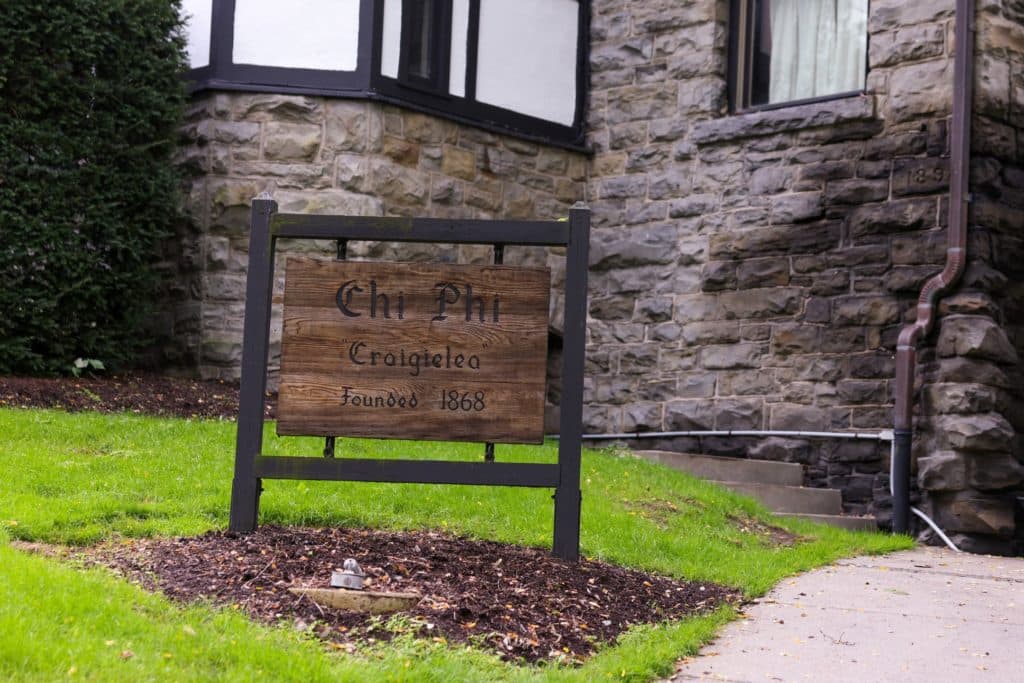
 Chi Phi fraternity house sign at Cornell, tied to the Title IX investigation.
Did Cornell and Prosecutors Bury a Rape Report?
Left says
- •The newly surfaced transcript shows Jane Doe told police just weeks after the incident that she was 'completely and totally incapacitated' and could say 'with 100% confidence' she was raped, undercutting claims that her account only hardened later in a civil lawsuit.
- •Cornell's own Title IX process gathered 50 interviews with 32 witnesses and resulted in expulsions and suspensions, suggesting the university's internal findings were far more serious than what reached prosecutors.
- •The district attorney admits he never received the full 565-page transcript, raising questions about whether campus police or university officials filtered or summarized evidence in a way that minimized the allegations before they reached law enforcement.
- •Survivors and student advocates argue this case illustrates a systemic failure in which institutions prioritize reputational protection over full accountability, reinforcing the need for the independent investigation and the attorney general's special prosecutor role.
Right says
- •The Tompkins County district attorney maintains that the woman's original statement to police did not include allegations of being drugged, incapacitated beyond consent, or forced into sex, and that this is why charges weren't filed at the time.
- •Due process concerns matter here: seven men already faced expulsion or suspension through a university disciplinary process, and some question whether campus Title IX proceedings — which use lower evidentiary standards than courts — are being treated as equivalent to criminal guilt.
- •The decision to reopen the case appears to stem from new allegations added in the civil lawsuit rather than clear evidence that the original investigation was deliberately suppressed, and critics caution against assuming institutional malice before the independent review is complete.
- •Political pressure, including the governor's executive order appointing a special prosecutor, risks substituting public outcry for careful legal process, which could complicate a fair resolution for all parties involved.
Common Take
High Consensus- A Cornell student alleges she was drugged and gang-raped at the Chi Phi fraternity house in October 2024.
- Cornell's Title IX investigation led to disciplinary action, including suspensions, expulsions, and a ban on the Chi Phi chapter, while no criminal charges were filed.
- The district attorney has reopened the criminal investigation and New York's governor appointed the attorney general as a special prosecutor.
- Both sides agree the full facts of what information was shared between Cornell, campus police, and prosecutors need to be clarified through independent review.
The Arguments
Left argues
The transcript shows Jane Doe told campus police within weeks of the incident that she was 'completely and totally incapacitated' and could say 'with 100% confidence' she was raped, which directly contradicts the DA's public characterization that her original statement lacked allegations of incapacitation or force.
Right counters
The DA has maintained his characterization reflects the sworn statement actually provided to his office, not the full transcript he says he never received — meaning the discrepancy may lie in what was passed along to prosecutors, not in deliberate mischaracterization of what she said.
Right argues
The DA's decision not to charge anyone was based on the specific sworn statement his office received, and he has been consistent that it did not contain the key elements — drugging, incapacitation, force — needed to support criminal charges at that time.
Left counters
If the DA never saw the full 565-page transcript containing the 'completely and totally incapacitated' and '100% confidence I was raped' statements, that itself is the scandal — it suggests the evidence that would have supported charges was filtered out before it ever reached him.
Left argues
Cornell's own Title IX investigation was extensive — 50 interviews with 32 witnesses — and resulted in expulsions and suspensions, showing the university's internal fact-finding uncovered serious misconduct even as the criminal process stalled, suggesting institutional incentives to limit external legal exposure while managing the matter internally.
Right counters
Title IX proceedings use a lower evidentiary standard ('preponderance of the evidence') than criminal courts, so disciplinary findings against the fraternity members are not equivalent to proof of criminal guilt, and treating them as interchangeable risks unfairly prejudging the seven men before any criminal process concludes.
Right argues
The reopening of the criminal case appears to be driven by new allegations introduced in the civil lawsuit — not necessarily by proof that the original 2024 investigation was deliberately suppressed — so it's premature to conclude institutions buried the report before the independent review is complete.
Left counters
The existence of a detailed transcript with unambiguous statements of incapacitation and rape that never reached the DA is itself evidence of a breakdown, regardless of what new details the lawsuit added — the civil suit may simply be what finally forced the full record into public view.
Right argues
The governor's executive order appointing the attorney general as special prosecutor came amid intense public and political pressure, raising legitimate concern that outcry — rather than new, carefully vetted evidence — is driving the legal process, which could compromise fairness to all parties including the accused.
Left counters
Political intervention here is a response to an apparent institutional failure to act on credible evidence already in hand for nearly a year; without that pressure, survivors argue, the case would likely have remained closed despite a transcript containing explicit, unambiguous statements of rape.
Challenge Questions
These questions target genuine internal contradictions — meant to provoke honest reflection.
Right asks Left
“If the Title IX process used a lower evidentiary standard than criminal courts, what justifies treating its expulsion and suspension outcomes as proof that prosecutors or campus police deliberately buried or minimized the case, rather than as two separate systems reaching different conclusions under different standards?”
Left asks Right
“If the DA's position is that the original sworn statement he received didn't support charges, does his acknowledgment that he never saw the full 565-page transcript undermine his confidence that the decision not to prosecute was actually based on complete information?”
Outlier Report
Left Fringe
Activist groups and some campus feminist organizations (e.g., student advocates quoted at Cornell's Student Assembly meeting) who frame this as definitive proof of institutional cover-up before investigations conclude, potentially representing 15-20% of the left that treats the case as settled fact rather than allegation.
Right Fringe
Men's rights and due-process absolutist commentators (e.g., outlets like Reason or figures associated with FIRE-style Title IX skepticism) who treat the case primarily as an example of Title IX overreach and campus kangaroo courts, representing perhaps 15-20% of the right who may downplay the victim's account entirely.
Noise Assessment
High amplification relative to actual public engagement — most Americans are not closely following this specific case, but the story taps into well-worn, highly polarized scripts about campus assault, Greek life, and institutional accountability, making social media discourse louder and more polarized than genuine nuanced public sentiment.
Sources (7)
CBS News has examined hundreds of pages of transcripts obtained by CBS News New York of the Title IX investigation conducted by Cornell University into the allegations made by a former student who claims she was drugged and gang-raped at a fraternity house.
A former Cornell student, identified as Jane Doe, filed a civil lawsuit against the school and seven former fraternity brothers she accuses of rape and sexual assault.
A woman, identified only as Jane Doe, alleges she was gang-raped by seven fraternity members in 2024 and accuses Cornell University of failing to protect her.
A newly obtained transcript raises new questions surrounding the local district attorney’s decision not to prosecute anyone at the time the woman reported the incident.
There are new revelations about how authorities handled an alleged gang rape at Cornell University in 2024. New reporting out today finds Cornell police left out key information in a statement given to local law enforcement. That includes Jane Doe's statement, "I can say with 100 percent confidence I was raped." Amna Nawaz discussed more with Sharon Otterman of The New York Times.
Cornell University is facing angry calls from politicians, activists and the general public demanding more transparency over how it handled the investigation into a former student’s alleged gang rape.   Cornell is under a microscope after a lawsuit was filed in September alleging the 20-year-old student was raped by seven men at a fraternity house…
The controlled substance is approved as an anesthetic, but also has long been abused as a party and date rape drug.