Photo: Democracy Now — http://www.democracynow.org/2026/11/12/mississippi_scott_colom_senate_win
Does Colom's Historic Win Signal a Mississippi Realignment?
Left says
- •Colom's victory is the culmination of generations of grassroots organizing by Black Mississippians, including voting rights activists who faced violence and disenfranchisement to secure the ballot.
- •The win carries deep symbolic redemption, occurring in the state that once drove millions of Black residents away through Jim Crow terror and now sends one of their own to the Senate.
- •Economic discontent with Trump-era policies, particularly rising costs, combined with heavy Democratic organizing and turnout gains across 75 counties to produce the upset.
- •The result offers hope that Black Mississippians can build futures and political power at home rather than having to leave the state, as many did during the Great Migration.
Right says
- •Colom's win reflects a narrow, half-a-percentage-point margin in a single unusual election cycle rather than a durable shift in a state Trump carried by 23 points just two years earlier.
- •Hyde-Smith's campaign faced specific self-inflicted setbacks, including a widely mocked comment about beef prices, that do not necessarily reflect broader voter rejection of Republican governance.
- •Outside spending and celebrity campaigning by national Democratic figures like Bill Clinton and Kamala Harris helped fuel the result, raising questions about whether local sentiment truly shifted.
- •Experts caution that Mississippi's electorate still favors Republicans among white voters, and without a broader, more diverse coalition like Georgia's, this outcome may be difficult to replicate in future elections.
Common Take
High Consensus- Colom defeated incumbent Cindy Hyde-Smith to become Mississippi's first Black U.S. senator since Reconstruction and the first Democrat elected to the state's Senate delegation since 1982.
- The race was extremely close, decided by roughly 4,700 votes out of more than 962,000 cast.
- Hyde-Smith conceded gracefully, congratulating Colom and affirming confidence in the election's fairness.
- Both sides agree that whether this result signals lasting realignment or a one-time event will be tested in Mississippi's 2027 statewide elections.
The Arguments
Left argues
Colom's gains were not confined to one region or fluke turnout spike — Democrats improved their margins in 75 of 82 counties, suggesting a broad-based shift rather than an isolated anomaly.
Right counters
Broad-based improvement across counties can still reflect a uniform short-term reaction to specific conditions, like cost-of-living anger and a gaffe-prone opponent, rather than a durable structural realignment.
Right argues
A half-a-percentage-point statewide margin, in a state Trump won by 23 points just two years earlier, is far too thin to be read as a lasting partisan realignment rather than an unusual one-off result.
Left counters
Even a narrow win is historic and meaningful on its own terms — it broke a 150-year barrier and reflects real organizing gains that shifted tens of thousands of votes, regardless of whether the exact margin repeats next cycle.
Right argues
Hyde-Smith's campaign suffered self-inflicted wounds, most notably her widely mocked answer about beef prices, meaning her loss may reflect candidate-specific failures rather than a broader rejection of Republican governance.
Left counters
Gaffes alone don't explain a 38,000-vote swing in the Delta or Colom outraising and outspending an incumbent with a cash advantage; sustained organizing and genuine economic discontent did the heavier lifting.
Right argues
Mississippi lacks Georgia's more diverse, multi-ethnic Democratic coalition, and white voters still favor Republicans by wide margins, making this outcome difficult to replicate in the 2027 statewide elections.
Left counters
Structural demographic challenges don't negate that organizers built a winning coalition this cycle; the 2027 elections will be the real test, but dismissing the win in advance ignores the concrete infrastructure now in place.
Left argues
The symbolic weight of electing a Black senator in the state that murdered Chaney, Schwerner, Goodman, Medgar Evers, and Emmett Till — exactly in the counties where those atrocities occurred — represents a meaningful reckoning with Mississippi's past, not mere optics.
Right counters
Symbolic resonance and emotional significance, however powerful, are distinct from evidence of an enduring political realignment that will persist once national money, celebrity campaigning, and favorable midterm conditions recede.
Challenge Questions
These questions target genuine internal contradictions — meant to provoke honest reflection.
Right asks Left
“If this victory is framed as proof of a broad, durable grassroots realignment, how do you reconcile that with experts like Andra Gillespie cautioning that the specific conditions producing this win — a blue wave, economic backlash, a weak opponent — are unlikely to recur, and that it's premature to call it a realignment?”
Left asks Right
“If the win is dismissed as a fluke driven by a single bad interview and outside spending, how do you explain the consistent, broad-based Democratic improvement across 75 of 82 counties rather than just isolated pockets tied to Hyde-Smith's specific missteps?”
Outlier Report
Left Fringe
Writers like Michele Goodwin at The Nation frame the win in maximalist historical-redemption terms ('greater than Obama's presidential victory'), representing perhaps 15-20% of the left that sees this as a transformative civil rights moment rather than a contingent electoral outcome.
Right Fringe
Figures in conservative media (e.g., commentators on Fox News or at outlets like The Federalist) may dismiss the win entirely as a fluke driven by outside money and Hyde-Smith's gaffes, denying any broader significance; this dismissive framing likely represents 25-30% of the right, while more mainstream conservative analysts acknowledge the upset while doubting durability.
Noise Assessment
Moderate-to-high: national media and political commentators are heavily amplifying both the historic symbolism and the 'is this realignment' debate, while most ordinary Americans outside Mississippi likely view this as a notable but geographically distant political story with limited direct relevance to their lives.
Sources (7)
<p>Mississippi, a state with the largest share of Black residents in the country, has elected its <a href="https://www.axios.com/2026/11/12/scott-colom-mississippi-delta-civil-rights-till" target="_blank">first Black U.S. senator</a> in nearly 150 years.</p><p><strong>Why it matters:</strong> For generations, Black Mississippians left the state to escape Jim Crow and pursue economic and political opportunities elsewhere.</p><ul><li>Now, Mississippi faces a new question: Was <a href="https://www.axios.com/2026/11/11/mississippi-ms-senate-scott-colom-cindy-hyde-smith" target="_blank">Scott Colom's</a> victory a once-in-a-generation breakthrough, or the beginning of an era of Black political power?</li></ul><hr /><p><strong>Driving the news:</strong> Colom's defeat of incumbent Sen. Cindy Hyde-Smith broke a barrier that had stood since Reconstruction.</p><ul><li>Mississippi was the first state to send <a href="https://history.house.gov/People/Listing/R/REVELS%2C-Hiram-Rhodes-%28R000166%29/" target="_blank">Black</a> <a href="https://history.house.gov/People/Detail/10029" target="_blank">senators</a> to Congress, before violence and disenfranchisement stripped Black residents of their political power.</li><li>In Colom's race, Democrats <a href="https://snjtoday.com/scott-colom-mississippi-senate/" target="_blank">gained</a> ground in 75 of the state's 82 counties, Marvin King, an associate professor of political science and African American studies at the University of Mississippi, told Axios.</li><li>"It wasn't just a fluke of super high turnout in one particular region," he said. "Scott Colom's victory can signal that maybe Mississippi is ready to govern differently."</li></ul><p><strong>The big picture:</strong> During the <a href="https://www.archives.gov/research/african-americans/migrations/great-migration" target="_blank">Great Migration</a>, roughly 6 million Black Americans left the South to escape discrimination and seek better opportunities.</p><ul><li>Many Black Mississippians built political power in Northern cities such as Chicago, said Keneshia Grant, a Great Migration expert at Howard University. For many, the question became, "should we go and try for a better life in these other places ... or should we stay and fight where we are?" Grant said.</li><li>"It was about economic opportunity, but I also think it was about terrorism too," Cassandra Overton Welchlin, executive director of the Mississippi Black Women's Roundtable, told Axios, pointing to the lynchings that drove families away.</li></ul><p><strong>Welchlin left Mississippi</strong> for graduate school and considered staying away.</p><ul><li>"I did not want to come back to Mississippi because it is hard here," she told Axios.</li><li>Mentors encouraged her to return. She did, eventually becoming a voting rights organizer.</li></ul><p><strong>Zoom in: </strong>"What Colom did is he really jazzed up his base. He didn't run from them," King said. "His campaign style and that strategy can certainly serve as a model" for future campaigns.</p><ul><li>Welchlin pointed to years of "nickeling and diming, doing organizing work to make sure that people had what they need to turn out the vote."</li></ul><p><strong>Between the lines:</strong> Colom rode a Democratic wave and <a href="https://www.axios.com/2026/10/21/mississippi-senate-competitive-hyde-smith-colom" target="_blank">discontent</a> with the Trump administration's economic policies, but those conditions may be difficult to recreate, said Andra Gillespie, who studies Black voter behavior at Emory University.</p><ul><li>Black residents make up roughly <a href="https://www.census.gov/quickfacts/fact/table/MS/AGE295224" target="_blank">37%</a> of Mississippi's population, while most white voters favor Republicans. Unlike Georgia, Mississippi lacks the same diverse potential Democratic coalition.</li><li>"[T]he conditions that we see this year are probably not going to be the new normal," Gillespie says. "It'd be way too early to diagnose that there's a realignment happening."</li></ul><p><strong>Welchlin also cautioned </strong>that one historic victory doesn't mean Mississippi's racial barriers have disappeared.</p><ul><li>"We understand here in Mississippi that racism ain't over, ... Racism is still very much embedded in everything from our policies to our elections."</li></ul><p><strong>What we're watching: </strong>Mississippi holds elections for governor, other statewide offices and state legislators in November 2027, testing whether Colom's coalition can hold.</p><ul><li>"For the first time in forever, Mississippi Democrats will go into an election with momentum," King said.</li></ul><p><strong>The bottom line: </strong>Welchlin hopes Colom's victory changes how Black Mississippians view their futures: "I believe ... this election has given people hope that maybe I can stay here and be that change."</p><p><strong>Go deeper: </strong><a href="https://www.axios.com/2026/11/12/scott-colom-mississippi-delta-civil-rights-till" target="_blank">The Mississippi Delta helped carry Scott Colom to Senate history</a></p>
<p><a href="https://www.axios.com/2026/11/05/mississippi-senate-election-scott-colom-democrat" target="_blank">Scott Colom</a>'s path to a historic <a href="https://www.axios.com/2026/11/11/mississippi-ms-senate-scott-colom-cindy-hyde-smith" target="_blank">U.S. Senate upset</a> ran through the Mississippi Delta — where <a href="https://www.axios.com/2025/11/24/emmett-till-barn-civil-rights-mississippi-lynching" target="_blank">Emmett Till</a> was abducted, Fannie Lou Hamer fought for the ballot and <a href="https://www.axios.com/2025/05/10/sinners-blue-trail-mississippi-history-louisiana" target="_blank">the blues</a> became an American art form.</p><p><strong>Why it matters:</strong> Nearly 150 years after Reconstruction, Mississippi sent a Black American to the U.S. Senate for the first time since 1881. The votes pushing Colom toward that milestone came from communities where Black residents spent generations fighting for the ballot.</p><hr /><p><strong>Driving the news:</strong> <a href="https://www.axios.com/2026/11/11/mississippi-ms-senate-scott-colom-cindy-hyde-smith" target="_blank">The Associated Press</a> projected the race for Colom on Wednesday, handing Democrats a historic upset over Republican Sen. Cindy Hyde-Smith.</p><p><strong>By the numbers:</strong> An Axios analysis of <a href="https://abcnews.com/Elections/ms-county-senate-election-results-2026" target="_blank">AP county returns</a> found Colom ahead in 16 of the 18 counties in the <a href="https://www.msdeltaheritage.com/counties" target="_blank">Mississippi Delta National Heritage Area</a>.</p><ul><li>Colom collected roughly 100,000 votes to Hyde-Smith's 62,000 — a 38,000-vote advantage.</li><li>In 2020, Democrat Mike Espy carried 15 of those counties by about 25,000 votes, according to <a href="https://www.sos.ms.gov/elections/electionresults_aspx/elections_results_2020_county.aspx" target="_blank">Mississippi's certified county returns</a>. Colom's share of the two-party vote climbed from about 56% to 62%.</li><li>Statewide, Colom led Hyde-Smith by about 4,700 votes out of more than 962,000 counted when the AP called the race Wednesday — a margin of roughly half a percentage point.</li></ul><p><strong>What they're saying: </strong>"Mississippi voters made history because they refused to be intimidated, discouraged, or counted out," NAACP president Derrick Johnson said in a statement.</p><ul><li>Johnson said Mississippi voters showed up despite efforts to <a href="https://www.axios.com/2026/11/06/mississippi-colom-hyde-smith-inactive-voter-registrations" target="_blank">remove voters from the rolls</a>.</li></ul><p><strong>Zoom in:</strong> Colom's electoral map traces some of the most painful and defining chapters of Black American history.</p><ul><li><strong>Coahoma County:</strong> Home to Clarksdale and the <a href="https://msbluestrail.org/blues-trail-markers/crossroads-of-49-61" target="_blank">famed crossroads</a> associated with the legend that bluesman <a href="https://www.axios.com/2022/02/24/tamales-blues-latino-links-american-black-south" target="_blank">Robert Johnson</a> sold his soul to the devil. Colom led with about 4,700 votes to 1,300.</li><li><strong>Leflore and Tallahatchie counties:</strong> Emmett Till was abducted near Money in Leflore County in 1955. His body was recovered from the Tallahatchie River in Tallahatchie County, where an all-white jury acquitted his killers. Colom led by about 4,200 votes in Leflore and 1,300 in Tallahatchie, according to <a href="https://abcnews.com/Elections/ms-county-senate-election-results-2026" target="_blank">AP returns</a>.</li><li><strong>Sunflower County:</strong> Fannie Lou Hamer, who lived in Ruleville, challenged Mississippi's racist voting restrictions. As late as the spring of 1965, only 155 Black residents had registered to vote in the county, according to the <a href="https://mshistorynow.mdah.ms.gov/issue/fannie-lou-hamer-civil-rights-activist" target="_blank">Mississippi Department of Archives and History</a>. Colom led with about 5,300 votes to 1,700.</li><li><strong>Washington County:</strong> Robert F. Kennedy visited Greenville during his <a href="https://mississippiencyclopedia.org/entries/robert-f-kennedy-in-mississippi/" target="_blank">1967 tour of Delta poverty</a>. 29.4% of Washington County is still in poverty per the <a href="https://www.census.gov/quickfacts/fact/table/washingtoncountymississippi/IPE120223" target="_blank">Census Bureau's 2020–2024 estimate</a>. Colom led with about 8,700 votes to 2,400.</li></ul><p><strong>Zoom out:</strong> Colom didn't suddenly turn the Delta blue. Espy won most of it in 2020. But Colom widened the Democratic margin.</p><ul><li>In DeSoto County, which falls within the heritage area but outside the Delta's historic heartland, Colom led by about 3,300 votes. Hyde-Smith won there by roughly 12,100 in 2020. </li><li>Colom also swept the Golden Triangle counties of Lowndes, Oktibbeha and Clay, his home region in northeastern Mississippi. He won all three by double-digit margins and improved on Espy's 2020 performance.</li></ul><p><strong>Between the lines:</strong> The historical symbolism stretches beyond the Delta.</p><ul><li>Colom led with about 12,100 votes to 9,700 in Forrest County, named for Confederate Gen. Nathan Bedford Forrest, the Ku Klux Klan's first grand wizard.</li><li>Hyde-Smith faced criticism during her 2018 race against Espy after saying she would sit in the front row if invited to a <a href="https://abcnews.com/Politics/photo-cindy-hyde-smith-wearing-confederate-soldier-hat/story?id=59317755" target="_blank">public hanging</a>. She later apologized to those offended.</li></ul><p><strong>The bottom line:</strong> The region where Black Mississippians fought some of America's fiercest battles for voting rights helped elect the state's first Black U.S. senator in 145 years — and raised a new question.</p><ul><li>Can political representation finally bring economic change to the Delta?</li></ul>
<p>Democrat Scott Colom defeated Republican Sen. Cindy Hyde-Smith in a stunning <a href="https://www.axios.com/2026/10/21/mississippi-senate-competitive-hyde-smith-colom" target="_blank">Mississippi upset</a>, becoming the first Democrat elected to the state's Senate delegation since 1982, AP projects.</p><p><strong>Why it matters:</strong> Colom's victory marks another extraordinary breakthrough for Democrats in the Deep South, extending the <a href="https://www.axios.com/2026/11/04/midterm-takeaways-blue-wave-trump-democrats" target="_blank">historic blue wave</a> that handed the party control of both chambers of Congress.</p><hr /><ul><li>Colom also becomes Mississippi's first Black senator since Reconstruction. </li><li><a href="https://www.senate.gov/senators/FeaturedBios/Featured_Bio_Revels.htm" target="_blank">Hiram Rhodes Revels</a> became the nation's first Black senator in 1870. Mississippi's last Black senator, Blanche K. Bruce, served until 1881.</li></ul><p><strong>Catch up quick: </strong>Colom's victory expands Democrats' 55–44 advantage over Republicans in the Senate.</p><ul><li>Worries of a recount — which requires a court order, as Mississippi has no recount law — seemed moot as Hyde-Smith <a href="https://x.com/cindyhydesmith/status/2120658269945344349" target="_blank">posted a video message</a> to X shortly after AP called the race, appearing to concede to Colom. </li><li>"While this is not the outcome we worked for or hoped for, I respect the decision of Mississippi voters. I want to congratulate Scott Colom and wish him well as he takes on the tremendous responsibility of representing our great state," she said. </li><li>Hyde-Smith also addressed another worry from Mississippi voters following a significant purge of the state's voter rolls, saying that her campaign "has worked tirelessly to ensure every legally cast vote was counted and that the people of Mississippi received a fair and transparent election." </li><li>"I am proud of what we have accomplished together, but I want to make one thing very clear: an election may come to an end, but our commitment to Mississippi never will," she said. </li></ul><p><strong>The big picture:</strong> Colom's victory followed a late surge of Democratic spending and organizing in a state Trump carried by 23 points in 2024.</p><ul><li>Hyde-Smith faced warning signs in the campaign's closing months, when Colom raised <a href="https://mississippitoday.org/2026/10/16/colom-hyde-smith-campaign-fundraising/" target="_blank">twice as much</a> as the GOP senator despite her overall cash advantage.</li><li>She was also <a href="https://www.axios.com/2026/10/28/mississippi-senate-scott-colom-hyde-smith" target="_blank">outspent on TV advertising</a>, with a flood of ads from left-leaning PACs and super PACs pushing support for Colom and attacking the senator for her vote not to release files related to the convicted human trafficker Jeffrey Epstein.</li><li>Hyde-Smith's campaign also faced criticism over an <a href="https://www.wlox.com/2026/10/25/sen-hyde-smith-discusses-record-food-prices-ahead-election/" target="_blank">interview</a> she gave to WLOX-TV in Biloxi, Mississippi, where she fumbled an answer about the price of beef, saying that Mississippians had "so many other proteins to choose from." </li><li>Colom's campaign capitalized on her blunder, creating a viral <a href="https://www.facebook.com/reel/977589328046532" target="_blank">campaign ad</a> urging voters to "choose another senator." </li></ul><p><strong>The GOP made</strong> a late push to help Hyde-Smith, including President <a href="https://www.axios.com/politics-policy/donald-trump" target="_blank">Trump</a> speaking at a rally for her in Alcorn County, where he won by 68% in 2024. </p><ul><li>But it wasn't enough. Hyde-Smith's term will end after eight years. </li><li>She was appointed to the Senate in 2018 by then-Mississippi Gov. Phil Bryant, and ran for a full term in 2020, where she bested her Democratic challenger Mike Espy by 10 points.</li></ul><p><strong>Zoom in:</strong> Colom, a 43-year-old district attorney from Columbus, <a href="https://scottcolom.com/priorities/" target="_blank">campaigned</a> on lowering the cost of living, raising wages and protecting rural hospitals. </p><ul><li>His campaign also drew in heavy Democratic hitters to stump for him, including former President Bill Clinton, former Vice President Kamala Harris and Georgia Sen. Raphael Warnock.</li></ul><p><strong>The bottom line: </strong>Colom's win adds Mississippi to a growing list of Republican strongholds where Democrats broke through in the midterms, including Texas and South Carolina.</p><ul><li>It also reinforces the role of Black voters in the Democratic comeback, after the party rebuilt support among a crucial voting bloc that showed signs of shifting toward Trump in 2024.</li></ul><p><em>Editor's note: This is a breaking news story and will be updated.</em></p><p><em>This story has been corrected to show that Hyde-Smith's interview was conducted in Biloxi (not Jackson, Mississippi).</em></p>
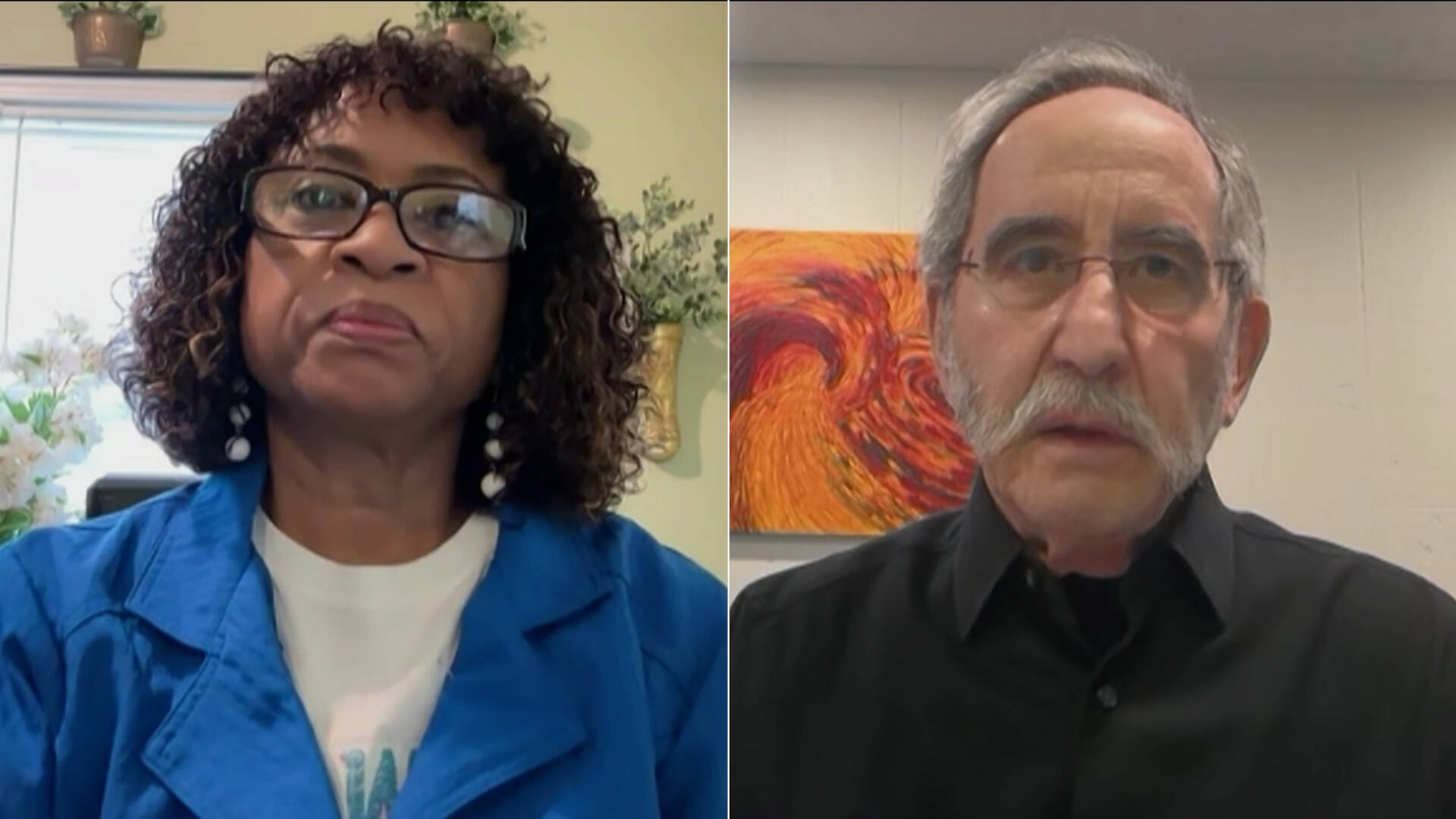
Democrat Scott Colom has defeated incumbent Cindy Hyde-Smith to become Mississippi’s first African American senator since the post-Civil War Reconstruction era. The electoral breakthrough is particularly meaningful given Mississippi’s history in the civil rights movement. In 1964, three civil rights activists — James Chaney, Michael Schwerner and Andrew Goodman — were murdered by the Ku Klux Klan after traveling to the state to register Black voters. We speak with two of their relatives about Colom’s stunning upset.</p> <p>“I believe that people were voting for help. And they evidently saw something in Mr. Colom that made them feel like that they could hope again and that he was the help that was needed,” says Angela Lewis, the daughter of James Chaney.</p> <p>“The people of Mississippi have spoken,” adds David Goodman, the brother of Andrew Goodman. “And we have to cease and desist this divide-and-conquer business, because it’s not in our collective interest as the United States of America.”
Democrat Scott Colom has made history as Mississippi’s first Democratic senator since 1982 — and its first African American senator since the post-Civil War Reconstruction era. Colom narrowly defeated Republican incumbent Senator Cindy Hyde-Smith in a state that President Trump won by nearly 23 points in 2024. Colom’s victory brings the incoming Senate Democratic caucus to 55. Colom gave his victory speech on Wednesday at the historically Black Tougaloo College, just miles from where civil rights activist Medgar Evers was murdered in 1963 by a member of the Ku Klux Klan.</p> <p>“There were times that I couldn’t get donors to answer the phone; they did not believe a moment like this was possible. But I kept the faith,” said Colom. “There are so many people that had faith in Mississippi at times where it seemed impossible, people like Medgar Evers.”
Colom's win is a boost to the Democratic Party as it seeks to gain a larger foothold in the South.
<p>Michele Goodwin</p> <div><img alt="" src="https://www.thenation.com/wp-content/uploads/2026/11/GettyImages-2304710396.jpeg" /></div> <div> <div class="wp-block-the-nation-dek article-title__dek"> <p>The Mississippi Democrat’s win is more than a joyous occasion—it’s redemption.</p> </div> </div> <p>The post <a href="https://www.thenation.com/article/society/scott-colom-historic-victory/">Scott Colom’s Historic Victory</a> appeared first on <a href="https://www.thenation.com">The Nation</a>.</p>