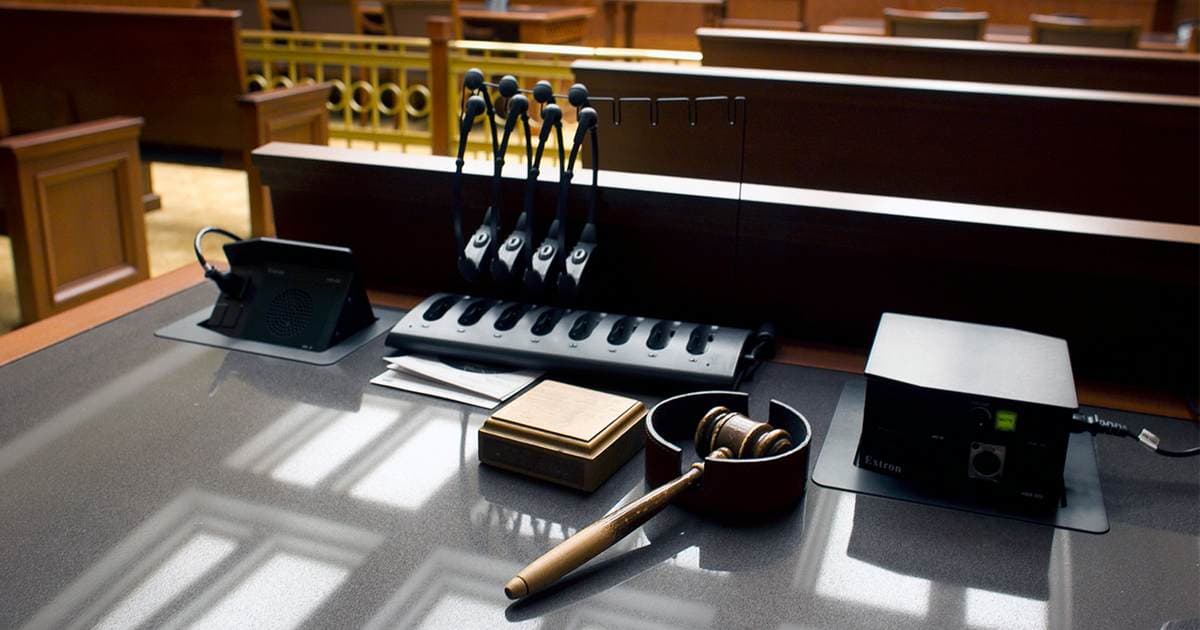
 A courtroom setting reflecting the legal battle between DOJ and federal judges.
DOJ Seeks Misconduct Probe of Judges Who Criticized ICE Surge
Left says
- •Judges spoke publicly only after an unprecedented surge of immigration enforcement overwhelmed their courthouse, and they framed their comments as defending judicial independence and the rule of law rather than prejudging specific cases.
- •Filing a misconduct complaint against judges for speaking to the press sets a chilling precedent that could discourage any judicial criticism of executive branch conduct, regardless of its merit.
- •The complaint follows a broader pattern of the administration using DOJ power to retaliate against perceived critics, including other federal judges who have ruled against immigration policies.
- •A separate ruling found ICE detention conditions in New York were 'inhumane and unconstitutional' and that officials misled the court, suggesting judicial concerns about the immigration crackdown are grounded in documented abuses, not partisan bias.
Right says
- •Judicial ethics rules, specifically Canon 3, prohibit judges from publicly commenting on pending cases or making political statements about matters before them, and seven judges speaking to the same newspaper raises legitimate concerns about coordinated messaging.
- •Judges are expected to be neutral arbiters, and when they grant extensive on-the-record interviews criticizing a specific administration policy, it undermines public confidence that they can rule impartially on related cases.
- •The DOJ's request that these judges recuse themselves from DHS-related matters is a reasonable remedy given their public statements, not an attempt to silence legitimate judicial administration concerns.
- •Referring the matter to the Eighth Circuit's Judicial Council for investigation is the appropriate, established process for addressing alleged judicial misconduct rather than an extraordinary attack on the judiciary.
Common Take
High Consensus- Seven Minnesota federal judges spoke to the New York Times about the impact of the immigration enforcement surge on their court, with some speaking on the record and others anonymously.
- Federal judicial ethics rules, including Canon 3, restrict judges from publicly commenting on the merits of pending litigation.
- The DOJ complaint names Judges Patrick Schiltz and John Tunheim specifically and asks the Eighth Circuit's Judicial Council to investigate and consider recusal from DHS-related cases.
- This dispute reflects a broader and ongoing tension between the Trump administration and the federal judiciary over immigration enforcement policy.
The Arguments
Right argues
Canon 3 of the Code of Conduct for U.S. Judges explicitly bars judges from publicly commenting on pending cases or making political statements on matters before them, and seven judges from the same district speaking on the record to one newspaper about an ongoing enforcement surge raises legitimate questions about whether that line was crossed.
Left counters
The judges framed their remarks as defending judicial independence and courthouse functioning under an unprecedented caseload surge, not as prejudging any specific case's merits, which is a distinction Canon 3 itself preserves for discussing court administration.
Left argues
Filing a formal misconduct complaint against sitting judges for talking to reporters establishes a precedent that could chill any judicial commentary on executive overreach, discouraging judges from ever flagging systemic problems regardless of how well-documented those problems are.
Right counters
Using the established Judicial Council referral process is not an attack on speech generally; it's the designated mechanism for adjudicating exactly this kind of alleged ethical breach, and judges remain free to raise administrative concerns through proper channels like formal court filings or conferences with court leadership.
Left argues
A separate federal ruling found ICE detention conditions 'inhumane and unconstitutional' and that officials misled the court about compliance, which lends credibility to the idea that judicial alarm about the immigration surge reflects documented abuses rather than partisan animus.
Right counters
That ruling, however damning, is a distinct legal proceeding with its own evidentiary record; it doesn't resolve whether the Minnesota judges violated ethics rules by discussing pending matters with a reporter, which is a separate question about judicial conduct, not about ICE's conduct.
Right argues
When judges grant extensive on-the-record interviews criticizing a specific administration's policy while related cases are still pending, it reasonably undermines public confidence that those judges can rule impartially, making recusal from DHS-related matters a proportionate response rather than retaliation.
Left counters
Demanding recusal from an entire category of cases based on public statements about court administration sets an alarmingly low bar that could be weaponized any time judges or the DOJ disagree, effectively letting the executive brand judges 'biased' whenever they describe the impact of policy on their courts.
Left argues
The complaint fits a broader pattern of the administration using DOJ authority to target perceived critics, including other federal judges who ruled against immigration policies, suggesting the motive is retaliatory rather than a genuine ethics concern.
Right counters
Pointing to a pattern of DOJ scrutiny doesn't negate the specific ethical question at hand; seven judges speaking to the same outlet about the same contested policy is a factual circumstance that independently warrants review regardless of what else the DOJ has done elsewhere.
Challenge Questions
These questions target genuine internal contradictions — meant to provoke honest reflection.
Right asks Left
“If judicial commentary to the press is acceptable when it concerns 'court administration' under executive pressure, what principled line distinguishes that from commentary that effectively signals how a judge views the merits of a contested policy still being litigated?”
Left asks Right
“If seven judges independently describing caseload strain to a reporter is sufficient grounds for a misconduct complaint and recusal demands, what would prevent any administration from using the same tactic to pressure or remove judges whenever judicial criticism, however restrained, proves politically inconvenient?”
Outlier Report
Left Fringe
Commentators like those at Democracy Docket or MSNBC legal analysts (e.g., Joyce Vance) who frame this as part of an authoritarian pattern threatening judicial independence outright; roughly 15-20% of the left holds this most alarmist framing.
Right Fringe
Outlets like RedState and commentators such as Mark Levin who frame the judges' comments as proof of a coordinated partisan judiciary conspiring against Trump policy, warranting removal or disciplinary action beyond just recusal; represents roughly 20-25% of the right.
Noise Assessment
High amplification relative to actual public awareness—this is largely an elite legal/media controversy with outsized social media and cable news attention versus limited broad public engagement or polling.
Sources (7)
<p>The Justice Department filed a complaint against a group of federal <a href="https://www.axios.com/2025/11/09/doj-blanche-war-activist-judges-dc-bar-associations" target="_blank">judges</a> from Minnesota for speaking to The New York Times about the impact of the <a href="https://www.axios.com/local/twin-cities/2026/02/04/minnesota-immigration-withdrawal-tom-homan" target="_blank">immigration enforcement</a> surge on their court. </p><p><strong>The big picture: </strong>The complaint opens a new front in the <a href="https://www.axios.com/politics-policy/donald-trump" target="_blank">Trump</a> administration's standoff with federal judges, bolstered by a loyal Justice Department.</p><hr /><p><strong>Driving the news:</strong> The <a href="https://www.justice.gov/opa/media/1463401/dl" target="_blank">complaint</a>, which was brought against two jurists who spoke on the record with the paper and those who spoke anonymously, alleged the behavior was "improper and unethical" and called for the judges to be recused from any DHS-related matters.</p><ul><li>It further urged the Eighth Circuit to investigate.</li><li>The chambers of the named senior district judges, Patrick J. Schiltz and John R. Tunheim, did not immediately respond to Axios' request for comment.</li></ul><p><em>This is a breaking news story and will be updated.</em></p>
<p>A federal judge slammed ICE for what he called "inhumane and unconstitutional" conditions at a New York City <a href="https://www.axios.com/2025/03/23/immigration-detention-overcrowding-trump" target="_blank">detention center</a> and issued a permanent injunction imposing sweeping standards on the facility.</p><p><strong>Why it matters:</strong> The ruling echoes other court decisions tied to President <a href="https://www.axios.com/politics-policy/donald-trump" target="_blank">Trump's</a> rapid expansion of immigration arrests and <a href="https://www.axios.com/2026/08/05/trump-deportation-costs-taxpayers" target="_blank">detention</a>.</p><hr /><ul><li>Kaplan found that ICE had repeatedly ignored his previous orders and misled the court about its compliance, saying officials had sometimes "intentionally concealed or recklessly disregarded the truth."</li></ul><p><strong>What they're saying: </strong>"The conditions of confinement to which ICE subjected immigration detainees at 26 Fed during the summer of 2025 were inhumane and unconstitutional," U.S. District Judge Lewis A. Kaplan wrote in a scathing 127-page <a href="https://www.nysd.uscourts.gov/sites/default/files/2026-09/Opinion%20%28Dkt%20186%29.pdf" target="_blank">opinion</a>.</p><ul><li>"By detaining far more persons in the hold rooms than ever was intended and for far longer than ever was intended, ICE objectively deprived detainees of sleep, sanitary living conditions, basic personal hygiene needs, sufficient food and water, and adequate medical care."</li></ul><p><strong>Catch up quick: </strong>The holding rooms at 26 Federal Plaza in NYC are meant to be short-term facilities that house detained immigrants for "12 hours or less," but ICE routinely held people for extended periods.</p><ul><li>"Fed 26 is not unique," Kaplan wrote, noting that "comparable litigation" has been brought against other facilities.</li><li>26 Federal Plaza's immigration court didn't immediately respond to Axios' request for comment. </li></ul><p><strong>Zoom in: </strong>Kaplan said the "overwhelmed" center "confined many of those arrested in <a href="https://www.axios.com/local/miami/2025/03/27/miami-ice-facility-overcrowding-poor-conditions" target="_blank">overcrowded</a>, squalid, and degrading rooms for excessive periods of time."</p><ul><li>He also noted that detained immigrants were "severely restricted" from accessing counsel in a "meaningful way," and that those who were able to make phone calls could do so for only a few minutes at a time.</li><li>ICE staff or contractors were typically close enough to overhear phone conversations, leaving at least one person "fearful and powerless" and scared of "speak[ing] freely."</li></ul><p><strong>The other side:</strong> "Detainees are only at <a href="https://www.google.com/maps/search/26%2BFederal%2BPlaza?entry=gmail&source=g" target="_blank">26 Federal Plaza</a> for a short period while they are being processed and awaiting transfer," a DHS spokesperson told Axios in an emailed statement.</p><ul><li>"Ensuring the safety, security, and well-being of individuals in ICE custody remains a top priority. ICE is using a range of strategies, including transferring detainees to facilities with available capacity, expediting case processing where appropriate, and coordinating with federal, state, and local partners to support continued oversight and accountability."</li><li>"ICE also remains committed to providing necessary medical care, access to legal resources, and safe living conditions for all individuals in its custody.</li><li>"Being in detention is a choice," the spokesperson said, adding that undocumented people can self-deport through the CBP Home App. </li></ul><p><strong>The intrigue:</strong> Kaplan said ICE's disregard of previous court-ordered capacity limits had been "persistent, egregious, and, at a minimum, reckless, if not willful."</p><p><strong>What's inside: </strong>The court's permanent <a href="https://storage.courtlistener.com/recap/gov.uscourts.nysd.647291/gov.uscourts.nysd.647291.187.0.pdf" target="_blank">injunction</a> requires ICE to provide at least 50 square feet of qualifying floor space per person — excluding space within eight feet of a toilet — and keep hold rooms between 68 and 74 degrees Fahrenheit.</p><ul><li>Kaplan also required ICE to provide detainees three daily meals, each with bottled water, and adequate supplies of soap, toilet paper, and oral and feminine hygiene products. Immigrants held overnight must receive a clean bedding mat or mattress, pillow and blanket.</li><li>He also directed ICE to keep a licensed medical professional on-site at all times, and provide detainees with a basic medical screening to identify and begin treating any acute or chronic medical conditions.</li><li>ICE must also give immigrants a way to make confidential, unmonitored and free telephone calls to their attorneys or potential attorneys.</li></ul><p><strong>Zoom out: </strong>The ruling highlights growing tensions between the courts and Trump's aggressive immigration crackdown.</p><ul><li>The administration insists that <a href="https://www.axios.com/2026/05/06/trump-ice-immigration-detention-court-ruling-florida" target="_blank">nearly all</a> unlawfully present noncitizens it arrests are incarcerated pending removal proceedings, putting the policy on a collision course with limited detention capacity.</li><li>More than <a href="https://www.politico.com/news/2026/01/05/trump-administration-immigrants-mandatory-detention-00709494" target="_blank">300 judges</a> have rebuffed Trump's mandatory detention policy, with many ruling it is illegal or unconstitutional. </li><li>Some immigration advocates say the goal is likely to make detention so brutal that immigrants are willing to <a href="https://www.axios.com/2026/07/28/trump-self-deportation-ice" target="_blank">self-deport</a> immediately rather than endure harsh conditions for years while fighting their cases.</li></ul><p><strong>Go deeper:</strong> <a href="https://www.axios.com/2026/05/06/trump-ice-immigration-detention-court-ruling-florida" target="_blank">Trump's mandatory detention policy fails in Florida appeals court</a></p><p><em>Editor's note: This story has been updated with a statement from DHS. </em></p>
Judge Patrick J. Schiltz had warned that the administration’s actions “created a grave threat to the rule of law.” The attorney general accused him of “obvious bias.”
The Department of Justice (DOJ) on Wednesday took the remarkable step of seeking to censure both a former and sitting federal judge in Minnesota after the pair spoke to The New York Times about the Trump administration’s immigration surge in the state. The two judges are Patrick Schiltz, an appointee of former President George W.…
Several judges spoke to the New York Times about their concerns around the immigration crackdown. One judge Wednesday defended his decision to speak publicly as “well within the ethical rules.”