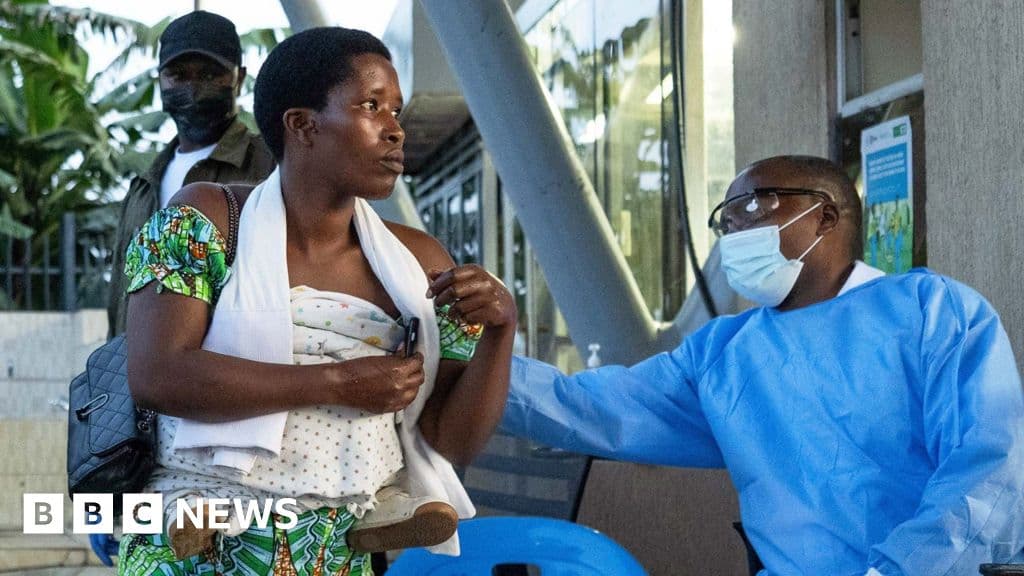
Ebola Outbreak May Be Spreading Faster Than WHO First Thought
Left says
- •The dismantling of USAID and withdrawal from WHO has left the U.S. unprepared to respond effectively to international health emergencies
- •Gutted public health workforces and reduced international cooperation capabilities mean the world is facing this crisis with 'both hands tied behind our backs'
- •The outbreak highlights how inadequate global health infrastructure and delayed detection systems put vulnerable populations at greater risk
- •Without proper international coordination and support, this outbreak could escalate to the scale of the devastating 2014-2016 West Africa epidemic that killed over 11,000 people
Right says
- •The risk to Americans remains low, and appropriate travel restrictions and enhanced screening measures have been implemented to protect U.S. citizens
- •President Trump has expressed appropriate concern about the outbreak while emphasizing that it remains confined to Africa for now
- •The outbreak demonstrates the importance of strong border controls and screening procedures to prevent international disease spread
- •Swift action by health authorities to issue travel advisories and implement protective measures shows the system is working to contain the threat
Common Take
High Consensus- The Ebola outbreak has killed over 130 people and infected more than 500 in the Democratic Republic of Congo and Uganda
- This particular strain (Bundibugyo) has no approved vaccine, making containment more challenging than previous outbreaks
- The outbreak appears to have been spreading undetected for weeks or months before being properly identified
- The affected region's conflict, population movement, and limited healthcare infrastructure complicate response efforts
The Arguments
Left argues
The dismantling of USAID and withdrawal from WHO has fundamentally weakened America's ability to respond to international health emergencies, leaving the world to face this crisis 'with both hands tied behind our backs' according to pandemic experts.
Right counters
The risk to Americans remains low and appropriate protective measures including travel restrictions and enhanced screening have been swiftly implemented, demonstrating that the current system is effectively protecting U.S. citizens.
Right argues
President Trump has expressed appropriate concern about the outbreak while emphasizing that it remains confined to Africa, and swift implementation of travel advisories and screening procedures shows the protective system is working as intended.
Left counters
The outbreak may have been spreading undetected for weeks or months, with modeling suggesting over 1,000 cases may already exist, indicating that current detection and response systems are inadequate to prevent another devastating epidemic like the 2014-2016 West Africa outbreak that killed over 11,000 people.
Left argues
Gutted public health workforces and reduced international cooperation capabilities mean the global community lacks the tools for effective contact tracing and outbreak response that are essential to containing Ebola spread.
Right counters
Strong border controls and screening procedures are the most effective way to prevent international disease spread, and the current travel restrictions demonstrate that America can protect itself without extensive international entanglements.
Right argues
The outbreak demonstrates the critical importance of maintaining strong border security and travel restrictions, as the virus spreading from conflict-torn regions with poor health infrastructure poses a direct threat that requires immediate protective barriers.
Left counters
Without proper international coordination and support for affected regions, isolated protective measures cannot prevent a localized outbreak from escalating into a global pandemic, as demonstrated by the 2014 West Africa epidemic that eventually reached multiple continents.
Challenge Questions
These questions target genuine internal contradictions — meant to provoke honest reflection.
Right asks Left
“If international cooperation and USAID involvement are so critical for containing outbreaks, why did the 2014-2016 West Africa Ebola epidemic—which occurred during a period of robust international health infrastructure—still become the deadliest Ebola outbreak in history, killing over 11,000 people despite extensive WHO and USAID involvement?”
Left asks Right
“If travel restrictions and border controls are sufficient to protect Americans, how do you reconcile this position with the fact that the 2014 Ebola outbreak eventually reached the United States despite existing screening measures, and that experts warn this current outbreak may have already spread undetected across multiple countries and provinces?”
Outlier Report
Left Fringe
Progressive activists like Congresswoman Alexandria Ocasio-Cortez and public health advocates like Dr. Peter Hotez who frame this primarily as a failure of Trump's dismantling of international health infrastructure. Represents roughly 15% of the left.
Right Fringe
Anti-globalist commentators like Alex Jones and some America First supporters who might advocate for complete border closure or conspiracy theories about WHO manipulation. Represents roughly 10% of the right.
Noise Assessment
Moderate noise level - most discourse focuses on legitimate policy debates about preparedness versus protection, though some amplification occurs around Trump administration health policy changes.
Sources (10)
Hundreds of cases are suspected in central Africa but experts fear the actual number may be much higher.
<p>The ongoing <a href="https://www.axios.com/2022/10/07/ebola-outbreak-uganda-vaccine-treatment-fatality-rate" target="_blank">Ebola</a> surge has <a href="https://www.axios.com/2026/05/13/hantavirus-response-raises-readiness-concerns" target="_blank">public health experts</a> anxious about the world's capacity to contain its spread.</p><p><strong>The big picture: </strong>Ebola epidemics aren't new, but the current outbreak has been identified as the rare Bundibugyo strain, which has no vaccine, and is located in a populated, mobile and conflict-stricken part of the world.</p><hr /><ul><li>Thirty cases have been confirmed in the Democratic Republic of Congo (DRC), while two confirmed cases, including one death, have been recorded in Uganda from people who traveled from the DRC, WHO Director General Tedros Adhanom Ghebreyesus said Monday.</li><li>There are more than 500 suspected cases and 130 suspected deaths, he said. One American working in the DRC <a href="https://www.washingtonpost.com/health/2026/05/18/ebola-outbreak-prompts-us-screen-travelers-airports-other-ports-entry/" target="_blank">tested</a> positive and is being taken to Germany for treatment, the CDC confirmed Monday.</li><li>The World Health Organization has deemed the outbreak a <a href="https://apps.who.int/gb/bd/pdf_files/IHR_2014-2022-2024-en.pdf" target="_blank">public health emergency of international concern</a>.</li></ul><p><strong>Context:</strong> Nasia Safdar, an infectious diseases physician and professor at the University of Wisconsin-Madison, tells Axios that Ebola concerns her more than the recent <a href="https://www.axios.com/2026/05/13/hantavirus-response-raises-readiness-concerns" target="_blank">hantavirus</a> outbreak, noting the cruise ship environment where it spread is very different than the outside world. </p><ul><li>Only one hantavirus strain is known to spread human-to-human, but four <a href="https://www.cdc.gov/ebola/about/index.html" target="_blank">Ebola strains</a> cause illnesses in people, per the CDC. Hantavirus rarely spreads among people, but public health experts pointed to the recent outbreak as evidence that more research is needed into its spread.</li><li>Once <a href="https://www.cdc.gov/ebola/causes/index.html" target="_blank">spillover</a> to humans occurs, the Ebola virus is challenging to contain and <a href="https://pmc.ncbi.nlm.nih.gov/articles/PMC12368420/" target="_blank">regularly</a> leads to the most life-threatening cases of viral hemorrhagic fevers. A <a href="https://www.who.int/emergencies/situations/ebola-outbreak-2014-2016-West-Africa" target="_blank">2014-2016 surge</a> in West Africa infected more than 28,600 people and killed 11,325, per the WHO. </li><li>The fatality rates in the past two Ebola outbreaks have ranged from 30-50%.</li></ul><p><strong>What they're saying: </strong>This particular Ebola outbreak is troubling, says Jennifer Nuzzo, the director of the Pandemic Center at Brown University School of Public Health.</p><ul><li>"Many people are worried that we could have another 2014 situation on our hands. That was the largest, deadliest outbreak of Ebola on record, and the conditions on the ground and the lack of tools to combat this particular Ebola virus make people very worried that we could see similar circumstances happen again," Nuzzo says.</li><li>There was also an <a href="https://www.nytimes.com/2026/05/18/world/africa/congo-ebola-testing.html" target="_blank">apparent delay</a> in health authorities acknowledging the spread.</li><li>"We actually don't know how large the situation already is, but it's certainly poised to become much, much larger," she says.</li></ul><p><strong>Reality check:</strong> The <a href="https://www.cdc.gov/media/releases/2026/cdc-mobilizes-international-ebola-response.html" target="_blank">risk</a> to the American public remains low, but travel restrictions for those without U.S. passports coming from Uganda, DRC and South Sudan were <a href="https://www.cdc.gov/ebola/situation-summary/title-42-order.html" target="_blank">announced</a> Monday, along with enhanced port health protection response strategies. </p><p><strong>Friction point: </strong>While neither the Ebola or hantavirus outbreaks have been labeled pandemics, general public health reforms have not kept up with the rising pandemic risk, a <a href="https://gpmb.org/reports/m/item/a-world-on-the-edge-2026-report" target="_blank">report</a> released Monday by the Global Preparedness Monitoring Board, co-convened by the WHO and World Bank, warned.</p><ul><li>Nuzzo is concerned about what <a href="https://www.axios.com/2025/03/28/usaid-reorganization-department-of-state" target="_blank">dismantling USAID</a>, which had helped <a href="https://x.com/JeremyKonyndyk/status/2056212760015356243" target="_blank">lead</a> past international responses to disease outbreaks, means for on-ground support for contact tracing and other efforts that she says "are really the only tools we have at this point to stop the spread."</li><li>She added: "Trying to combat these very serious emergencies with a gutted public health workforce, and with fewer tools — it's like we're basically leaning into them with both hands tied behind our backs."</li></ul><p><strong>Go deeper: </strong><a href="https://www.axios.com/local/columbus/2026/03/18/ohio-state-covid-19-pandemic-research-history" target="_blank">Why we don't talk about COVID anymore</a></p>
The health minister has acknowledged that medics are playing catch-up with the virus after being slow to detect it.
<p>As the world watches an Ebola outbreak which has claimed 131 lives in the Democratic Republic of Congo, a World Health Organization (W.H.O). representative warned Tuesday the deadly malady may be disseminating faster than first thought.</p> <p>The post <a href="https://www.breitbart.com/europe/2026/05/19/nobody-panic-yet-w-h-o-fears-ebola-may-be-spreading-faster-and-further-than-first-thought/" rel="nofollow">Nobody Panic (Yet) — W.H.O Fears Ebola May Be Spreading Faster and Further Than First Thought</a> appeared first on <a href="https://www.breitbart.com" rel="nofollow">Breitbart</a>.</p>
<p>President Donald Trump said on Monday he was “concerned” about the Ebola outbreak in the Democratic Republic of the Congo (DRC), because it could have a “breakout” beyond the current infection area.</p> <p>The post <a href="https://www.breitbart.com/africa/2026/05/19/trump-concerned-about-congo-ebola-outbreak-as-fatalities-rise-to-131/" rel="nofollow">Trump ‘Concerned’ About Congo Ebola Outbreak as Fatalities Rise to 131</a> appeared first on <a href="https://www.breitbart.com" rel="nofollow">Breitbart</a>.</p>
The State Department on Tuesday strongly urged Americans to avoid travel to Congo, Uganda and South Sudan because of the Ebola outbreak there. More than 130 people have already died. Mark Strassmann has more.
Officials suspect the disease has caused 80 deaths in the Democratic Republic of Congo so far.
By the time the American surgeon who contracted Ebola was flown to Germany, he was barely able to stand on his own, according to leaders of the Christian missionary group where he worked.
The world is already playing catch-up to a deadly disease.
The State Department “strongly” urged U.S. citizens on Tuesday against traveling to several nations impacted by a growing Ebola outbreak.  The department advised Americans not to visit Democratic Republic of the Congo (DRC), South Sudan and Uganda “for any reason.” Additionally, the department recommended that people “reconsider travel” to Rwanda.  The Centers for Disease Control…