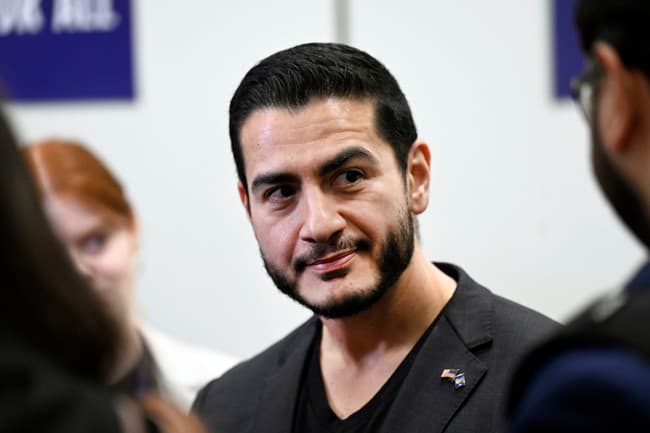
 Abdul El-Sayed speaking with attendees at a campaign event.
El-Sayed's 'Ogre on a Pike' Remark Sparks Sexism Accusations
Intra-Party Split Detected
Democratic primary pits progressive Abdul El-Sayed against moderate Haley Stevens, dividing the party over Medicare for All, Israel policy, outside spending (including AIPAC-linked funds), and electability, with figures like Neera Tanden and Gretchen Whitmer weighing in on opposing sides.
Left says
- •El-Sayed clarified during the debate that the 'ogre on a pike' remark referred to Sen. John Fetterman, whom progressives view as having abandoned his campaign values by embracing hawkish pro-Israel positions, not to Haley Stevens.
- •El-Sayed has publicly called for civility toward Stevens, including telling his own supporters to stop mocking her accent, undercutting claims he's fostering sexist rhetoric.
- •The controversy risks overshadowing El-Sayed's substantive critique of nearly $30 million in AIPAC-affiliated outside spending backing Stevens, which he argues compromises independence on Israel policy.
- •Progressives see this as part of a broader pattern where establishment Democrats and centrist figures like Neera Tanden seize on ambiguous language to discredit insurgent, anti-establishment candidates.
Right says
- •El-Sayed's leaked comments reveal a winner-take-all, primary-your-own-party mentality that many Democrats, including centrists like Neera Tanden, found alarming and divisive.
- •Stevens and her campaign argue the remark reflects a broader pattern of El-Sayed prioritizing personal attacks and national political celebrity over substantive representation of Michigan voters.
- •Even after El-Sayed's clarification, critics note the ambiguity of the remark reasonably led many to initially believe it targeted his female opponent, raising legitimate concerns about tone in the race.
- •Stevens's pointed line — thanking El-Sayed for 'clarifying' he didn't call her an ogre — underscores skepticism that his explanation fully resolves the controversy.
Common Take
High Consensus- El-Sayed stated during the debate that his 'ogre on a pike' comment referred to Sen. John Fetterman, not Haley Stevens.
- The remark originated from leaked audio of a Zoom donor call published by Politico shortly before the debate.
- El-Sayed has publicly asked his supporters to stop making unkind comments about Stevens, including remarks about her accent.
- The debate also centered on substantive policy disputes, including outside spending tied to AIPAC and differing positions on U.S. military aid to Israel.
The Arguments
Left argues
El-Sayed clearly stated the 'ogre' remark referred to Sen. John Fetterman's abandonment of progressive values on Israel, not Haley Stevens, and this context is corroborated by his broader comments about primarying figures like Fetterman.
Right counters
The remark was made in a call about El-Sayed's own Senate race and his willingness to fight opponents who spend big against him, so it was reasonable for listeners—including Stevens's own campaign—to initially assume it targeted her, especially given the timing and lack of explicit context in the original audio.
Right argues
The leaked audio reveals a winner-take-all mentality where El-Sayed explicitly relishes primarying fellow Democrats and using violent imagery to intimidate the party, a tone even centrist Democrats like Neera Tanden found alarming regardless of who the 'ogre' referred to.
Left counters
Aggressive rhetoric about primary challenges is a normal feature of intra-party ideological battles, and progressives argue the outrage is selectively applied to insurgent candidates while establishment figures' hardball tactics go unremarked upon.
Left argues
El-Sayed has taken concrete, public steps to promote civility—explicitly asking his supporters to stop mocking Stevens's accent—which undercuts the narrative that he is fostering or tolerating sexist rhetoric in his campaign.
Right counters
A single civility appeal doesn't erase the pattern Stevens's campaign points to, where El-Sayed's rhetoric repeatedly veers into personal insult territory, making his critics skeptical that one tweet resolves the deeper concern about his tone.
Right argues
Stevens's biting line—thanking El-Sayed for 'clarifying' he didn't call her an ogre—captures legitimate public skepticism that his after-the-fact explanation fully neutralizes the damage of comments that plausibly could have been about her.
Left counters
Political opponents routinely exploit ambiguous statements for maximum rhetorical damage in the final days before a primary, and Stevens's quip is itself a calculated attack line rather than a neutral assessment of the facts.
Left argues
The controversy over one leaked phrase risks eclipsing El-Sayed's substantive policy argument that nearly $30 million in AIPAC-affiliated spending compromises Stevens's independence on Israel policy, a matter of real consequence for voters.
Right counters
Voters are entitled to weigh candidates' tone and temperament alongside policy substance, and Stevens's campaign argues El-Sayed's own conduct—prioritizing national culture-war fights over Michigan-specific concerns—is itself a legitimate substantive critique, not a distraction.
Challenge Questions
These questions target genuine internal contradictions — meant to provoke honest reflection.
Right asks Left
“If El-Sayed's 'ogre' comment was clearly about Fetterman and not sexist, why did he feel compelled to separately and publicly ask his supporters to stop mocking Stevens's accent—doesn't that suggest a broader tone problem in his campaign independent of this one remark?”
Left asks Right
“If critics acknowledge that El-Sayed's clarification about Fetterman is plausible, why does coverage and criticism continue to treat the incident as a definitive sexism controversy rather than an ambiguous remark that was resolved once its target was clarified?”
Outlier Report
Left Fringe
Progressive commentators and outlets sympathetic to El-Sayed's anti-AIPAC framing (e.g., some DSA-aligned social media voices) who dismiss the sexism accusation entirely as bad-faith establishment attack; roughly 15-20% of the left.
Right Fringe
Commentators like those at RedState and some conservative pundits who amplify the 'ogre' remark as proof of broader Democratic Party dysfunction/sexism, using it opportunistically rather than out of genuine concern for Stevens; roughly 20-25% of the right.
Noise Assessment
High noise ratio - much of the controversy is amplified by partisan actors (Tanden's tweet, RedState's framing) for strategic messaging within an intra-Democratic primary fight, rather than reflecting deep public engagement with the substance.
Sources (11)
Abdul El-Sayed and Rep. Haley Stevens clashed on outside spending and electability in their last debate before Michigan's Democratic primary next week.
The final Democratic Senate debate before next week’s Michigan primary was overshadowed Monday night by Abdul El-Sayed’s recently leaked comments about putting the head of an “ogre” on a pike, as rival Rep. Haley Stevens argued the far-Left candidate was more interested in national political fights than representing Michigan. The confrontation came just hours after ...
At the final debate before next week’s Democratic primary for Senate, Dr. Abdul El-Sayed and Representative Haley Stevens showcased their wildly different ideological stances and political styles.
The two faced off in the final Michigan Democratic primary debate hours after POLITICO published a leaked recording of El-Sayed.
The Michigan Senate candidate saw immediate backlash from within his own party amid a tense primary that has divided progressives and moderate Democrats.
<p>El-Sayed says in TV debate ‘ogre on a pike’ Zoom comment was in reference to John Fetterman, not Haley Stevens</p><p>The Michigan Democratic Senate candidate Abdul El-Sayed said his comments that progressives need to put the head of an “ogre” on a pike was in reference to the US senator John Fetterman – not his opponent, representative Haley Stevens.</p><p>In a televised debate on Monday, the final head-to-head before the state’s 4 August primary, the moderator asked El-Sayed whether he regretted his comments made in a Zoom meeting, in which, according to leaked audio published by Politico, he suggested that if “you put one ogre on a pike, and then everyone else gets the message”.</p> <a href="https://www.theguardian.com/us-news/2026/jul/27/michigan-abdul-el-sayed-debate-ogre">Continue reading...</a>
Rep. Haley Stevens (D-Mich.) and former Wayne County health director Abdul El-Sayed squared off in their second one-on-one debate to replace retiring Sen. Gary Peters (D-Mich.) — just one week out from the Aug. 4 Democratic Senate primary.   The duo clashed once again over corporate influence and support for Israel, with El-Sayed hammering Stevens over the tens of millions of dollars pouring into the…
Republicans have 100 days to sink the newly-minted Democratic Maine Senate nominee — and they're throwing everything they have at him.
Abdul El-Sayed warned Monday in the final debate with Rep. Haley Stevens that a vote for her in next week's primary is a vote for the same corporations, billionaires and special-interest groups that he says have left the working class suffering.