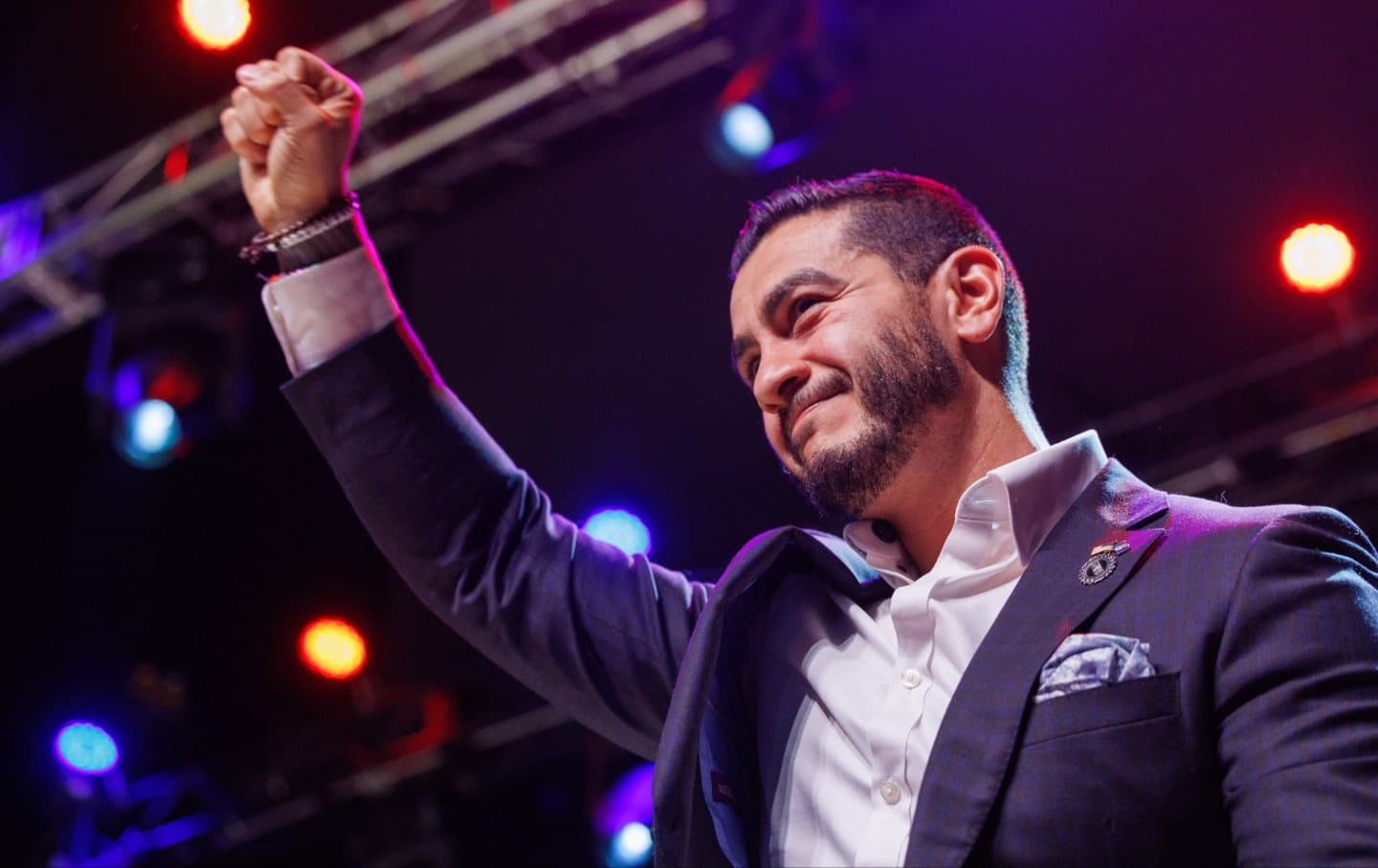
 Abdul El-Sayed raises his fist in celebration on election night.
El-Sayed's Upset Win Sparks AIPAC Backlash and Islamophobia Charges
Intra-Party Split Detected
Progressive/democratic-socialist wing (backed by Sanders, AOC, UAW, DSA-aligned groups) defeated the AIPAC-backed establishment centrist candidate Haley Stevens, exposing a deep rift between the Democratic establishment and its left flank over Israel policy, corporate/PAC money, and party direction.
Left says
- •El-Sayed's win represents a broader progressive sweep in Michigan, alongside Donovan McKinney and Will Lawrence, showing the party's left flank overpowering corporate-backed rivals despite record spending against them.
- •AIPAC and allied super PACs poured a record-breaking $30-70 million into defeating El-Sayed, and his victory despite this spending disparity signals waning establishment and pro-Israel lobby power within the Democratic base.
- •Attacks on El-Sayed, including Trump calling Democrats' embrace of Muslim candidates an election of 'jihadists' and use of his full name by the NRSC, reflect a pattern of Islamophobic rhetoric targeting Muslim politicians as they gain prominence.
- •El-Sayed's platform centering Palestinian rights and ending U.S. military aid to Israel resonated with voters amid shifting American sentiment on Israel and Gaza, and his win is seen as a landmark for the pro-Palestine movement.
- •Party leaders like Whitmer, Stevens, and Harris quickly rallied behind El-Sayed post-primary, illustrating a shift toward unifying around progressive nominees rather than repeating past establishment refusals to endorse figures like Zohran Mamdani.
Right says
- •El-Sayed's narrow win, closer than polls predicted, raises questions about whether a candidate with his positions and associations can hold a competitive swing-state Senate seat in the general election against Republican Mike Rogers.
- •Trump and other Republicans characterize El-Sayed as a radical figure hostile to Israel and describe his win as favorable for the GOP, framing it as evidence Democrats are drifting toward extremism.
- •Concerns are raised about El-Sayed's past comments and his association with commentator Hasan Piker, whose remarks about 9/11 have drawn sharp criticism from Republican senators like Tommy Tuberville.
- •The Dispatch situates this race within a larger Democratic Party struggle between moderates and further-left populist or socialist-leaning candidates, questioning what this internal shift means for the party's general-election viability.
Common Take
High Consensus- El-Sayed defeated Rep. Haley Stevens by a narrow margin of roughly one percentage point in the Michigan Democratic Senate primary.
- The race became the most expensive Democratic Senate primary in U.S. history, with AIPAC-aligned spending reaching tens of millions of dollars.
- El-Sayed will face Republican Mike Rogers in the general election for the seat being vacated by Senator Gary Peters.
- If elected, El-Sayed would become the first Muslim senator in U.S. history, a milestone acknowledged across the political spectrum.
The Arguments
Left argues
El-Sayed's victory despite $30-70 million in outside spending against him shows that grassroots organizing and progressive policy positions can overcome establishment money and AIPAC's influence within the Democratic base.
Right counters
A win by roughly one percentage point despite polling that predicted a wide margin suggests the spending had a real effect and that El-Sayed's coalition is fragile, not a decisive repudiation of establishment power.
Right argues
El-Sayed's narrower-than-expected win, combined with his past comments and association with Hasan Piker, raises legitimate questions about whether his positions and associations are too far outside the mainstream to win a competitive swing-state general election against Mike Rogers.
Left counters
Attacking El-Sayed over Piker's remarks, which El-Sayed himself did not make and pushed back on as a 'gotcha,' is guilt-by-association rather than a substantive critique of his actual platform or record.
Left argues
Trump's description of Democrats electing 'jihadists,' the NRSC's deliberate use of El-Sayed's full name, and Tuberville's 9/11 comment reflect a recognizable pattern of Islamophobic rhetoric deployed against rising Muslim politicians.
Right counters
Criticizing a candidate's specific statements on Israel, Hamas, or associations with controversial commentators is a legitimate political attack on substance, not inherently bigotry, even if some rhetoric from figures like Trump is inflammatory.
Right argues
El-Sayed's win, alongside other progressive victories in Michigan, is evidence the Democratic Party is drifting toward positions—like ending military aid to Israel—that are out of step with general-election swing voters, handing Republicans a favorable contrast heading into November.
Left counters
Shifting American sentiment on Israel and Gaza, combined with rapid establishment endorsements from Whitmer, Stevens, and Harris, suggests the party is unifying around this position rather than being dragged into an unpopular extreme.
Left argues
The swift, unified endorsements from Whitmer, Stevens, and Harris after the primary signal that party leaders are now willing to rally around progressive nominees, a contrast to the establishment's earlier refusal to fully embrace Zohran Mamdani.
Right counters
Post-primary endorsements are often a matter of political necessity to preserve a competitive Senate seat rather than genuine ideological alignment, and don't erase underlying doubts about El-Sayed's general-election viability.
Challenge Questions
These questions target genuine internal contradictions — meant to provoke honest reflection.
Right asks Left
“If El-Sayed's win is framed as proof that grassroots organizing overpowers big money, how do you square that with the fact that he won by less than one point despite polls predicting a much wider margin—doesn't that suggest the massive spending against him did have a significant effect?”
Left asks Right
“If concerns about El-Sayed's associations and rhetoric are meant to be substantive policy critiques rather than identity-based attacks, why did the NRSC's first move be to spotlight his full Arabic name rather than any specific policy position?”
Outlier Report
Left Fringe
The Nation writers (Iman Abid, Aaron Regunberg) and USCPR Action activists framing this primarily through a pro-Palestine lens represent roughly 20-25% of the Democratic coalition; most Democratic primary voters likely prioritized cost-of-living and healthcare messaging over Israel-Palestine specifically.
Right Fringe
Tommy Tuberville's explicit 9/11 comments and Trump's 'jihadists'/antisemitism framing represent an aggressive minority (~25-30%) of Republican rhetoric; many establishment Republicans prefer to critique El-Sayed on socialism/policy grounds rather than religion-based attacks.
Noise Assessment
Substantial amplification from both ideological media ecosystems; actual swing/independent voters in Michigan's general election will likely focus far less on AIPAC spending totals or Islamophobia framing and more on pocketbook issues and perceived electability against Mike Rogers.
Sources (8)
Plus: The allegations against Ohio Rep. Max Miller.
As Muslim politicians like Abdul El-Sayed in Michigan have become more prominent, they have experienced considerable bigotry. President Trump said Democrats were electing “jihadists.”
Republican efforts to turn the Democratic Senate nominee into a bogeyman betray their fear
Progressive candidate Abdul El-Sayed has been declared the winner of Michigan’s closely watched Democratic Senate primary, narrowly beating out Congressmember Haley Stevens, according to the Associated Press and other news agencies. <span class="caps">AIPAC</span> and its affiliated groups spent as much as $46 million to help Stevens in what has become the most expensive Democratic Senate primary contest in U.S. history. El-Sayed will face former Republican Congressman Mike Rogers in November to fill the seat now held by Democratic Senator Gary Peters, who is retiring. If El-Sayed wins the general election, he would become the first Muslim senator in U.S. history. His key supporters included Senator Bernie Sanders, Congresswoman Alexandria Ocasio-Cortez and the United Auto Workers.</p> <p>“Dr. Abdul El-Sayed worked unbelievably hard in this race,” says John Nichols, executive editor of <em>The Nation</em>, pointing out that El-Sayed campaigned in rural counties across Michigan. “It was literally about physically going to the people early, and then again and again and again, and talking to them about issues.”</p> <p>We also speak with Andy Levin, a former Democratic congressmember from Michigan who lost to Stevens in 2022 after <span class="caps">AIPAC</span> spent $4.3 million on her campaign. El-Sayed’s rise represents “a movement of Americans who are saying, 'Enough of politics as usual,'” says Levin. “’We’re done with the parties as they are. We need some way more active effort for us to be able to have living wages and healthcare and education and childcare and retirement.’”
<p>Abdul El-Sayed narrowly defeated Rep. Haley Stevens — despite a record-setting $60 million in outside spending in her favor.</p> <p>The post <a href="https://theintercept.com/2026/08/05/michigan-primary-results-el-sayed-stevens-aipac/">Abdul El-Sayed Beats the Democratic Establishment and AIPAC in Michigan</a> appeared first on <a href="https://theintercept.com">The Intercept</a>.</p>
<p>Iman Abid</p> <div><img alt="" src="https://www.thenation.com/wp-content/uploads/2026/08/AP26217265488036.jpg" /></div> <div> <div class="wp-block-the-nation-dek article-title__dek"> <p>Even though the Palestine movement is on the march, we can’t afford any complacency.</p> </div> </div> <p>The post <a href="https://www.thenation.com/article/activism/abdul-el-sayed-aipac-win/">Abdul El-Sayed’s Win Is a Landmark. But the Fight Is Far From Over.</a> appeared first on <a href="https://www.thenation.com">The Nation</a>.</p>
<p>Aaron Regunberg</p> <div><img alt="" src="https://www.thenation.com/wp-content/uploads/2026/08/el-sayed-michigan-win-getty.jpg" /></div> <div> <div class="wp-block-the-nation-dek article-title__dek"> <p>It’s time for the Democratic establishment to take its own medicine.</p> </div> </div> <p>The post <a href="https://www.thenation.com/article/politics/el-sayed-michigan-vote-blue-no-matter-who/">Will El-Sayed’s Centrist Opponents “Vote Blue No Matter Who”?</a> appeared first on <a href="https://www.thenation.com">The Nation</a>.</p>
<p>John Nichols</p> <div><img alt="" src="https://www.thenation.com/wp-content/uploads/2026/08/AP26217550375290.jpg" /></div> <div> <div class="wp-block-the-nation-dek article-title__dek"> <p>The lessons from a primary win that can be applied to defeat a Republican in November.</p> </div> </div> <p>The post <a href="https://www.thenation.com/article/politics/abdul-el-sayed-primary-results-speech/">Abdul El-Sayed: “The Power of Our Many Is Greater Than the Power of Their Money”</a> appeared first on <a href="https://www.thenation.com">The Nation</a>.</p>