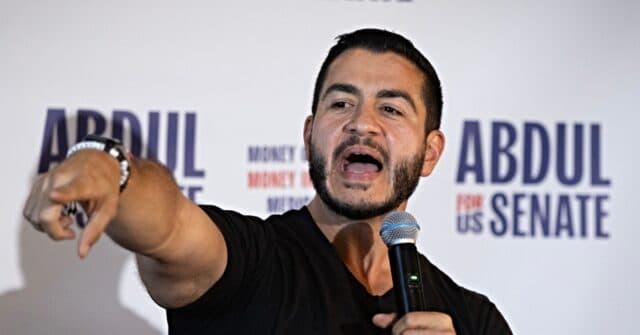
 Abdul El-Sayed speaking at a campaign event, pointing while holding microphone.
El-Sayed's Usha Vance Jab Sparks Racism, Sexism Accusations
Intra-Party Split Detected
Some Democrats and Rogers-aligned Democratic critics condemned El-Sayed's remarks as sexist and politically damaging, breaking from those defending him.
Left says
- •El-Sayed's response was directed at Vance's rhetorical framing, which suggested that anyone who disagrees with his politics is somehow less authentically American, a framing El-Sayed and his supporters see as coded questioning of his own identity as a Muslim immigrant's son.
- •El-Sayed argues Vance and Trump repeatedly single him out in ways that invoke his religion and skin color rather than engaging with his policy positions, and he sees his comment as turning that dynamic back on Vance by asking how Vance squares his 'Papaw's' era politics with his own interracial, interfaith marriage.
- •Some observers note the double standard in outrage cycles, pointing out that politicians on the right have made similarly personal jabs at opponents' families without facing the same intensity of backlash.
- •El-Sayed has not apologized, framing his remarks as a legitimate challenge to what he considers Vance's exclusionary rhetoric rather than an attack on Usha Vance's heritage.
Right says
- •El-Sayed's comment implied that Vance's white, working-class grandfather would have rejected Usha Vance because of her Indian heritage, which critics call an offensive and unfounded assumption about rural, white Americans.
- •Critics, including Republican lawmakers and commentators, argue the remark was both racially insensitive and demeaning to Usha Vance, who had no connection to Vance's original comments about Sharia law.
- •The episode follows other recent incidents, including Sen. Jon Ossoff's comment about a female Trump aide, which critics say reflects a broader pattern of Democrats making personal or gendered attacks that could alienate moderate voters.
- •Some point out the apparent contradiction in El-Sayed criticizing Vance's stance on Sharia law while his own past comments describe following Sharia as a personal lifelong obligation.
Common Take
High Consensus- Vice President Vance criticized Abdul El-Sayed's past comments linking criticism of Sharia law to white supremacy during a campaign speech referencing his grandfather.
- El-Sayed responded publicly on social media by referencing Usha Vance and the idea of her meeting Vance's grandfather, which ignited widespread backlash.
- The exchange has become part of a broader, heated debate over identity, religion, and rhetoric in the Michigan Senate race.
- Both sides agree the remark drew significant public attention and forced clarification from El-Sayed's campaign and critics alike.
The Arguments
Left argues
El-Sayed argues Vance's 'Papaw' framing implied that people like him—an American-born son of a Muslim immigrant—are less authentically American than those who can trace working-class lineage back generations, and his retort simply exposed that logic by applying it to Vance's own interracial, interfaith family.
Right counters
Even if El-Sayed's underlying critique of Vance's rhetoric has merit, he chose to make his point by impugning a specific woman's family based on her race rather than engaging Vance's actual argument about Sharia law, which is precisely the kind of identity-based reasoning he claims to oppose.
Right argues
Critics argue El-Sayed's comment rested on an offensive and unfounded assumption—that a white, working-class Midwestern grandfather would have rejected an Indian daughter-in-law—which stereotypes rural white Americans as inherently racist and drags an uninvolved spouse into a political fight she had no part in.
Left counters
El-Sayed's defenders note he wasn't making a claim about all rural white Americans but specifically responding to Vance invoking his grandfather as a moral authority against 'un-American' politics, a rhetorical move Vance himself introduced into the exchange.
Right argues
Commentators point to a glaring inconsistency: El-Sayed has criticized Vance's comments on Sharia law as bigoted, yet El-Sayed's own past statements describe personally following Sharia as a lifelong obligation, raising questions about what exactly he was objecting to in Vance's remarks.
Left counters
Personally adhering to religious practice in one's own life is entirely different from imposing that law on others, and conflating the two misrepresents El-Sayed's actual position, which was about not conflating criticism of a religious practice with sweeping claims about who counts as a 'real' American.
Left argues
El-Sayed's supporters highlight a double standard: Republican figures have made similarly personal or identity-tinged jabs at Democratic opponents' families without facing anywhere near the same intensity or duration of media backlash, suggesting the outrage is selectively applied.
Right counters
The scale of backlash isn't proof of hypocrisy but of genuine outrage at a candidate seemingly implying an entire demographic—working-class white Midwesterners—would reject a daughter-in-law over her ethnicity, a claim serious enough to warrant scrutiny regardless of who says it.
Right argues
The episode fits a broader pattern—alongside Sen. Ossoff's comment about a female Trump aide and El-Sayed's own follow-up 'Natalie' jab—of Democratic figures making personal, gendered digs that risk alienating the moderate voters they need in competitive races.
Left counters
Treating a handful of sharp political jabs as evidence of a systemic 'pattern' ignores that pointed personal rhetoric flows in both directions in modern politics, and singling out Democrats for it while giving Republicans a pass reveals more about the framing than about any unique Democratic problem.
Challenge Questions
These questions target genuine internal contradictions — meant to provoke honest reflection.
Right asks Left
“If El-Sayed's point was that Vance's rhetoric wrongly implies some Americans are less legitimate than others, how does assuming Vance's grandfather would have rejected Usha Vance based on her race avoid making the same kind of generalized, identity-based judgment he criticizes Vance for making?”
Left asks Right
“If critics believe Vance's comment about 'my Papaw's Democrat Party' was a legitimate values-based argument rather than an identity attack, why is a comparable rhetorical move by El-Sayed—invoking Vance's family to make a point about generational values—treated as categorically different and disqualifying?”
Outlier Report
Left Fringe
Figures like Hasan Piker and some progressive social media accounts defending El-Sayed's comment as fair political turnabout represent roughly 15-20% of the left, with most mainstream Democrats either staying silent or distancing themselves from the remark.
Right Fringe
Commentators like Ryan Girdusky and accounts amplifying claims that El-Sayed's comment reveals broader anti-white sentiment represent a more aggressive framing held by maybe 20-25% of the right, while most conservatives simply see it as an unforced political error rather than requiring extensive commentary.
Noise Assessment
High noise ratio; this is largely a social-media-driven controversy amplified by partisan accounts and opposition researchers on both sides, with the actual electoral impact likely much smaller than the online discourse volume suggests.
Sources (6)
<p>Michigan's radical left Democrat U.S. Senate nominee Abdul El-Sayed, who is Muslim, became hot under the collar when he misunderstood comments Vice President JD Vance made about Sharia law and his own grandfather. The Democrat also pointedly attacked Vance's marriage.</p> <p>The post <a href="https://www.breitbart.com/midterm-election/2026/08/23/watch-abdul-el-sayed-again-attacks-jd-vances-marriage-after-vp-criticizes-mi-democrats-stance-on-sharia-law/" rel="nofollow">WATCH: Abdul El-Sayed Again Attacks JD Vance’s Marriage After VP Criticizes MI Democrat’s Stance on Sharia Law</a> appeared first on <a href="https://www.breitbart.com" rel="nofollow">Breitbart</a>.</p>
Abdul El-Sayed's post about Usha Vance and JD Vance's grandfather sparked accusations of racism and sexism from Rep. Brandon Gill and others.
<p>“JD Vance has Brown kids who he thinks are less American than everyone else,” El-Sayed said. “Usha, like, get out. Okay? Still got time.”</p> The post <a href="https://legalinsurrection.com/2026/08/abdul-el-sayed-targets-usha-vance-in-racist-attack/">Abdul El-Sayed Targets Usha Vance in Racist Attack</a> first appeared on <a href="https://legalinsurrection.com">Le·gal In·sur·rec·tion</a>.
He eked out a win for the Michigan party's Senate nomination, but that doesn't force the likes of Sen. Chuck Schumer to turn a blind eye to his blatant Islamist ties and sympathies.
After Abdul El-Sayed won the Democratic Senate nomination in Michigan, conservative commentary about him shifted focus from socialism to his Muslim identity.