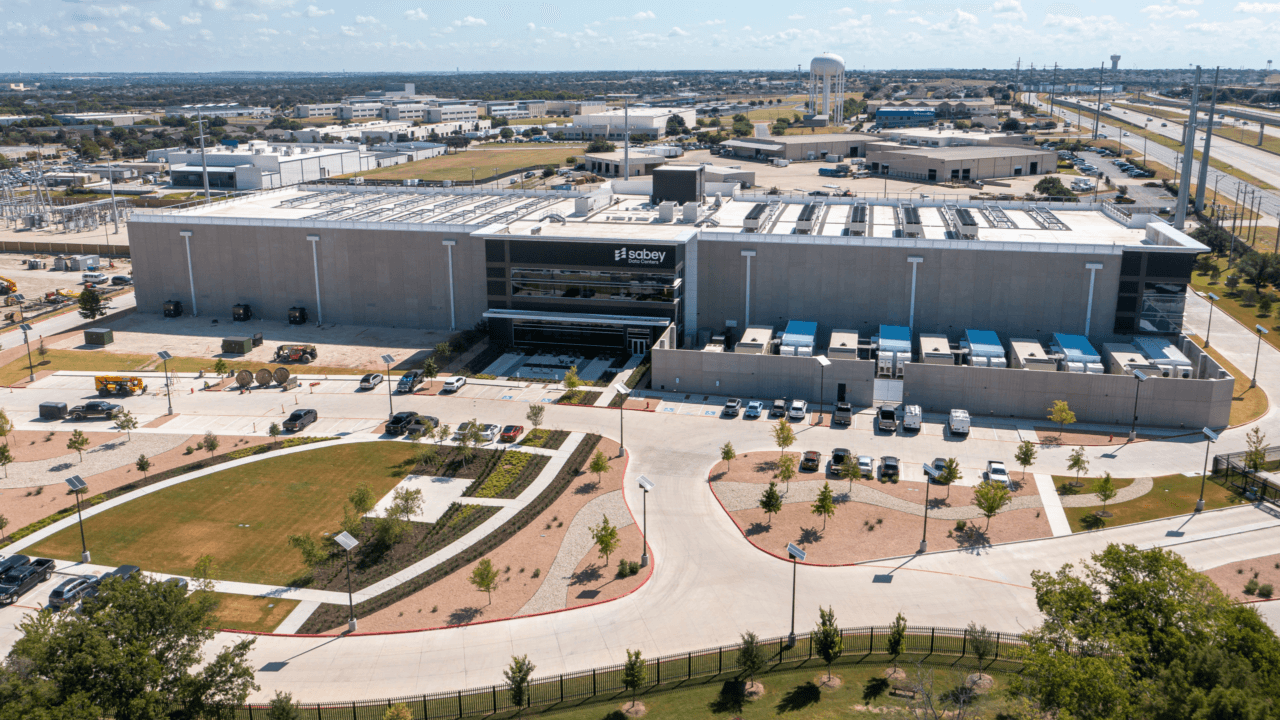
 Aerial view of a large data center facility, the core subject of the story.
Even Republicans Now Turn on Big Tech's Data Centers
Intra-Party Split Detected
Republicans are increasingly split between traditional pro-business, pro-tech-growth stances and a populist backlash against data centers over rising electricity bills, water use, and community strain. GOP figures like Paxton, Abbott, and Breitbart commentators are breaking from Big Tech, blaming the industry itself, while others in the party continue to emphasize AI competitiveness with China and support for industry growth.
Left says
- •Bipartisan backlash against data centers validates long-standing concerns about corporate power and unchecked tech expansion that progressives have raised for years.
- •Public opinion data showing 61% opposition, including majorities across party lines, reflects real harm to ordinary people through rising electricity bills and strained water resources in vulnerable communities.
- •Republican candidates like Paxton adopting AI-generated campaign graphics while criticizing AI's societal costs highlights a contradiction worth scrutinizing.
- •Genuine consumer and environmental protections, such as forcing companies to fund their own infrastructure rather than passing costs to ratepayers, deserve support regardless of which party proposes them.
Right says
- •Communities have every right to push back when tech companies extract local resources like electricity and water without giving back economically to the towns hosting them.
- •Winning the AI race against China remains essential, but that goal doesn't require sacrificing American neighborhoods, family safety, or grid stability in the process.
- •Big Tech's failure to communicate honestly with the public about the costs of data centers has fueled justified panic and eroded trust the industry needs to repair.
- •Practical, market-oriented fixes such as letting data centers build their own power plants, blocking Chinese technology, and ending taxpayer-subsidized sales tax exemptions can protect communities while still allowing responsible growth.
Common Take
High Consensus- Data centers are consuming significant amounts of electricity and water, raising costs and straining resources for nearby residents.
- Winning the artificial intelligence race against China is a shared national priority.
- Tech companies have handled public communication and community engagement around data centers poorly.
- Data center developers should bear more responsibility for the infrastructure costs they create rather than shifting the burden onto ordinary electricity customers.
The Arguments
Left argues
Bipartisan polling showing 61% opposition, including majorities of Democrats, Republicans, and independents, validates long-standing progressive concerns about unchecked corporate power and Big Tech's ability to externalize costs onto ordinary ratepayers and water-stressed communities.
Right counters
Public frustration crosses party lines not because progressive critiques of corporate power were correct in the abstract, but because Big Tech's specific failure to communicate honestly and negotiate fair local deals created concrete, measurable harms like spiking electric bills that anyone would object to.
Right argues
Communities have every right to demand that data centers give back economically, through lower property taxes, school funding, or infrastructure investment, rather than simply extracting local electricity and water while sending costs to ordinary ratepayers.
Left counters
Demanding that companies 'give back' voluntarily is an inadequate substitute for binding regulation; without enforceable rules, good actors like the Louisiana or Quincy examples remain the exception while most communities are left hoping companies choose generosity over profit.
Left argues
Paxton's use of an AI-generated campaign graphic to promote a plan restricting AI's societal harms exposes a real contradiction in the Republican critique, suggesting the opposition is more about capturing a politically potent issue than principled concern about AI's effects.
Right counters
Using an AI tool to design a graphic is categorically different from operating data centers that spike electricity bills or expose children to harmful chatbots; conflating the two trivializes legitimate policy concerns about grid strain and child safety.
Right argues
Winning the AI race against China is a legitimate national security priority, but that goal doesn't require sacrificing grid stability, family safety, or neighborhood integrity, so practical fixes like allowing data centers to build their own power plants and blocking Chinese technology can serve both goals simultaneously.
Left counters
Market-oriented fixes like self-generated power or tax exemption repeals are useful but insufficient without stronger federal consumer and environmental protections, since voluntary or state-by-state patchwork solutions leave many communities exposed depending on which state or company they happen to deal with.
Left argues
Forcing companies to fund their own electric and water infrastructure rather than passing costs to ratepayers is a genuine consumer protection that deserves support regardless of which party champions it, since the harm of rising bills falls hardest on lower-income and rural households.
Right counters
Republicans like Paxton and Abbott are already leading on exactly this policy, proposing to repeal sales tax exemptions and require data centers to add rather than drain electricity capacity, showing this is a substantive bipartisan solution rather than a partisan talking point to be credited to one side.
Challenge Questions
These questions target genuine internal contradictions — meant to provoke honest reflection.
Right asks Left
“If progressive concerns about corporate power are validated by this backlash, why did many of the same communities and even blue-state governments actively court data center investment for years before the costs became politically salient?”
Left asks Right
“If Republicans like Paxton and Abbott genuinely believe data centers are harming communities, why do their plans stop short of a moratorium and continue to prioritize winning the AI race, even while acknowledging the industry 'dug its own grave'?”
Outlier Report
Left Fringe
Progressive AI-skeptic activists and degrowth-oriented commentators (e.g., some Jacobin/The Intercept writers) who argue for halting or heavily restricting AI expansion entirely represent maybe 10-15% of the left, more radical than the mainstream Democratic emphasis on consumer protection and rate fairness.
Right Fringe
Tech-accelerationist Republicans and Silicon Valley-aligned figures like David Sacks or Marc Andreessen-adjacent voices who oppose most restrictions on data centers as anti-growth and anti-China-competition represent maybe 10-15% of the right, out of step with the Paxton/Abbott-style populist backlash now dominant in the GOP base.
Noise Assessment
Moderate-to-high; much of the elite political messaging (Paxton's AI-generated graphics, dueling policy plans) is performative campaign positioning ahead of midterms, while the underlying public concern about bills and water use reflected in polling is genuine and less partisan than the political theater suggests.
Sources (6)
<p>Texas Attorney General and Republican Senate candidate Ken Paxton released an AI data center plan Monday, calling for federal legislation to block Chinese technology in the facilities and criminal liability for centers that power AI chatbots harming children.</p> <p>The post <a href="https://www.breitbart.com/tech/2026/08/25/ken-paxton-unveils-plan-to-prevent-negative-impact-of-ai-data-centers-on-texas/" rel="nofollow">Ken Paxton Unveils Plan to Prevent ‘Negative Impact’ of AI Data Centers on Texas</a> appeared first on <a href="https://www.breitbart.com" rel="nofollow">Breitbart</a>.</p>
<p>Innovation Council Action (ICA) Founder Taylor Budowich pointed out during a Breitbart News event on Tuesday that AI data centers "should be feeding our communities" instead of taking away from communities and draining them.</p> <p>The post <a href="https://www.breitbart.com/politics/2026/08/25/exclusive-innovation-council-actions-taylor-budowich-data-centers-should-be-feeding-our-communities-start-listening-to-what-people-are-saying/" rel="nofollow">Exclusive — Innovation Council Action’s Taylor Budowich: Data Centers ‘Should Be Feeding Our Communities,’ Start ‘Listening to What People are Saying</a> appeared first on <a href="https://www.breitbart.com" rel="nofollow">Breitbart</a>.</p>
<p>Locals have every right to question data centers, Breitbart News social media director and "Code Red: The Left, the Right, China, and the Race to Control AI" author Wynton Hall said.</p> <p>The post <a href="https://www.breitbart.com/radio/2026/08/25/exclusive-wynton-hall-arrogance-big-tech-elite-locals-have-every-right-question-data-centers/" rel="nofollow">Exclusive – Wynton Hall on Arrogance of Big Tech Elite: Locals Have Every Right to Question Data Centers</a> appeared first on <a href="https://www.breitbart.com" rel="nofollow">Breitbart</a>.</p>
Republican U.S. Senate candidate and Texas Attorney General Ken Paxton has released his plan to protect Texas’ power grid and communities from issues associated with data centers while ensuring the United States beats China in the artificial intelligence race. On Monday, Paxton released his “Texas First Data Center Plan,” which outlines four key proposals to...
<p>The Republican Senate candidate announced the plan with a graphic flagged as ‘Made with AI’</p><ul><li><p><a href="https://www.theguardian.com/us-news/live/2026/aug/25/donald-trump-tariffs-canada-midterms-primary-south-carolina-iran-ukraine-voting-rights-latest-news-updates">US politics live – latest updates</a></p></li></ul><p><a href="https://www.theguardian.com/us-news/ken-paxton">Ken Paxton</a>, a Republican candidate for the US Senate in Texas, has unveiled plans to tackle the “negative impact” of <a href="https://www.theguardian.com/us-news/datacenters--us-">datacenters</a> amid a growing backlash across the political spectrum.</p><p>Paxton, endorsed by <a href="https://www.theguardian.com/us-news/donaldtrump">Donald Trump</a> but facing a close contest against Democrat James Talarico, posted a “Texas first” datacenter plan on X with a graphic that <a href="https://x.com/KenPaxtonTX/status/2091888962474279215?s=20">the social media network flagged</a> as “Made with AI”.</p> <a href="https://www.theguardian.com/us-news/2026/aug/25/ken-paxton-datacenters-plan-texas">Continue reading...</a>
Texas Attorney General Ken Paxton (R) unveiled a plan Monday to place restrictions on data centers if elected to the U.S. Senate, becoming the latest GOP candidate to take a stronger stance against the controversial AI infrastructure. Paxton laid out his four-point plan, vowing to “fiercely advocate” for Gov. Greg Abbott’s (R) state-level data center…