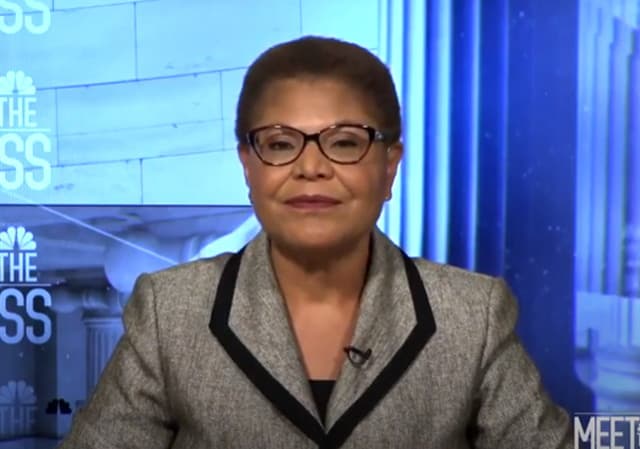
Fake Pollster Fooled Karen Bass and the Political Media
Left says
- •Bass and her campaign were victims of a deliberate deception, not a case of intentional misinformation on her part, and she reasonably shared a poll that appeared legitimate.
- •This episode reflects a broader, alarming vulnerability in how unverified information — including fabricated polling — can spread rapidly across social media and news coverage before anyone checks its authenticity.
- •The identity and motive of whoever created Median Strategies remain unknown, raising concerns about coordinated disinformation campaigns targeting Democratic primary races specifically.
- •Legitimate, methodologically sound polling still exists and should not be broadly discredited because of one bad actor's fabricated 'social experiment.'
Right says
- •This incident exposes how easily fake or biased data can manipulate the political narrative and how eagerly campaigns and media amplify numbers that flatter their preferred candidates without verification.
- •The pattern fits a broader trend of polling consistently overstating Democratic support, as seen in Wisconsin, Michigan, and other races, fueling skepticism about polling's reliability generally.
- •Karen Bass's public celebration of a poll that turned out to be fabricated raises questions about due diligence by campaigns and the political press before promoting favorable data.
- •The affair underscores long-standing conservative criticism that mainstream polling operations and media outlets are too quick to report and circulate numbers favorable to Democrats without adequate scrutiny.
Common Take
High Consensus- Median Strategies published fabricated polling data for races in Wisconsin, Nevada, and Los Angeles before shutting down and admitting the polls were fake.
- The company described its actions as a 'short-term social experiment' testing how unverified polling information spreads through the political information ecosystem.
- Karen Bass publicly promoted the fake poll showing her with a 12-point lead before it was revealed to be bogus.
- The identity and motive behind Median Strategies remain unknown, and no candidate or political organization has been tied to creating it.
The Arguments
Left argues
Bass and her campaign were themselves targets of a deliberate deception engineered by an anonymous actor whose stated goal was to test how unverified information spreads, so sharing a poll that appeared to use standard methodology (sample size, margin of error, dates) was a reasonable, good-faith mistake rather than intentional misinformation.
Right counters
Reasonable or not, a sitting mayor publicly touted a poll from a firm no one had ever heard of without any apparent effort to verify its existence or track record, which is precisely the lack of due diligence critics are pointing to — good faith doesn't excuse a failure to check basic credibility.
Right argues
This episode fits a documented pattern — including Wisconsin and Michigan primaries and Patrick Ruffini's analysis of over 3,000 polls showing 73% overstated Democratic support — suggesting polling errors favoring Democrats are systemic rather than random, making it easier for a fake poll favoring a Democrat to blend in and go unchallenged.
Left counters
Conflating a criminal fabrication with genuine methodological polling error is misleading; real pollsters use disclosed, testable methods and get things wrong for identifiable reasons, while Median Strategies invented numbers from nothing, so lumping them together to indict 'polling' as an institution unfairly discredits legitimate survey research.
Left argues
The real story is a broader vulnerability in the information ecosystem — an anonymous, unaccountable actor was able to inject fabricated data into political coverage across multiple states and have it taken seriously by media and campaigns alike, which is a systemic problem beyond any one candidate's judgment.
Right counters
That vulnerability was exploitable precisely because campaigns and journalists have a habit of uncritically amplifying numbers that flatter their preferred narrative, which is not a neutral technological failure but a predictable consequence of motivated reasoning that conservatives have long criticized in mainstream political media.
Right argues
Karen Bass didn't just passively receive bad information — she actively celebrated the fake poll on social media as evidence of 'momentum,' which raises legitimate questions about whether campaigns and the press apply real scrutiny to data before amplifying it, especially when it's favorable to their side.
Left counters
Nearly every observer, including professional pollsters and the Los Angeles Times itself, initially treated Median Strategies' poll as facially plausible since it included standard elements like sample size and margin of error, meaning it wasn't uniquely careless of Bass to be fooled by something specifically engineered to look legitimate.
Right argues
The complete anonymity of Median Strategies, combined with its multi-state reach across Wisconsin, Nevada, and California and its polls specifically flattering more moderate Democratic candidates over further-left challengers, raises the question of whether this was less a 'social experiment' and more a targeted operation designed to affect specific primary outcomes.
Left counters
Speculating about hidden motives without evidence risks becoming its own form of misinformation; the honest answer is nobody yet knows who created Median Strategies or why, and drawing partisan conclusions from that mystery before any investigation is premature.
Challenge Questions
These questions target genuine internal contradictions — meant to provoke honest reflection.
Right asks Left
“If Bass's campaign is excused for uncritically sharing a favorable poll from a firm nobody had vetted, does that standard also apply the next time a Republican campaign shares a flattering but unverified poll — or does the benefit of the doubt only run one direction?”
Left asks Right
“If Ruffini's data and past cycles already show polling systematically overstating Democratic support, why did a poll favoring the Democratic incumbent Bass need to be fabricated at all in order to fit the narrative the right now cites it as proof of — and doesn't that undercut the claim that Democratic-leaning polls are inherently untrustworthy?”
Outlier Report
Left Fringe
Commentators like Jonathan Chait or pollster-defenders such as Nate Cohn's supporters might argue this is purely a bad-actor anomaly with zero bearing on legitimate polling's credibility; this view represents maybe 15-20% of left-leaning commentary, as most Democrats are also frustrated with recent polling misses.
Right Fringe
Figures like Patrick Ruffini or RedState commentators go further, using this incident to argue nearly all mainstream polling is systematically rigged or unreliable for Democrats specifically, a more sweeping claim than most conservatives would make; this represents roughly 20-25% of right-leaning commentary.
Noise Assessment
Moderate-to-high; the story is being amplified more by partisan media seeking to score points about polling credibility (especially on the right) than reflecting deep public engagement, though the underlying skepticism about polls is a genuine, widely-shared sentiment beyond just this one incident.
Sources (6)
<p>"Median Strategies has concluded its polling project and will not publish additional polls. All previously published polling releases have been withdrawn and should not be cited or treated as genuine polling data."</p> The post <a href="https://legalinsurrection.com/2026/08/pollster-behind-karen-bass-12-point-lead-admits-poll-was-fake-shuts-down-operations/">Pollster Behind Karen Bass’ 12-Point Lead Admits Poll Was Fake, Shuts Down Operations</a> first appeared on <a href="https://legalinsurrection.com">Le·gal In·sur·rec·tion</a>.
<img alt="Failed Wisconsin gubernatorial candidate Francesca Hong" class="webfeedsFeaturedVisual wp-post-image" src="https://thefederalist.com/wp-content/uploads/2026/08/Screenshot-2026-08-18-at-1.27.51-PM-scaled-e1787074254461-1200x675.png" style="display: block; margin: auto; margin-bottom: 5px;" />Francesca Hong, the failed communist candidate in the Wisconsin gubernatorial primary race, was supposed to shellac David Crowley. After all, she had a 23-point lead over her opponent, according to data from Median Strategies. But it turns out Median Strategies was a fake polling company that just wanted to run a “social experiment” and observe […]
Locked in a competitive reelection race, Los Angeles Mayor Karen Bass declared on social media last week that a new poll was evidence that her campaign was "gaining momentum."
Locked in a competitive reelection race, Los Angeles Mayor Karen Bass declared on social media last week that a new poll was evidence that her campaign was "gaining momentum."