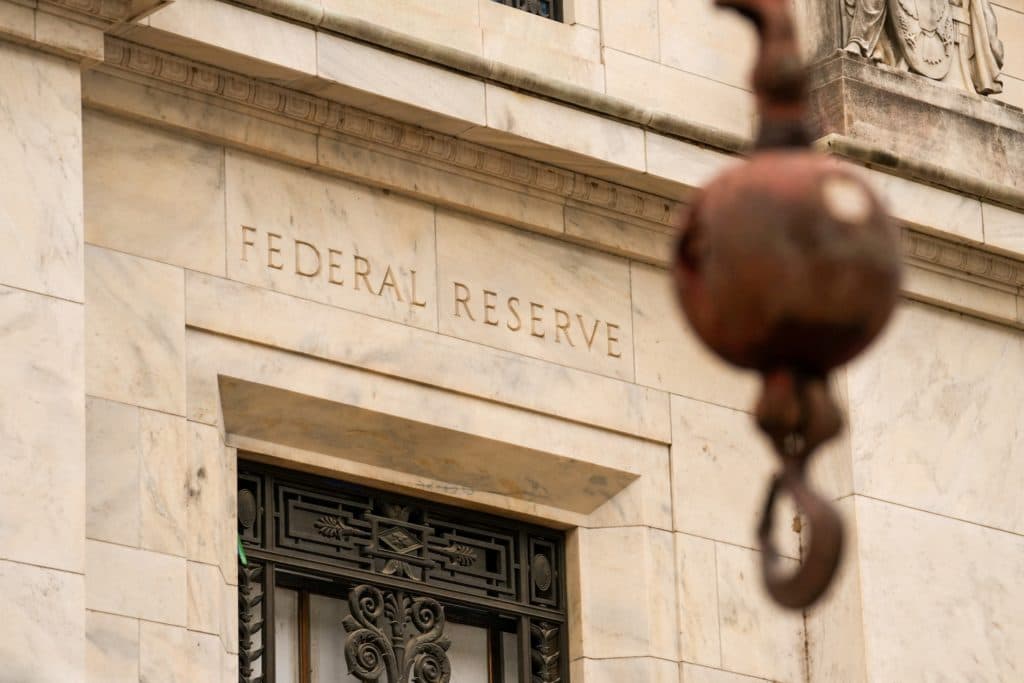
 The Federal Reserve building, central to the debate over interest rate hikes.
Fed Officials Split as Inflation Data Fuels Rate Hike Debate
Intra-Party Split Detected
The divide here is less partisan and more institutional, within the Federal Reserve itself: some officials (including regional bank presidents who dissented in July) favor an immediate rate hike to combat inflation, while others like Governor Waller and NY Fed President Williams favor waiting for more data. This is not a clean left-right split but reflects genuine disagreement among policymakers, with Chair Warsh holding decisive influence.
Left says
- •Some Fed officials, including Governor Christopher Waller, argue two consecutive months of improving inflation data warrant patience rather than a hasty rate hike, favoring letting disinflation continue.
- •Raising rates prematurely risks tightening financial conditions unnecessarily and could slow job growth or economic momentum without clear evidence that current policy is insufficient.
- •Officials like New York Fed President John Williams emphasize a wait-and-see approach, noting there's no clear sign more tightening is needed to hit the 2% target.
- •Energy price spikes tied to the Iran war, not broad demand-driven inflation, are largely responsible for elevated headline CPI, suggesting the underlying inflation picture may be less alarming than the topline number implies.
Right says
- •Inflation has stayed stubbornly above the Fed's 2% target for months, and August's 3.4% annual rate and hotter-than-expected core CPI justify decisive action to restore price stability.
- •Fed Chairman Kevin Warsh has signaled the central bank 'must be confident' inflation is clearly moving toward target or else it 'will have work to do,' reflecting a firmer stance against further delay.
- •Three reserve bank presidents already dissented in favor of a rate hike at the last meeting, showing meaningful internal support for tightening policy now rather than waiting longer.
- •Markets moved sharply toward pricing in a rate hike (up to 90% odds) after the CPI report, reflecting broad recognition that inflation risks remain serious and unresolved.
Common Take
High Consensus- August CPI rose 3.4% annually and 0.4% monthly, matching July's pace and coming in slightly above some forecasts.
- Core CPI rose 2.4% annually and 0.3% monthly, slightly above expectations.
- Elevated gasoline and energy prices, driven partly by the Iran war, were major contributors to the CPI increase.
- The Fed's September 16 meeting is a pivotal, closely watched decision point with significant internal disagreement among officials.
The Arguments
Left argues
Two consecutive months of improving inflation data suggest disinflation is underway, and officials like Waller and Williams argue there's no clear evidence current policy is insufficient, so hiking now risks overcorrecting.
Right counters
August's report came in hotter than expected on both headline and core measures, with core CPI accelerating month-over-month, undercutting the claim that disinflation is clearly continuing rather than stalling.
Right argues
Inflation has been stuck at 3.4% for two straight months, well above the Fed's 2% target, and Chairman Warsh has explicitly warned the Fed must be confident inflation is moving toward target or it 'will have work to do,' justifying decisive action now.
Left counters
Much of the elevated headline number is driven by energy price spikes tied to the Iran war rather than broad demand-driven inflation, meaning the core economic picture may not warrant the aggressive response the headline number implies.
Right argues
Markets moved sharply toward pricing in a rate hike (up to 90% odds) immediately after the CPI release, reflecting a broad, real-time market judgment that inflation risks are serious and that the Fed has waited long enough.
Left counters
Market odds swung dramatically within days—from a coin flip to near-certainty and back to a toss-up after subsequent Fed commentary—showing that the 'consensus' is fragile and highly reactive to individual speeches rather than settled economic fundamentals.
Left argues
Raising rates prematurely risks unnecessarily tightening financial conditions and slowing job growth or economic momentum at a moment when officials themselves admit there's no clear sign more tightening is needed.
Right counters
Three reserve bank presidents already dissented in favor of a hike at the last meeting, and delaying further risks allowing inflation expectations to become entrenched, which could require even harsher tightening later.
Left argues
Since gasoline price spikes tied to the Iran war accounted for more than a third of the CPI's monthly increase, the headline inflation figure overstates underlying demand-driven inflationary pressure that monetary policy can actually address.
Right counters
Core CPI, which strips out energy and food, still jumped 0.3% monthly—an acceleration from July—showing inflation pressure is broadening beyond just energy and into shelter, transportation, and other core categories.
Challenge Questions
These questions target genuine internal contradictions — meant to provoke honest reflection.
Right asks Left
“If core CPI accelerated on a monthly basis and has stayed well above the 2% target for months, at what point would continued patience become an excuse for inaction rather than a data-driven judgment?”
Left asks Right
“If three reserve bank presidents already dissented toward hiking last meeting and markets are swinging wildly between 70% and 90% odds within a single day, how confident can the case for 'decisive action' really be when even insiders and markets can't agree on the underlying signal?”
Outlier Report
Left Fringe
Progressive economists and commentators like Stephanie Kelton or Skanda Amarnath (Employ America) argue the Fed should heavily prioritize labor market strength over inflation-fighting, an even more dovish stance than Waller/Williams represent; likely under 15% of the left.
Right Fringe
Hardline inflation hawks and some conservative commentators (e.g., voices aligned with Larry Kudlow or hard-money advocates) argue the Fed has already waited too long and risks losing credibility, pushing for more aggressive/faster hikes than even Warsh suggests; likely around 15-20% of the right.
Noise Assessment
High noise-to-signal ratio: this is largely an inside-Fed technical debate covered intensely by financial media and market participants, but most ordinary Americans have limited engagement with FOMC dissent dynamics or CPI subcomponent analysis, reacting mainly to headline 'prices are still high' sentiment.
Sources (6)
<p>After Federal Reserve chairman Kevin Warsh's <a href="https://www.axios.com/2026/08/28/kevin-warsh-federal-reserve-jackson-hole" target="_blank">speech in Jackson Hole</a>, the markets penciled in an interest rate hike for the central bank's mid-September meeting. Comments from two influential officials now throw those expectations into question.</p><p><strong>The big picture: </strong>With August jobs and inflation data due out before a policy meeting in two weeks, the decision of whether to tighten policy appears to be on a knife-edge.</p><hr /><ul><li>A meaningful contingent of Fed leadership is eager to raise interest rates to address stubbornly high inflation, while another, as Fed governor Christopher Waller put it Thursday morning, channeling <a href="https://www.youtube.com/watch?v=C3_0GqPvr4U" target="_blank">John Lennon</a>, is willing to "give disinflation a chance."</li><li>It's a close enough call that Warsh will likely be able to steer a decision whichever way he prefers.</li></ul><p><strong>Driving the news: </strong>At a <a href="https://www.reuters.com/business/feds-waller-open-leaving-rates-unchanged-september-meeting-if-inflation-cools-2026-09-03/" target="_blank">Reuters newsmaker event</a> Thursday, Waller noted two consecutive months of improving inflation data. If it continues in August reports over the coming days, he said, "I would be inclined to support" holding rates steady.</p><ul><li>But if the incoming data shows "improvement has been fleeting," he is open to a rate hike, Waller added.</li><li>On Wednesday, New York Fed president John Williams <a href="https://www.cnbc.com/video/2026/09/02/watch-cnbcs-full-interview-with-new-york-fed-president-john-williams.html" target="_blank">told CNBC </a>that "I think we have to wait and see" whether an interest rate increase is needed.</li><li>"There's no clear signs right now whether monetary policy is currently sufficient to make sure we bring inflation back to target in the next year or two, or whether you need to see further action to do that."</li></ul><p><strong>State of play: </strong>Their comments come after Warsh said that the Fed "must be confident that underlying inflation is moving to our objective, clearly and at sufficient speed," or else they "have work to do."</p><ul><li>That leaves room for a judgment call on whether that bar has been reached. Warsh has resisted hanging policy decisions on the fine details of each incoming data release, as Waller seems inclined to do.</li><li>CME's FedWatch tool now puts the odds of a rate hike at the meeting concluding Sept. 16 as essentially a coin flip, whereas on Wednesday, the futures market-based odds favored an increase.</li></ul><p><strong>Zoom in: </strong>The New York Fed president is vice chair of the policy-setting Federal Open Market Committee and has traditionally acted as part of a leadership troika, with the chairman and vice chair of the Board of Governors.</p><ul><li>Traditionally, governors like Waller are reluctant to dissent from policy decisions, though that norm has dissolved in the last couple of years.</li><li>Three reserve bank presidents, meanwhile, dissented at the late July meeting favoring a rate hike, implying that Warsh will face internal disagreement — <a href="https://www.axios.com/2026/07/22/warsh-fed-congress-comms" target="_blank">the "good family fight"</a> he often speaks of — no matter which way he ultimately leans.</li></ul><p><strong>Of note: </strong>Waller has offered none-too-subtle criticisms of Warsh's reticent communication style. Warsh has said he wants markets to react to "the ball" of incoming data, not "the ref," or how the Fed may react to it.</p><ul><li>On Thursday morning, Waller made his own addendum to that metaphor.</li><li>"I view myself as a home plate umpire in baseball," <a href="https://www.federalreserve.gov/newsevents/speech/waller20260903a.htm" target="_blank">he said</a>. Both the pitcher and the batter "want to play the ball, but they cannot do that until they know the umpire's strike zone," which is essentially the umpire's reaction function.</li><li>"If the ball goes here, it's a strike; if it goes there, it's a ball. The players don't expect the umpire to have a perfect strike zone — they just need a rough idea of its parameters and some guarantee that it won't change much on every pitch."</li></ul>
The report comes at a pivotal moment for the Federal Reserve, which is scheduled to meet next week to decide whether to hike interest rates.
In our news wrap Friday, the Labor Department reported that consumer prices rose 3.4% in August when compared to last year, the inflation report is fueling speculation that the Fed will raise interest rates, U.S. health officials declared an end to the cyclospora outbreak and a British official says more than half a million Russian troops have been killed since the start of the Ukraine invasion.
The Federal Reserve appears increasingly likely to hike interest rates next week, as inflation remains stubbornly elevated amid the war with Iran.  New data out Friday showed annual inflation remained unchanged in August, still well above the central bank’s target 2 percent rate. This is raising expectations of a rate hike, even as President Trump pushes…
Inflation remained unchanged in August as gas prices continued to rise amid the war with Iran, new data from the Bureau of Labor Statistics (BLS) showed Friday. The consumer price index (CPI) increased 0.4 percent last month and 3.4 percent over the same time last year. This was unchanged from July, when the annual inflation rate also sat at 3.4 percent. …