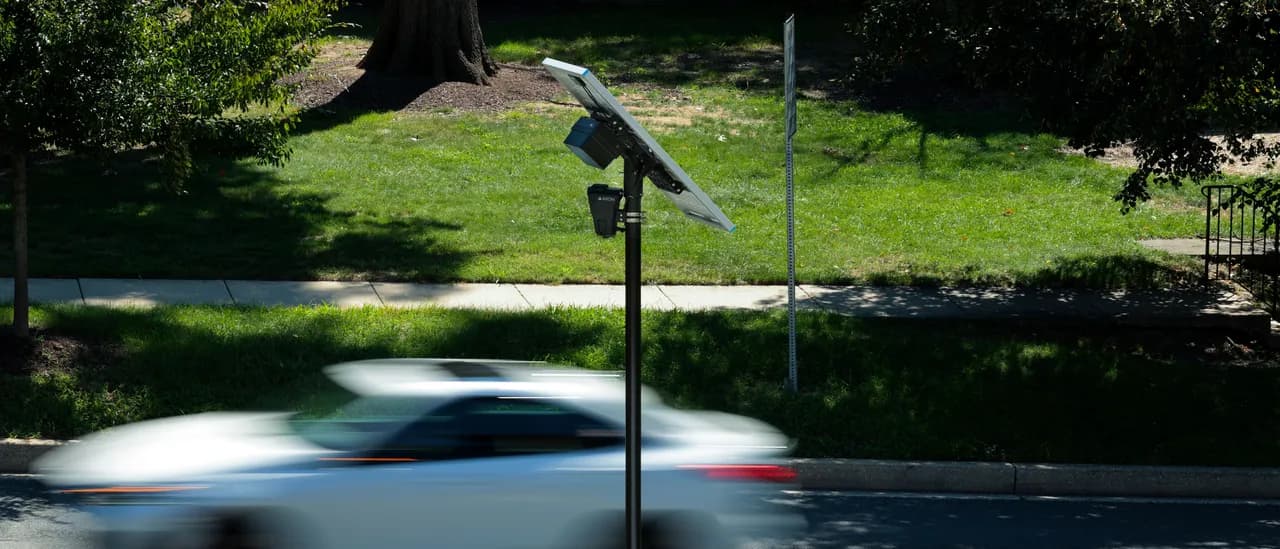
Flock's AI Cameras: Crime-Fighting Tool or Mass Surveillance Threat?
Intra-Party Split Detected
Most right-leaning coverage and figures like Sen. Hawley, local activists, and the ACLU-aligned critiques emphasize privacy dangers and back reining in Flock, while some conservative and law-enforcement-aligned voices continue to defend ALPR cameras as effective crime-fighting and anti-theft tools, creating tension between civil-liberties-minded conservatives and law-and-order conservatives.
Left says
- •Automated license plate readers reinforce racially and economically biased policing, with academic geospatial research showing camera placement disproportionately concentrated near marginalized communities like the area encircling Norfolk State University, a historically Black public university.
- •New AI tools like OS Investigate go further than passive tracking by actively ranking which drivers are algorithmically deemed 'suspicious' based on movement patterns and associations, shifting policing from investigating known suspects to generating suspicion out of ordinary behavior.
- •Data sharing across large regional networks with minimal oversight creates opportunities for misuse, including officers searching plates for personal reasons such as stalking former partners.
- •Without federal rules or clear Fourth Amendment protections, Americans' only privacy safeguard is a private company's internal policy, leaving millions of innocent drivers' daily movements permanently logged and searchable.
Right says
- •Human error in maintaining Flock's wanted-vehicle database led to an innocent Wisconsin woman being arrested at gunpoint twice, costing her two jobs and demonstrating how bureaucratic failure compounds the technology's risks.
- •Grassroots opposition spans the political spectrum, uniting libertarians, conservatives, and progressives alike in concern that unchecked surveillance infrastructure threatens constitutional freedoms regardless of ideology.
- •Senator Josh Hawley is opening a formal Senate investigation because Congress has failed to establish any legal framework governing how camera data is collected, retained, searched, or sold, despite the technology capturing 20 billion license plate images monthly.
- •Local officials, including a Tennessee county mayor, are responding to constituent pressure by moving to cancel their Flock contracts outright, showing that skepticism is translating into concrete policy pushback at the local level.
Common Take
High Consensus- Flock's automated license plate readers and AI tools have expanded rapidly, with over 120,000 cameras now deployed across the country.
- Data misuse has already occurred, including an officer charged with searching a plate 124 times for personal reasons and a department employee's error leading to a wrongful armed arrest.
- There are currently no federal laws specifically regulating how this camera data is collected, retained, or shared, leaving oversight primarily up to individual company policy and local contracts.
- Opposition to expanded surveillance is bipartisan, drawing critics from across the political spectrum at the local and national level.
The Arguments
Left argues
Peer-reviewed geospatial research shows camera placement is not race-neutral but concentrated around marginalized communities, such as cameras encircling Norfolk State University, an HBCU, demonstrating that surveillance infrastructure reinforces existing patterns of biased policing.
Right counters
Camera placement often follows crime data and traffic patterns rather than deliberate racial targeting, and the bipartisan backlash against Flock—including from conservatives in affluent, majority-white counties—shows the concern is about surveillance overreach generally, not a race-specific conspiracy.
Right argues
Congress has never established legal rules for how license plate data is collected, retained, searched, or sold, meaning 120,000+ cameras capturing 20 billion images a month operate under nothing but a private company's internal policy, an accountability gap Senator Hawley is now formally investigating.
Left counters
A Senate investigation is a welcome first step, but it should go further than exposing gaps in Flock's policies and instead produce binding federal privacy legislation with Fourth Amendment-level protections, since voluntary corporate policy can be changed or ignored at any time.
Right argues
Human error in Flock's wanted-vehicle database led to an innocent Wisconsin woman being arrested at gunpoint twice and losing two jobs, showing that even if the technology works as designed, bureaucratic failure to maintain it turns it into a weapon against innocent people.
Left counters
This case is not just a bureaucratic glitch but proof of a structural problem: a system built to flag and act on citizens' movements with minimal human verification will inevitably produce wrongful detentions at scale as it expands, which is precisely why stronger oversight and due-process safeguards are needed before further deployment.
Left argues
Flock's new OS Investigate tool doesn't just track known suspects—it actively ranks ordinary drivers as 'suspicious' based on movement patterns and associations, fundamentally shifting policing from investigating crimes to algorithmically generating suspicion out of innocuous behavior.
Right counters
Even the ACLU's own analyst acknowledges the likely fix is technological, not prohibitive—shifting toward local, in-house AI models that keep sensitive data from leaving police premises—suggesting the problem is solvable through better system design rather than requiring the tool's elimination.
Right argues
Opposition to Flock spans the entire political spectrum, from libertarians and conservatives to progressives, with local officials like Knox County's mayor moving to cancel contracts in direct response to constituent pressure, proving that concern about unchecked surveillance is a unifying democratic value rather than a partisan talking point.
Left counters
Bipartisan discomfort with Flock's abuses doesn't mean the technology itself is illegitimate; it means oversight, auditing, and access controls have been inadequate, and the same coalition canceling contracts could instead demand reform and accountability rather than abandoning a tool with documented anti-theft and public-safety benefits.
Challenge Questions
These questions target genuine internal contradictions — meant to provoke honest reflection.
Right asks Left
“If the core problem is the absence of legal limits and oversight rather than the technology itself, why should the remedy be banning or defunding camera networks rather than demanding the federal privacy legislation and audit requirements your own coalition partners on the right are already pushing for?”
Left asks Right
“If conservative and libertarian critics accept that ALPR technology has real anti-theft and public-safety value and only object to the lack of rules, why has no Republican-controlled legislature or Congress passed a comprehensive federal framework instead of leaving oversight to scattered local contract cancellations and after-the-fact investigations?”
Outlier Report
Left Fringe
Academics like Jonny Finn and Andrew Baird pushing the 'surveillance inequality' geospatial framework represent a narrow slice (~15-20%) of the left focused specifically on racialized policing critiques rather than general privacy concerns.
Right Fringe
Some MAGA-aligned commentators and local activists (e.g., grassroots figures like Barry Harris) frame Flock opposition in more populist/anti-government terms verging into broader distrust of federal law enforcement, representing maybe 20-25% of the right who prioritize this over pro-police, tough-on-crime instincts common among conservatives.
Noise Assessment
Moderate: local council protests and viral moments (like the beekeeper speech) amplify visibility disproportionate to broad public awareness, but Hawley's Senate investigation and cross-partisan contract cancellations suggest genuine, not merely performative, bipartisan concern.
Sources (5)
This New Tool Finds You Without A Name Or Plate
“It was a nightmare. It is a nightmare”
Local Hero Barry The Beekeeper Electrifies Room With Anti-Flock Speech At Council Meeting
Every month, AI-powered cameras take 20 billion snapshots of cars in America. In almost every case, these photos capture drivers who did nothing wrong. These are regular folks on their way to work, picking up kids at school, or driving to church. Now, they are understandably asking what happens to the data captured by a ...
<p>The same technology that helps catch car thieves can just as easily be turned toward tracking ordinary people without cause, and the growing wave of vandalism shows how deep that unease already runs.</p> The post <a href="https://legalinsurrection.com/2026/08/flock-cameras-face-backlash-even-as-new-study-show-anti-theft-benefits/">Flock Cameras Face Backlash Even as New Study Shows Anti-Theft Benefits</a> first appeared on <a href="https://legalinsurrection.com">Le·gal In·sur·rec·tion</a>.