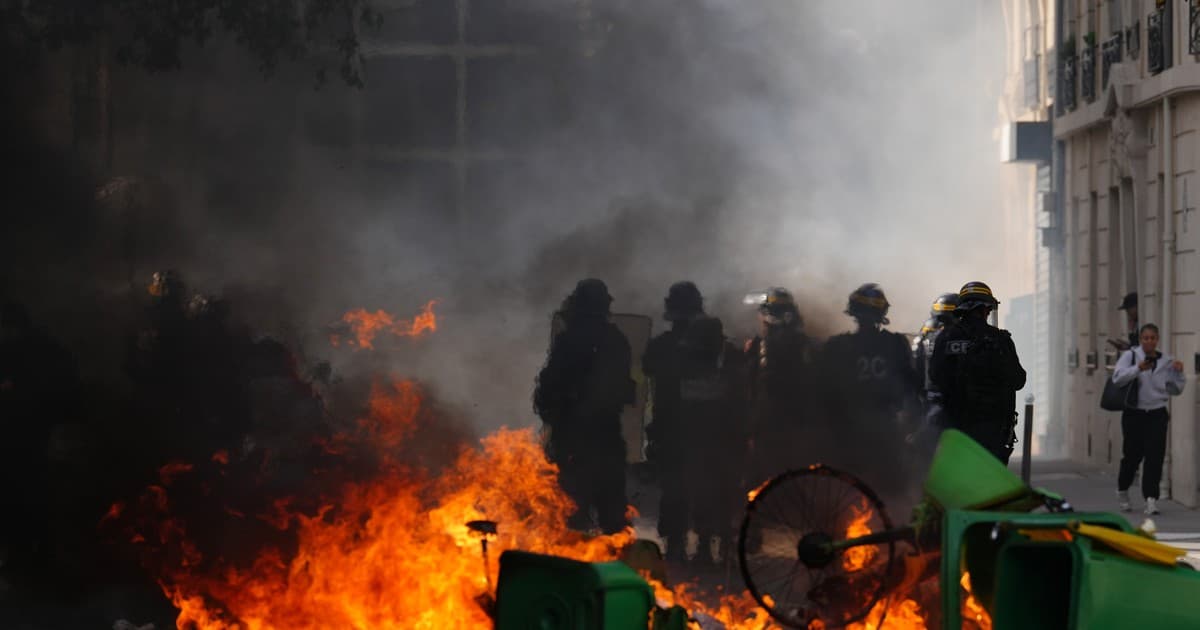
 Riot police advance through smoke past a burning barricade in France.
France's Student Protests: Legitimate Grievance or Far-Left Riot?
Left says
- •Students are responding to genuine, long-documented failures in French public education, including overcrowded classrooms of up to 35 pupils, teacher shortages, and buildings with inadequate heating, cooling, and sanitation.
- •The movement originated organically in Seine-Saint-Denis, one of France's poorest areas, reflecting how underinvestment falls hardest on working-class and immigrant communities already underserved by the state.
- •Grueling schedules, such as 8 a.m. to 6 p.m. school days, are taking a documented toll on teenagers' mental health, and young people demanding to be heard deserve good-faith engagement rather than dismissal.
- •Police use of tear gas and force against minors has escalated tensions, and protesters argue that heavy-handed crackdowns, not the students' underlying demands, are responsible for making the unrest worse.
Right says
- •What began as a protest over school conditions has devolved into coordinated violence, including arson, Molotov cocktails, and assaults that have injured over 300 police officers and 65 school staff, suggesting organized far-left and outside agitation rather than spontaneous student activism.
- •Roughly 90% of the nearly 2,000 people detained are minors, raising serious concerns about who is mobilizing children into frontline confrontations with police and vandalism of their own schools.
- •Specific brutal incidents, including an officer beaten unconscious in Belfort, a teacher doused in gasoline, and firefighters driven off by rioters while trying to extinguish school fires, show the unrest has moved far beyond peaceful advocacy for better classrooms.
- •Masked agitators dressed in black, described by officials as unaffiliated with the schools themselves, appear to be exploiting legitimate student frustration to pursue broader anti-government and anti-police violence ahead of France's presidential election.
Common Take
High Consensus- French schools face real problems with overcrowded classrooms, teacher shortages, and deteriorating buildings, which sparked the initial protests in Seine-Saint-Denis in mid-September.
- The unrest has caused significant injuries on both sides, with over 300 police officers and at least 65 school staff members, including 40 principals, hurt during the demonstrations.
- Hundreds of schools across France, including in Paris, Nantes, Marseille, and Lyon, have been disrupted, damaged, or forced to close.
- A substantial share of those arrested, roughly 90%, are minors, and the violence has drawn in people beyond the original student protesters, including masked individuals acting separately from school grievances.
The Arguments
Left argues
The underlying grievances are well-documented and legitimate: overcrowded classrooms of up to 35 students, teacher shortages, dilapidated buildings, and grueling 8 a.m. to 6 p.m. schedules reflect real underinvestment, particularly in poorer areas like Seine-Saint-Denis where the protests began.
Right counters
Legitimate grievances do not explain or justify the arson, Molotov cocktails, and assaults that have injured over 300 police officers and 65 staff; the scale and coordination of the violence far exceeds what spontaneous frustration over classroom conditions would produce.
Right argues
The fact that 90% of nearly 2,000 detainees are minors, combined with masked agitators dressed in black who are reportedly unaffiliated with the schools, suggests organized actors are exploiting and mobilizing children for broader anti-government violence rather than this being purely organic student activism.
Left counters
Framing youth-led protest as the product of outside manipulation echoes a long history of French governments discrediting student movements (as with 1968) to avoid confronting legitimate demands, and ignores that young people are fully capable of organizing and escalating protest on their own behalf.
Left argues
Protesters argue that police use of tear gas and force against minors has itself escalated tensions and violence, meaning the crackdown—not the students' original demands—bears significant responsibility for how the unrest has worsened.
Right counters
Specific incidents like an officer beaten unconscious in Belfort and a teacher doused in gasoline occurred independently of police action and demonstrate a level of premeditated brutality that cannot be attributed to defensive reactions against policing.
Right argues
Targeted attacks on school infrastructure itself—burning entrance halls, torching buses, assaulting principals with gasoline—undermine the claim that this is a coherent protest for better school conditions, since destroying the very buildings students claim to be fighting for is self-defeating unless outside agitators have redirected the movement's aims.
Left counters
Anger at decrepit, underfunded buildings can manifest destructively without requiring outside orchestration; young people subjected to years of neglect may direct frustration at the physical symbols of that neglect, however counterproductive that is.
Left argues
The movement's origin in one of France's poorest districts, and its focus on documented structural problems like staffing shortages and budget cuts, shows this is fundamentally a response to state failure toward working-class and immigrant communities rather than a manufactured political event.
Right counters
Even if the origins were organic, the current scale of coordinated nationwide violence, cross-border spillover into Belgium, and politically timed escalation ahead of the presidential election indicate the movement has since been captured and redirected by organized political actors with aims well beyond classroom reform.
Challenge Questions
These questions target genuine internal contradictions — meant to provoke honest reflection.
Right asks Left
“If police crackdowns are responsible for escalating violence, how does that explain the earliest, most severe incidents—like a teacher being doused in gasoline or a bus being set ablaze—that occurred as part of the protests themselves rather than as reactions to policing?”
Left asks Right
“If masked, unaffiliated agitators are truly driving the violence, why have French officials and media continued to describe the unrest primarily as a 'student' or 'high school' protest movement rather than treating it as a separate security crisis distinct from the schools' grievances?”
Outlier Report
Left Fringe
Figures like Jean-Luc Mélenchon and La France Insoumise-aligned commentators (and their American sympathizers in DSA-adjacent media) who frame the police response itself as the primary injustice and minimize or excuse the arson and violence as a predictable reaction to state neglect; this represents a small fringe, perhaps 10-15% of left-leaning American observers following the story.
Right Fringe
Commentators like those at Breitbart and RedState framing this explicitly through an anti-immigration lens (e.g., 'France Imported' framing, references to 'second and third generation migrant students') who attribute the unrest primarily to demographic change rather than education policy failures; this represents roughly 15-20% of right-leaning commentary, with most mainstream conservatives focusing on law-and-order rather than immigration framing specifically.
Noise Assessment
High noise ratio: most American engagement is driven by viral video clips (burning buses, officer beatings) shared on X with minimal context, amplifying the violence narrative far beyond what a representative sample of Americans following detailed reporting would conclude, and few Americans have deep knowledge of French education policy specifics like Seine-Saint-Denis demographics or the 1968 protest parallels.
Sources (10)
More than 600 schools have faced disruption as protests over standards and lack of teachers continue.
A movement that started nearly two weeks ago has spread, and in France young people on the streets spells trouble, writes Hugh Schofield.
<p>Paris and numerous other French regional cities were engulfed in the chaos of mass-scale violent riots and protests incited by the far-left on Thursday, with hundreds of reported acts of vandalism, arson, blockades of school facilities, and assaults against law enforcement agents and civilians.</p> <p>The post <a href="https://www.breitbart.com/europe/2026/10/02/chaos-in-france-far-left-incited-day-of-urban-violence-leaves-nearly-2000-detained/" rel="nofollow">Watch: Chaos Engulfs France as Far-Left Driven Violence Sees Nearly 2,000 Detained</a> appeared first on <a href="https://www.breitbart.com" rel="nofollow">Breitbart</a>.</p>
A teacher was doused in petrol
Paris is burning, but this time, the kids are holding the matches. What started as a teenage tantrum over hot classrooms and missing teachers has exploded into full-blown chaos across France. Masked high school students and leftist agitators have turned Parisian schools and suburban schoolyards into war zones, hurling Molotovs, torching entrance halls, and fighting ...
<p>"Authorities reported violence near high schools, mainly in Nantes, blaming 'violent individuals' who 'join the students to carry out acts of vandalism.'"</p> The post <a href="https://legalinsurrection.com/2026/10/hundreds-arrested-as-second-and-third-generation-migrant-students-riot-across-france/">Hundreds Arrested as Students Riot Across France, Setting Schools on Fire</a> first appeared on <a href="https://legalinsurrection.com">Le·gal In·sur·rec·tion</a>.
Days of unrest have affected more than 1,000 schools across France as high school students push for better standards.
The demonstrations erupted in Paris-region schools last week and have snowballed, with police making hundreds of arrests in clashes with the young protesters.