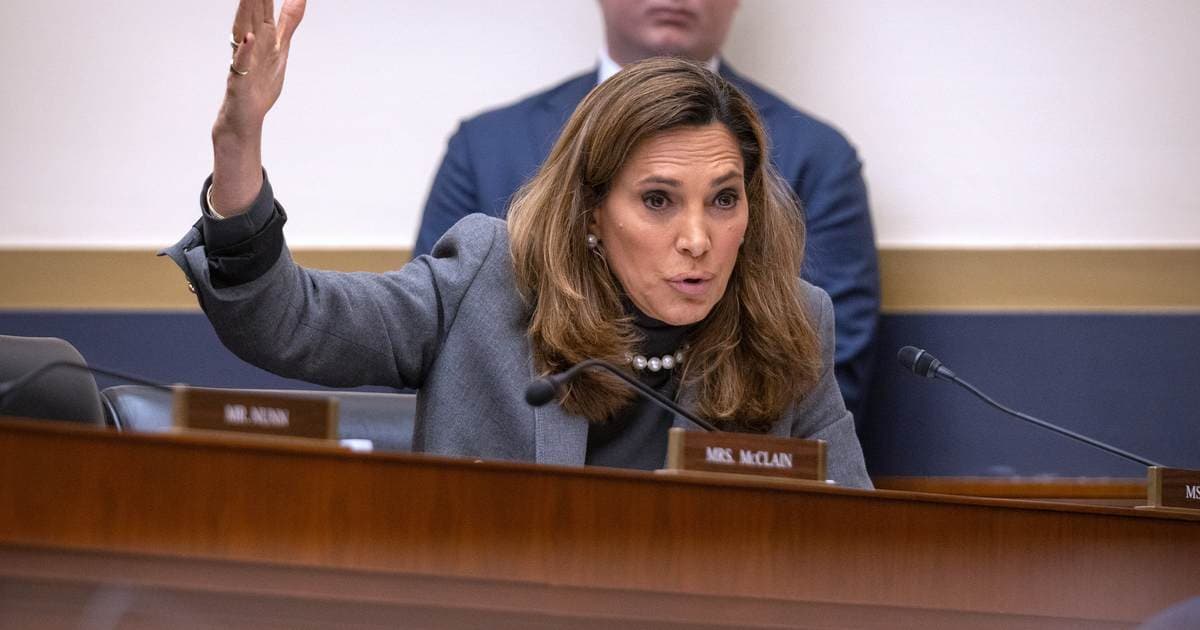
 Florida Rep. María Elvira Salazar speaks animatedly during a House hearing.
GOP Rep. Salazar Breaks With Trump, Says Immigration Crackdown 'Betrayed' Hispanics
Intra-Party Split Detected
Rep. Salazar and a small number of other Republicans in heavily Hispanic districts are publicly criticizing Trump's immigration enforcement as too aggressive, while Trump, Homeland Security Secretary Mullin, and most of the GOP defend the crackdown as necessary border security.
Left says
- •ICE data showing that half of July detainees had no criminal record undercuts the administration's framing that enforcement is targeting dangerous criminals rather than ordinary undocumented residents.
- •A sitting Republican in a 74%-Hispanic district publicly warning that the crackdown has betrayed Hispanic voters lends credibility to longstanding criticism that mass deportation policy is overly harsh and politically damaging.
- •Salazar's push for a bipartisan Dignity Act, which pairs border security with a path to legal status for long-term undocumented residents without criminal records, reflects a more humane, balanced approach than blanket enforcement.
- •Polling suggesting Republicans risk losing their majority over their close association with Trump's immigration approach signals that the crackdown is politically unpopular beyond its base.
Right says
- •President Trump maintains that strong, consistent border enforcement, including not releasing a single illegal border-crosser in 16 months, is necessary and effective, and he stands by that record even while disagreeing with Salazar.
- •Trump and Homeland Security Secretary Markwayne Mullin defend the administration's enforcement approach as firm but fair, rejecting the characterization that it has gone too far.
- •Trump's response, saying Salazar has gotten 'a little bit soft on the border' while still not withdrawing his endorsement, shows the party tolerating internal disagreement without abandoning its core enforcement stance.
- •Salazar remains a Trump-endorsed Republican in a district rated 'Likely Republican,' suggesting this is a policy disagreement within the coalition rather than a full break from the party or its priorities.
Common Take
High Consensus- Both sides acknowledge that half of ICE detainees in July had no criminal record, according to the cited data.
- Both sides recognize Salazar's district is heavily Hispanic and that immigration policy carries real political stakes there.
- Trump and Salazar both continue to support each other politically despite the public disagreement, with Trump not withdrawing his endorsement.
- Both sides agree the immigration debate is unfolding against the backdrop of the upcoming midterm elections and could affect Republican prospects.
The Arguments
Left argues
ICE data showing that half of July detainees had no criminal record contradicts the administration's repeated claim that enforcement prioritizes dangerous criminals, suggesting the crackdown is sweeping up ordinary undocumented residents.
Right counters
Lacking a criminal record is not the same as posing no threat to enforcement of immigration law, and the administration argues that consistent enforcement of the law itself, not just targeting violent offenders, is what deters illegal crossings and maintains order.
Right argues
Trump and DHS Secretary Mullin point to the concrete achievement of not releasing a single illegal border-crosser in 16 months as evidence the policy is working exactly as designed, and that firm enforcement is what voters who elected Trump actually wanted.
Left counters
A record of zero releases says nothing about who is being detained or whether the human cost, including the reported detention of many with no criminal history, aligns with the 'targeting criminals' framing the administration used to sell the policy.
Left argues
A sitting Republican in a 74%-Hispanic district publicly breaking with the president on this issue is a meaningful signal, since she has firsthand political incentive to know how the policy is landing with the voters most affected by it.
Right counters
Salazar remains a Trump-endorsed Republican in a district still rated 'Likely Republican,' which suggests this is a targeted policy critique rather than evidence of a broader Hispanic exodus from the GOP coalition.
Right argues
Trump's measured response, disagreeing with Salazar's characterization while still not pulling his endorsement, demonstrates the party can tolerate internal policy disagreement without it becoming an existential fracture over its core enforcement stance.
Left counters
Tolerating dissent doesn't resolve the underlying problem; polling shows Republicans risk losing their majority precisely because of their close association with an enforcement approach that even their own members in swing-adjacent, heavily Hispanic districts are now publicly disavowing.
Left argues
The bipartisan Dignity Act, pairing border security with a path to legal status for long-term undocumented residents without criminal records, represents a more calibrated policy alternative to blanket mass enforcement.
Right counters
Trump's framing of Salazar as having gone 'soft on the border' reflects a view that any legal pathway short of continued strict enforcement risks recreating the incentives for illegal crossings that his policy was designed to eliminate.
Challenge Questions
These questions target genuine internal contradictions — meant to provoke honest reflection.
Right asks Left
“If Salazar remains a Trump-endorsed Republican whose district is still rated 'Likely Republican,' does citing her as evidence of a broader Hispanic 'betrayal' of the GOP overstate what is, by the data itself, a contained intra-party policy disagreement?”
Left asks Right
“If having no criminal record doesn't disqualify someone from enforcement priority, does the administration's original messaging that it was targeting 'dangerous criminals' still hold, or was that framing always going to diverge from the practical reality of who gets detained?”
Outlier Report
Left Fringe
Immigration advocacy groups and figures like Rep. Alexandria Ocasio-Cortez represent a further-left position favoring more expansive amnesty and criticizing even Salazar's bill as too restrictive (E-Verify, security provisions); this represents roughly 15-20% of the left.
Right Fringe
Figures like Stephen Miller and commentators such as Tucker Carlson represent a hardline zero-tolerance faction that would view any criticism of ICE enforcement, even Salazar's, as unacceptable betrayal; this represents roughly 20-25% of the right.
Noise Assessment
High noise ratio: social media reaction to Salazar's ad was intensely amplified by partisan accounts on both sides, but the underlying issue (support for legal status for non-criminal long-term residents alongside border security) reflects a more moderate, stable public consensus than the loud online debate suggests.
Sources (7)
Rep. Maria Elvira Salazar said Hispanic voters who helped Trump win the White House in 2024 “feel betrayed today.”
Rep. Chip Roy, R-Texas, told Newsmax on Friday that state Rep. James Talarico, the Democrat nominee for the U.S. Senate in Texas, is out of step with the state, citing remarks from Talarico's pastor and the candidate's past comments on gender and God.
President Trump said he still supports Rep. Maria Elvira Salazar (R-Fla.) but disagrees with her on immigration one day after her campaign rolled out an ad criticizing the president on the policy issue. “She obviously doesn’t have a very strong feeling about the border. I do,” Trump told reporters when asked about the video in…
Homeland Security Secretary Markwayne Mullin on Friday defended the Trump administration’s immigration policy after a Republican lawmaker endorsed by President Trump said Immigration and Customs Enforcement (ICE) has “gone too far” by arresting people without criminal records. Rep. Maria Elvira Salazar (R-Fla.) made a notable break from Trump in a new campaign ad for her…
Sen. Martin Heinrich (D-New Mexico) halted passage of a proposal that had passed the House by an overwhelming margin.
Rep. María Elvira Salazar (R) is running in a Latino-heavy district in Florida.