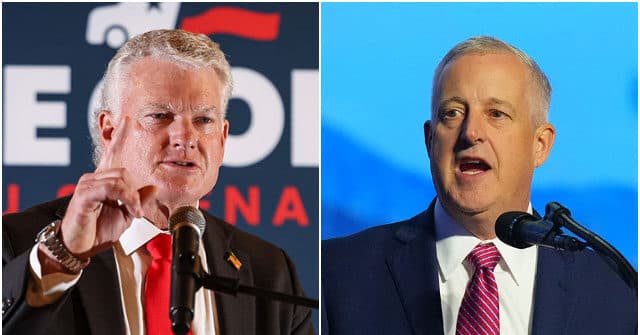
 Two Senate GOP candidates speaking at campaign events, representing widening battleground races.
GOP Senators Sound Alarm as Kansas, Nebraska Turn Competitive
Intra-Party Split Detected
Some Republican senators (e.g., Kennedy, Murkowski, an unnamed GOP senator) publicly criticize their party's handling of the economy, energy prices, and the Iran conflict, breaking from more optimistic messaging (e.g., Bessent) about consumer economic strength.
Left says
- •Rising energy prices tied to Trump's military conflict with Iran are fueling economic anxiety that is driving traditionally red-state voters toward Democratic candidates.
- •Democrats see genuine opportunity to expand the map into states like Kansas, Nebraska, and New Hampshire, with polling showing candidates like Adam Hamilton building strong leads among independents.
- •Voter frustration reflects broader dissatisfaction with Republican governance on affordability, with polling showing voters trust Democrats over Republicans on inflation by double digits.
- •The erosion of GOP strength in deep-red farm states suggests economic pain from tariffs, energy costs, and agricultural disruptions is cutting across partisan lines.
Right says
- •Republican senators are candidly acknowledging that rising gas and energy prices, exacerbated by the conflict with Iran, are creating real political headwinds even in reliably conservative states.
- •Farmers in Kansas and Nebraska are especially frustrated over beef prices and energy costs, signaling that economic concerns are hitting core GOP constituencies hard.
- •Republican leaders like Sen. John Kennedy are being transparent about the tough environment, expressing disappointment in the Senate's legislative record and campaigning hard in states once considered safe wins.
- •Despite the tougher landscape, some Republicans remain confident they will ultimately hold these traditionally red seats even if the races are closer than expected.
Common Take
High Consensus- Both parties agree the Senate battleground map has expanded significantly in the weeks before the midterm election.
- Kansas and Nebraska, traditionally safe Republican states, are now considered competitive by senators on both sides.
- Rising energy and gas prices are identified as a key driver of voter frustration heading into the midterms.
- Both sides connect economic anxiety, including agricultural and fuel costs, to the ongoing military conflict with Iran.
The Arguments
Left argues
Rising energy prices tied to Trump's Iran conflict are causing genuine economic pain that cuts across partisan lines, driving even deep-red farm state voters toward Democratic candidates as evidenced by polling showing double-digit trust advantages on inflation.
Right counters
Republicans themselves acknowledge the economic pressures but note that under Biden inflation rose 21.4% versus 5.5% under Trump, suggesting the current discontent is a temporary reaction to a specific conflict rather than a verdict on GOP economic stewardship overall.
Right argues
Republican senators are being remarkably candid and transparent about the tough political environment, with figures like Kennedy openly criticizing his own party's Senate record rather than spinning the situation, which reflects a healthy self-awareness within the GOP.
Left counters
This candor is notable, but the fact that sitting Republican senators are publicly disappointed in their own legislative accomplishments six weeks before an election suggests deeper substantive failures, not just a messaging problem.
Left argues
Polling from Emerson College showing Democrat Adam Hamilton leading by 15 points among independents in Kansas represents genuine, measurable movement in a state Trump won by 16 points, indicating this isn't just anecdotal senator anxiety but a real electoral shift.
Right counters
Single polls six weeks before an election, especially in low-turnout midterm environments in historically Republican states, often overstate Democratic strength as enthusiasm and turnout patterns typically favor the traditional base once actual voting begins.
Right argues
Despite the tighter races, Republicans retain structural advantages in these states from partisan lean, incumbency, and voter registration, and figures like Sen. Kennedy express confidence that the GOP will ultimately hold these seats even amid short-term turbulence.
Left counters
Confidence in structural advantages doesn't address the underlying issue that farmers and rural voters, a core GOP base, are described as 'irate,' which suggests erosion of enthusiasm that could depress turnout even if outright flips don't occur everywhere.
Left argues
The bipartisan acknowledgment that voters blame the Iran conflict and resulting energy costs for their economic anxiety validates a broader left-leaning critique that Trump's unilateral military action, taken without congressional authorization, has produced tangible economic consequences voters are now punishing at the ballot box.
Right counters
Attributing all economic anxiety to one conflict oversimplifies a complex inflation picture involving tariffs, supply chains, and broader global energy markets, and Republicans like Bessent point to consumer spending data showing the economy remains fundamentally strong.
Challenge Questions
These questions target genuine internal contradictions — meant to provoke honest reflection.
Right asks Left
“If Democratic gains in Kansas and Nebraska are driven primarily by anger over Iran-linked energy prices rather than durable ideological realignment, what happens to this 'expanding map' narrative if energy prices stabilize before November?”
Left asks Right
“If Republican senators privately admit the Senate's own legislative record is disappointing and insufficient on affordability, why should voters trust that reelecting the same GOP majority will produce different results in the next term?”
Outlier Report
Left Fringe
Progressive commentators and some Democratic strategists (e.g., those emphasizing '9 Senate pickups possible' rhetoric like Sen. Sheldon Whitehouse) may overstate the scale of the political realignment happening in deep-red states, representing roughly 15-20% of the left that sees this as a broader ideological shift rather than short-term economic backlash.
Right Fringe
Figures like Treasury Secretary Scott Bessent, who argues consumer economy data contradicts 'faulty media reporting' about economic distress, represent a smaller right-wing faction (roughly 15-20%) that downplays or denies the economic anxiety altogether, diverging from the more candid concerns expressed by senators like Murkowski and Kennedy.
Noise Assessment
Moderate: cable news and partisan outlets amplify the 'battleground map widening' narrative more than typical voters are tracking six weeks before midterms, but the underlying economic complaints (gas prices, beef prices, cost of living) reflect genuine, widely-held voter concerns rather than manufactured outrage.
Sources (5)
Senators in both parties say the Senate midterm election battleground map has expanded significantly six weeks before Election Day, putting the GOP majority in greater jeopardy. Several solidly Republican-leaning states — including Kansas and Nebraska — are now seen as being in play, the senators say...
<p>Republican lawmakers worry that the battleground map is widening as the midterms draw closer, putting their slim majority in jeopardy.</p> <p>The post <a href="https://www.breitbart.com/politics/2026/09/21/report-gop-senators-worry-as-battleground-map-widens-ahead-of-midterms/" rel="nofollow">Report: GOP Senators Worry as Battleground Map Widens Ahead of Midterms</a> appeared first on <a href="https://www.breitbart.com" rel="nofollow">Breitbart</a>.</p>
Sen. John Kennedy (R-LA) argues that where he’s campaigning says a lot about how Republicans are trending with the American people before the midterm elections in November. “I’m going to Kansas, Nebraska, and Iowa to help raise money and campaign for our very good candidates,” he said last week. “If you told me six months ...
Anthropic’s <span class="caps">CEO</span> Calls for the Development of Artificial Intelligence to Slow Down, Head of Iran’s Atomic Energy Organization Blocked from Attending Annual <span class="caps">IAEA</span> Meeting, Houthis Claim Drone and Missile Attack on Military Base in Southern Saudi Arabia, B’Tselem: Israel Systematically Dismantling Palestinian Life in Occupied West Bank, Israeli Airstrike in Gaza Kills at Least Two People, Israeli Military Uses More Than 1,000 Tons of Explosives to Destroy Hezbollah Tunnels in Lebanon, Former U.S. <span class="caps">CIA</span> Director Petraeus Narrowly Escapes Russian Drone Strike at Train Station Near Poland-Ukraine Border, Ebola Cases in the Democratic Republic of Congo Top 7,000, <span class="caps">EPA</span> Set to Repeal Carbon Pollution Standards for Coal and Gas Power Plants, Federal Judge Rules Trump Admin Broke the Law in Directing FEMA’s Workforce Be Cut in Half, <span class="caps">NYT</span> and Flatwater Free Press: Nebraska’s <span class="caps">GOP</span> Governor Backs Trump’s <span class="caps">ICE</span> Raids as His Hog Business Employs Undocumented Workers, Trump Demands Smithsonian Install a 30-Foot Colossal Statue of George Washington
Senators in both parties say the Senate midterm election battleground map has expanded significantly six weeks before Election Day, putting the GOP majority in greater jeopardy. Several solidly Republican-leaning states — including Kansas and Nebraska — are now seen as being in play, the senators say. Democrats can also add New Hampshire to the list…