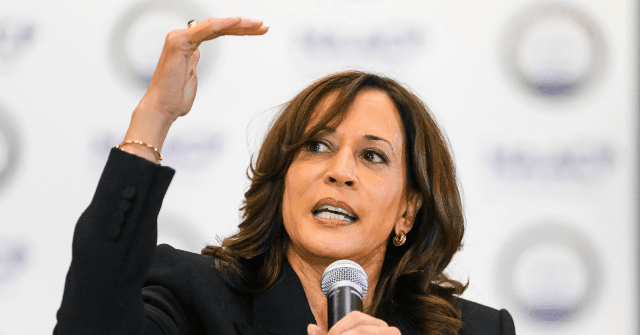
 Kamala Harris speaking animatedly at a podium during a public event.
Harris Eyes 2028 While Backing Court Expansion, Electoral College Overhaul
Left says
- •Harris frames structural reforms like Supreme Court expansion and ending the Electoral College as ways to make government more responsive to the popular will, not as power grabs.
- •She ties her travel and advocacy explicitly to winning the 2026 midterms first, arguing that Democratic control of Congress is a prerequisite for any larger political ambitions.
- •Statehood for Puerto Rico and D.C. is presented as a matter of fairness and representation for residents who currently lack full voting power in Congress.
- •Her continued public engagement, including fundraising and grassroots organizing calls, reflects sustained energy within the party base that sees her as a leading voice against the Trump administration.
Right says
- •Proposals to expand the Supreme Court and abolish the Electoral College are viewed as attempts to rewrite constitutional rules because Democrats have struggled to win under the current system.
- •Critics argue the Electoral College exists precisely to balance influence between smaller and larger states, and changing it would centralize power in a handful of population centers.
- •Harris's early travel to states like New Hampshire and Nevada, which hold early Democratic primaries, is seen as clear evidence she is already positioning for a 2028 run despite her public hesitance.
- •Her 2024 loss is cited as reason for skepticism that voters want to see her atop the ticket again, with her renewed visibility seen as premature or self-serving.
Common Take
High Consensus- Harris has publicly stated she has not yet decided whether to run for president in 2028.
- She is campaigning for Democratic candidates in multiple states, including Nevada, Mississippi, New Hampshire, Wisconsin, and Georgia, ahead of the November midterms.
- Her remarks on court expansion and the Electoral College were made during an interview on Keke Palmer's podcast.
- Both sides recognize that her travel schedule overlaps with early Democratic presidential primary states, fueling speculation about her future plans.
The Arguments
Left argues
Harris frames Supreme Court expansion and Electoral College reform as ways to make the federal government more responsive to the popular will, not as partisan maneuvering, arguing that structural fixes are needed to restore democratic legitimacy.
Right counters
Critics counter that these aren't neutral democratic fixes but rule-changes proposed specifically because Democrats have lost under the existing system, making the 'legitimacy' framing self-serving.
Right argues
The Electoral College was deliberately designed to balance power between smaller and larger states, and abolishing it would concentrate political influence in a handful of dense population centers, fundamentally altering the federalist structure of the country.
Left counters
Proponents respond that a system where the popular vote winner can lose the presidency undermines the basic democratic principle that every vote should carry equal weight, regardless of the state the voter lives in.
Right argues
Harris's early travel to primary-critical states like New Hampshire and Nevada, paired with hiring senior staff and courting donors, is concrete behavioral evidence of 2028 positioning that contradicts her public claims of indecision.
Left counters
Her team notes that campaigning in battleground and early states for the 2026 midterms is standard surrogate work for any prominent party figure, and doesn't require a hidden presidential motive to explain.
Left argues
Statehood for Puerto Rico and D.C. addresses a genuine democratic deficit, since millions of American citizens currently have no voting representation in Congress despite paying federal taxes and serving in the military.
Right counters
Opponents argue the push is transparently strategic, since both would likely send reliably Democratic representatives and senators to Congress, tilting the partisan balance under the guise of fairness.
Left argues
Harris explicitly ties her future ambitions to the 2026 midterms, arguing that Democratic control of Congress must come first, which suggests her current advocacy is about party strategy rather than personal positioning.
Right counters
Skeptics note that tying 2028 rhetorically to 2026 doesn't prevent simultaneous groundwork for her own campaign, and her repeated refusal to rule out a run keeps that ambiguity conveniently alive.
Challenge Questions
These questions target genuine internal contradictions — meant to provoke honest reflection.
Right asks Left
“If structural reforms like court expansion and Electoral College abolition are about neutral democratic principles rather than partisan advantage, why are they being proposed now, specifically by a losing presidential candidate, rather than during periods of Democratic electoral success?”
Left asks Right
“If the Electoral College's state-balancing design is sacrosanct, how do you reconcile that principle with Senate representation, which already gives smaller states disproportionate power, suggesting selective application of the 'small state protection' argument?”
Outlier Report
Left Fringe
Figures like Rep. Alexandria Ocasio-Cortez and progressive groups such as Indivisible and Demand Justice have long pushed Court expansion and D.C./Puerto Rico statehood; this represents roughly 15-20% of the Democratic coalition, with most mainstream Democrats hesitant to fully embrace Court packing.
Right Fringe
Commentators like Mark Levin and some RedState/Breitbart writers frame these proposals as proof of authoritarian intent, representing a vocal but not universal slice (~20-25%) of conservative media, while many mainstream Republicans simply call it bad politics rather than existential threat.
Noise Assessment
Significant noise: cable news and partisan outlets amplify Harris's podcast comments far beyond their practical political weight, since Court expansion and Electoral College abolition have near-zero chance of enactment in the current Congress.
Sources (6)
<p>Failed presidential candidate Kamala Harris is heading to key swing states like Wisconsin and Georgia as well others that are part of the early Democrat primary lineup for 2028, according to reports.</p> <p>The post <a href="https://www.breitbart.com/politics/2026/10/14/report-kamala-harris-fuels-2028-speculation-with-planned-stops-in-new-hampshire-wisconsin-georgia-and-more/" rel="nofollow">Report: Kamala Harris Fuels 2028 Speculation with Planned Stops in New Hampshire, Wisconsin, Georgia and More</a> appeared first on <a href="https://www.breitbart.com" rel="nofollow">Breitbart</a>.</p>
The Department of Justice is threatening legal action against California unless state and local election officials review a federal list of suspected noncitizen voters within 48 hours, as the Trump administration presses states to address voter eligibility ahead of the November midterms. The deadline is noon Eastern time on Thursday, October 15. In letters sent ...
Former Vice President Kamala Harris told actor Keke Palmer she has not yet decided on a presidential run in 2028 amid mounting speculation surrounding whether the Democrat will launch a third campaign. Harris joined Palmer’s podcast, “Baby, This is Keke Palmer,” for a lengthy interview on the Trump administration, the midterms, her time as vice…
Former Vice President Kamala Harris is set to hit the campaign trail for the last few weeks of the midterms, her office announced Wednesday. Harris is set to make stops in Georgia, Mississippi, Nevada, New Hampshire and Wisconsin in support of Democrats “up and down the ballot,” her office said. The announcement comes shortly after former…
Kamala Harris is building out her final fall campaign blitz on behalf of other Democrats, completing a midterm schedule that by Election Day will have taken her to multiple early presidential primary states on Democrats' 2028 calendar as the former vice president mulls whether to seek the White House again.