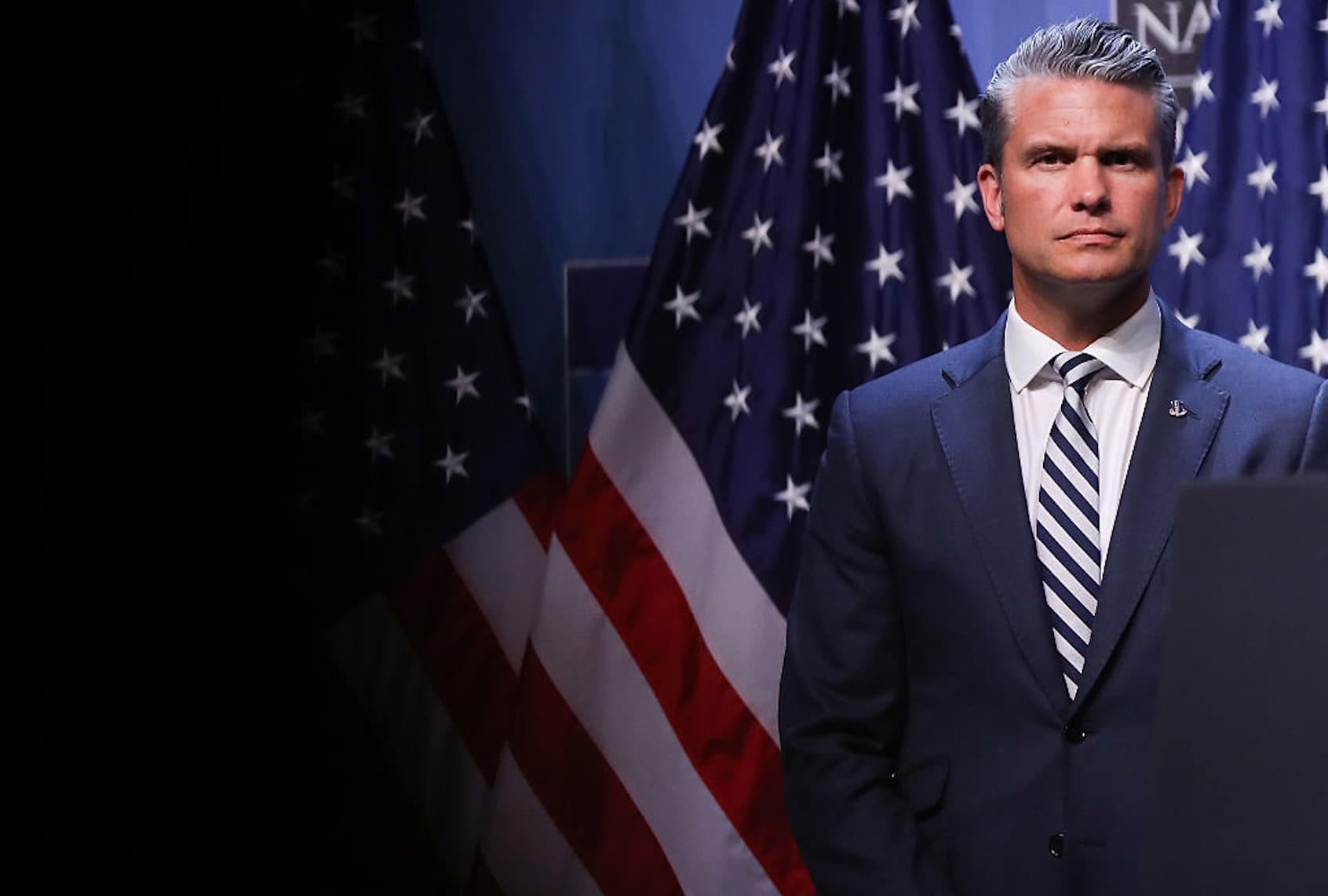
 Defense Secretary Pete Hegseth stands before American flags at a press event.
Hegseth's Mandatory Testosterone Tests for Troops Spark Ridicule
Left says
- •The policy reflects a broader right-wing cultural obsession with testosterone as a proxy for masculinity, treating it as a mythical marker of manly power rather than just one health metric among many.
- •Critics see a glaring irony in Hegseth offering hormone therapy to optimize troops' 'natural capabilities' while simultaneously banning transgender troops and halting gender-affirming care for them.
- •Low testosterone affects only about 2% of men, raising questions about why blanket annual screening for all service members over 30, including women, is necessary or scientifically justified.
- •The move fits a pattern of Hegseth emphasizing macho branding—like calling troops 'warfighters' and pursuing a 'High-T Department of War'—that critics see as performative and insecure rather than substantively focused on military readiness.
Right says
- •Testosterone deficiency is a legitimate medical condition with real consequences for energy, mood, muscle mass, and bone density, and screening for it is a reasonable preventive health measure.
- •Service members may face elevated risk of hypogonadism due to the physical demands of military life, making targeted screening a sensible policy rather than an unusual overreach.
- •The program is voluntary in terms of treatment: those who test positive for low testosterone are offered, not forced into, hormone replacement therapy.
- •The policy is part of a broader effort to sharpen military fitness and readiness standards, alongside other changes to physical fitness testing and body composition measures.
Common Take
High Consensus- Testosterone naturally declines with age and can cause measurable symptoms like fatigue, decreased muscle mass, and mood changes.
- The screening will be incorporated into troops' existing annual Periodic Health Assessments rather than requiring separate appointments.
- Treatment following a positive screening is voluntary, and hormone replacement therapy will not be forced on any service member.
- This policy is one of several fitness and readiness changes Hegseth has implemented during his tenure as defense secretary.
The Arguments
Left argues
Critics see a glaring hypocrisy in offering hormone therapy to 'optimize' cisgender troops' 'natural capabilities' while the same administration banned transgender troops and halted their gender-affirming care, suggesting the objection to hormone therapy was never really medical.
Right counters
The two policies address distinct medical situations—correcting an age-related hormone deficiency in an otherwise stable endocrine system is different from the broader clinical, legal, and readiness questions the administration says are raised by gender transition—so treating them as identical is a category error, even if one disagrees with the transgender policy.
Right argues
Testosterone deficiency is a recognized medical condition with well-documented effects on energy, mood, muscle mass, and bone density, and given the physical toll of military service, proactive screening during routine annual health assessments is a reasonable, low-cost preventive measure rather than an ideological stunt.
Left counters
If this were purely about evidence-based preventive medicine, the policy would target the roughly 2% of men actually at risk rather than mandating annual blanket screening for everyone over 30, including women, which suggests the driving motivation is cultural signaling rather than clinical necessity.
Left argues
The policy fits a broader pattern of Hegseth's macho branding—'warfighters,' the 'High-T Department of War,' fitness and body-composition overhauls—that critics argue is more about performative masculinity and messaging than substantively improving military readiness.
Right counters
Framing and branding aside, the substance of the policy—free diagnostic screening bundled into an existing checkup, with voluntary treatment—is modest and clinically unremarkable; judging it by Hegseth's rhetorical style rather than its actual medical content conflates packaging with policy.
Right argues
The treatment is explicitly voluntary—troops who screen positive are offered, not compelled to undergo, hormone replacement therapy—which undercuts the idea that this is some kind of coercive masculinity mandate.
Left counters
Voluntariness doesn't erase the underlying implication that low testosterone is being framed as a deficiency to be 'fixed' in the name of 'lethality' and 'restoring natural capabilities,' language that reveals an ideological premise about masculinity even if no one is literally forced onto hormones.
Left argues
Low testosterone affects a small share of men and is not established as a widespread problem justifying universal annual testing across the force, including for women, raising doubts about whether this is scientifically driven policy or symbolic messaging.
Right counters
Military populations may face elevated hypogonadism risk due to injury, stress, and physical strain unique to service, and a simple blood test added to an already-scheduled annual exam is a low-burden way to catch a condition whose symptoms—fatigue, low mood, decreased bone density—could otherwise undermine readiness if missed.
Challenge Questions
These questions target genuine internal contradictions — meant to provoke honest reflection.
Right asks Left
“If critics believe hormone therapy should be available to those who medically need it regardless of political framing, why is offering testosterone replacement to servicemembers with diagnosed deficiency treated as absurd or hypocritical rather than as consistent, evidence-based medical care?”
Left asks Right
“If the policy is purely about evidence-based preventive medicine, why mandate blanket annual screening for a condition affecting only about 2% of men rather than targeting screening at those with actual risk factors or symptoms?”
Outlier Report
Left Fringe
Salon's framing (via commentary comparing Hegseth to 'a third-grade boy dressing up his G.I. Joes') represents the most mocking, personal-insult-driven fringe, alongside commentators emphasizing MAGA masculinity psychoanalysis; this represents maybe 20-25% of left commentary, with most mainstream left criticism focusing more on the trans hypocrisy angle than personal ridicule.
Right Fringe
Figures like Dr. Oz and testosterone-optimization influencers (e.g., Bronze Age Pervert-adjacent online masculinity commentators) who treat testosterone as near-magical represent maybe 10-15% of the right and give ammunition to left mockery; most mainstream conservatives and military officials would defend the policy in purely clinical/readiness terms without the macho framing.
Noise Assessment
High noise ratio - the 'ridicule' angle is amplified heavily on social media and by left-leaning commentary outlets, but most Americans likely have a mild, non-visceral reaction to a health screening policy that doesn't personally affect them, making actual public opinion far less polarized than the discourse suggests.
Sources (6)
For a group of people who get their health advice from the supplement ads on Tucker Carlson's podcast, this totally tracks.
Soldiers seem to be at particular risk of hypogonadism
Secretary of Defense Pete Hegseth recently announced required testosterone screenings for some military members.
“This sounds suspiciously like taxpayer-funded gender affirming care,” one commenter wrote.
“This initiative is not about artificial enhancement, it’s about restoring and optimizing your natural capabilities,” Hegseth said.
The defense secretary's obsession with high testosterone levels can't hide MAGA insecurity