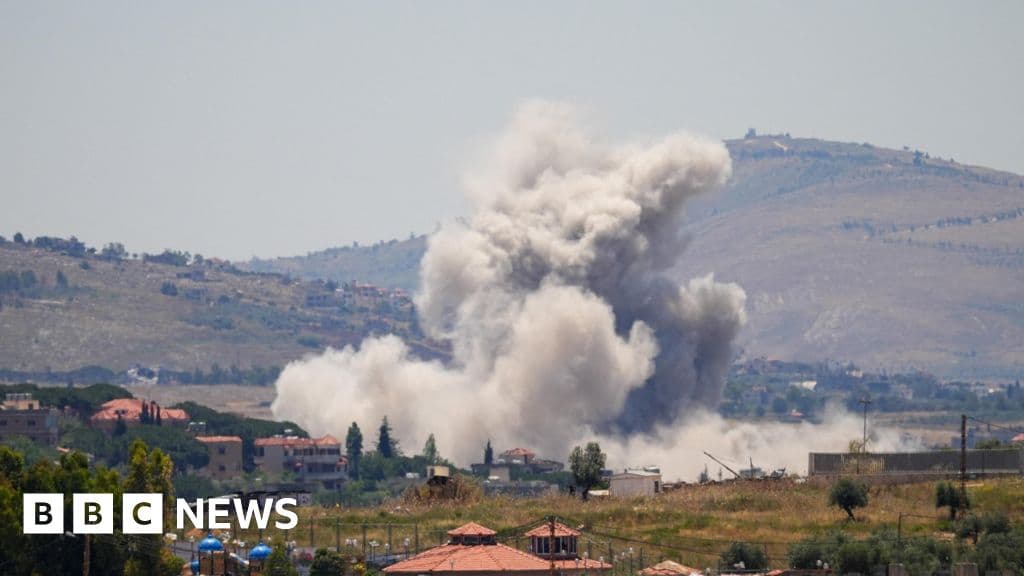
Hezbollah Rejects US-Brokered Ceasefire Deal Between Israel and Lebanon
Left says
- •Trump's aggressive intervention, including an expletive-laden call with Netanyahu, demonstrates the need for diplomatic pressure to prevent escalation in Lebanon
- •The agreement creates meaningful pilot zones where Lebanese Armed Forces will take exclusive control, offering a pathway to restore Lebanese sovereignty
- •Direct negotiations between Israel and Lebanon represent progress toward a comprehensive peace agreement that could resolve longstanding regional tensions
- •The framework rejects attempts by non-state actors to hold Lebanon's future hostage, supporting legitimate government authority
Right says
- •Hezbollah's rejection proves the Iranian proxy remains committed to armed resistance regardless of diplomatic efforts by sovereign governments
- •The ceasefire terms appropriately require Hezbollah to withdraw from southern Lebanon and end attacks before Israel makes concessions
- •Lebanon's government lacks real authority over Hezbollah-controlled territory, making any agreement dependent on the militant group's cooperation
- •Iran's influence through Hezbollah continues to destabilize the region and undermine legitimate peace negotiations
Common Take
High Consensus- Israel and Lebanon's governments reached a ceasefire agreement after US-mediated talks at the State Department
- Hezbollah was not included in the negotiations and has officially rejected the proposed terms
- The agreement requires Hezbollah to withdraw from areas south of the Litani River and end attacks on Israel
- A UN peacekeeper was killed and others wounded in recent fighting in southeastern Lebanon
The Arguments
Left argues
Trump's direct diplomatic intervention, including his confrontational call with Netanyahu, demonstrates effective pressure tactics that prevented massive Israeli strikes on Beirut and created a framework for Lebanese sovereignty through pilot zones controlled by the Lebanese Armed Forces.
Right counters
Trump's intervention only highlights the fundamental problem - any ceasefire depends entirely on Hezbollah's cooperation, and the militant group has already rejected the terms while continuing attacks, proving that diplomatic pressure on Israel alone cannot resolve Iranian proxy resistance.
Right argues
Hezbollah's immediate rejection of ceasefire terms that require them to withdraw from southern Lebanon while allowing Israeli forces to remain proves the Iranian proxy prioritizes armed resistance over Lebanese sovereignty and will undermine any peace agreement.
Left counters
The ceasefire terms are inherently one-sided, demanding Hezbollah withdrawal while Israeli forces remain in Lebanese territory - any legitimate peace process must require mutual withdrawal and cannot expect a resistance movement to surrender while under occupation.
Right argues
Lebanon's government lacks real authority over Hezbollah-controlled territory in southern Lebanon, making any agreement meaningless without the militant group's consent and demonstrating how Iranian influence continues to hold the Lebanese state hostage.
Left counters
The pilot zone framework specifically aims to restore Lebanese government authority by having the Lebanese Armed Forces take exclusive control, offering a practical pathway to strengthen state institutions and reduce non-state actor influence over time.
Left argues
Direct negotiations between Israel and Lebanon represent unprecedented progress toward a comprehensive peace agreement, with both sides committing to future talks and rejecting attempts by non-state actors to control Lebanon's diplomatic future.
Right counters
These negotiations are meaningless theater when the actual military force controlling southern Lebanon - Hezbollah - was excluded from talks and has categorically rejected the results, proving that Iran's proxies will continue destabilizing the region regardless of government agreements.
Challenge Questions
These questions target genuine internal contradictions — meant to provoke honest reflection.
Right asks Left
“If diplomatic pressure and pilot zones can restore Lebanese sovereignty, why does the proposed framework still require Hezbollah's voluntary compliance rather than providing mechanisms to enforce Lebanese government authority against an armed group that explicitly rejects state control?”
Left asks Right
“If Hezbollah's rejection proves Iranian proxies will always choose armed resistance over diplomacy, how do you explain the group's previous acceptance of UN Resolution 1701 in 2006, and what conditions might make future agreements more viable than simply demanding unilateral withdrawal?”
Outlier Report
Left Fringe
Progressive Squad members like Rashida Tlaib and Ilhan Omar, along with activists like Linda Sarsour, who frame any Israeli military action as illegitimate regardless of context. They represent roughly 15-20% of the left coalition.
Right Fringe
Hardline pro-Israel voices like John Hagee and some evangelical leaders who oppose any negotiations with Iran-backed groups and favor maximum military pressure. They represent about 25-30% of the right coalition.
Noise Assessment
Moderate noise level - most discourse reflects genuine policy disagreements rather than performative positioning, though social media amplifies the most extreme voices on both sides.
Sources (7)
<p><a href="https://www.axios.com/world/israel" target="_blank">Israel</a> and Lebanon agreed to implement a full ceasefire, contingent on Hezbollah halting attacks and withdrawing its operatives from the area south of the Litani River in Lebanon, according to a joint statement from the U.S., Israel and Lebanon.</p><p><strong>Why it matters:</strong> <a href="https://www.axios.com/2026/06/01/lebanon-full-ceasefire-hezbollah-israel-nabih-berri" target="_blank">Hezbollah</a> had already said it would agree to a full ceasefire, but it was not immediately clear whether the Shia militia would accept the terms agreed by the Israeli and Lebanese governments.</p><hr /><ul><li>A full ceasefire in Lebanon is one of the key demands <a href="https://www.axios.com/world/iran" target="_blank">Iranian</a> officials have made as part of their negotiations with the Trump administration on an agreement for ending the war.</li></ul><p><strong>Driving the news:</strong> On Monday, President <a href="https://www.axios.com/politics-policy/donald-trump" target="_blank">Trump</a> put the brakes on Israel's plan to launch massive strikes on Beirut in retaliation for Hezbollah's drone and missile strikes. </p><ul><li>Trump lashed out at Israeli Prime Minister Benjamin Netanyahu in an <a href="https://www.axios.com/2026/06/01/trump-netanyahu-israel-lebanon-call" target="_blank">expletive-laden call</a>. </li><li>After the call, Trump announced a new partial ceasefire in Lebanon that included an Israeli commitment not to attack Beirut in return for Hezbollah stopping attacks on Israeli towns along the border. </li><li>Despite the announcement, Hezbollah has conducted several drone attacks against targets inside Israel over the past 48 hours. </li></ul><p><strong>Zoom in: </strong>The new agreement between Israeli and Lebanese officials was reached after two days of negotiations between the two countries at the U.S. State Department, mediated by Trump officials. </p><ul><li>As part of this understanding, the two sides agreed to create "pilot zones" in southern Lebanon in which the Lebanese Armed Forces will take exclusive control and make sure there is no Hezbollah presence. In return, the Israel Defense Forces will withdraw from the area.</li><li>"These steps will enable progress towards a comprehensive peace and security agreement," the parties said in a joint statement. </li></ul><p><strong>Zoom in: </strong>"All countries reaffirmed that the future of the relationship between Israel and Lebanon must be decided by the two sovereign governments," the joint statement said.</p><ul><li>"They rejected any attempt, by any state or non-state actor, to hold Lebanon's future hostage."</li></ul><p><strong>What to watch: </strong>In the joint statement, Israel and Lebanon "reaffirmed that they have no hostile intent toward one another and committed to continuing direct negotiations to build confidence, resolve all outstanding issues, and work toward a comprehensive agreement between the two countries."</p><ul><li>The parties agreed to hold another round of negotiations over a comprehensive agreement on June 22 in Washington, D.C.</li></ul><p><strong>Go deeper: </strong><a href="https://www.axios.com/2026/06/03/trump-netanyahu-call-lebanon-iran-ny-post" target="_blank">Trump confirms profanity-laced Netanyahu call over Lebanon</a></p><p><em>Editor's note: This is a breaking news story. Please check back for updates.</em></p>
The United States announced the ceasefire agreement on Wednesday night following a fresh round of talks.
<p>Israel and Lebanon agreed Wednesday to implement a U.S.-brokered ceasefire framework contingent on Hezbollah ending its attacks.</p> <p>The post <a href="https://www.breitbart.com/politics/2026/06/03/following-u-s-mediated-talks-israel-lebanon-agree-ceasefire-hezbollah-ends-attacks/" rel="nofollow">Following U.S.-Mediated Talks, Israel and Lebanon Agree to Ceasefire if Hezbollah Ends Attacks</a> appeared first on <a href="https://www.breitbart.com" rel="nofollow">Breitbart</a>.</p>
'The resistance will continue'
Hezbollah is widely regarded as an Iranian proxy group and the implications of the continued fighting for the broader negotiations remain unclear.
The U.N. peacekeeping mission for Lebanon, known as UNIFIL, said one peacekeeper was killed and others were wounded when they came under mortar fire in southeastern Lebanon.
Hezbollah on Thursday rejected the latest U.S.-brokered ceasefire agreement between Israel and Lebanon, which will create “pilot zones” in which Beirut will work to drive out the militant group. Hezbollah’s leader, Naim Kassem, described the ceasefire as “absurd, humiliating, and insulting” while urging Israel to withdraw from southern Lebanon entirely, according to The Associated Press. …