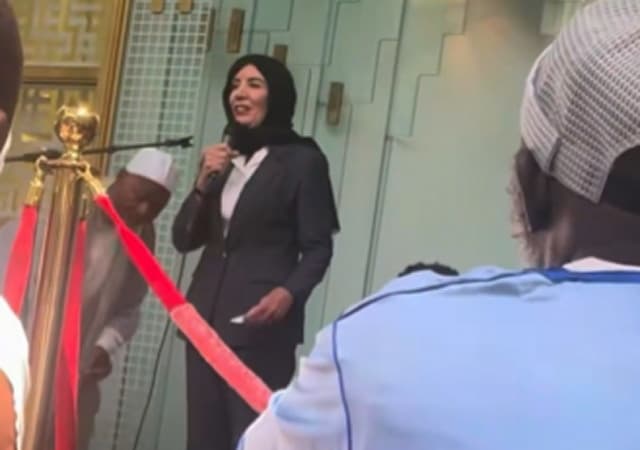
 Kathy Hochul wearing a hijab while speaking at a mosque event.
Hochul's Hijab at Mosque Sparks 'Feminist Icon' Backlash
Left says
- •Wearing a head covering at a mosque, funeral, or house of worship is a common courtesy extended out of respect for the customs of the community being visited, not an endorsement of a religious or political worldview.
- •Hochul has framed her actions as consistent with how leaders and decent people show respect for a 'grieving family's faith,' pointing to her prior appearance at a Muslim police officer's funeral.
- •The backlash is seen as disproportionate and driven by a right-wing media ecosystem eager to caricature a Democratic governor rather than engage with substantive policy issues.
- •Framing this as a 'feminist' betrayal is viewed as a bad-faith attempt to weaponize feminism against a political opponent rather than a genuine concern about women's rights.
Right says
- •Critics argue that a self-described feminist adopting a head-covering associated with female modesty codes sends a contradictory message about women's equality.
- •The timing, just before the 25th anniversary of 9/11, strikes many as tone-deaf given the attacks' association with radical Islamist ideology.
- •Some point to Hochul's broader political alliances, including her endorsement of Mayor Mamdani, as evidence of a pattern of pandering to Muslim political constituencies rather than genuine cultural respect.
- •Questions are raised about foreign influence, noting that the mosque she visited has reported funding ties to Kuwait, fueling suspicion about the motives behind her outreach.
Common Take
High Consensus- Hochul wore a head covering while visiting the Islamic Cultural Center of New York and speaking at a Friday Jummah prayer service.
- This was not the first time Hochul wore a headscarf at a Muslim community event, having done so previously at the funeral of NYPD Detective Didarul Islam.
- The event occurred close to the 25th anniversary of the 9/11 attacks, a fact both sides note as relevant context.
- The reaction to Hochul's clothing choice became a major social media flashpoint, with figures like Spencer Pratt drawing widespread attention to it.
The Arguments
Left argues
Wearing a head covering when visiting a mosque or attending a religious service is a widely recognized gesture of courtesy and respect for the customs of one's hosts, not an ideological endorsement, and Hochul has done this consistently, including at a Muslim police officer's funeral.
Right counters
Courtesy has limits, and a self-described feminist voluntarily donning a symbol many associate with mandated female modesty codes sends a message that goes beyond politeness, especially when done repeatedly and photographed for political consumption.
Right argues
The timing—days before the 25th anniversary of 9/11—combined with Hochul's political alliance with Mamdani, who has ties to controversial religious figures, suggests a pattern of political pandering to a specific voting bloc rather than simple cultural sensitivity.
Left counters
Tying a routine act of religious courtesy to 9/11 conflates ordinary American Muslims and their customs with terrorism, an inference critics say is both unfair and exactly the kind of guilt-by-association rhetoric that fuels anti-Muslim bigotry.
Left argues
The 'feminist icon' mockery is a bad-faith weaponization of feminist language by commentators who show little sustained interest in women's rights issues, deployed here specifically to score partisan points against a Democratic governor.
Right counters
Pointing out an apparent inconsistency between a politician's stated values and her public actions is fair political criticism regardless of who raises it; the identity of the critic doesn't neutralize the substance of the contradiction.
Right argues
The revelation that the mosque she visited has reported funding ties to Kuwait raises legitimate questions about foreign influence and the political relationships state leaders are cultivating with foreign-linked institutions.
Left counters
Many religious institutions in the U.S., including churches and synagogues, receive international funding or support without triggering accusations of foreign meddling, so singling out this mosque's funding appears selectively applied to delegitimize Muslim civic participation.
Left argues
Focusing outrage on a governor's headscarf while ignoring substantive governance questions—like disputed counterterrorism funding cuts affecting actual public safety—reflects a media ecosystem more interested in cultural spectacle than policy accountability.
Right counters
Symbolic gestures by public officials are legitimate subjects of scrutiny because they reveal priorities and political calculations, and criticizing the optics doesn't preclude also holding her accountable on funding and policy issues.
Challenge Questions
These questions target genuine internal contradictions — meant to provoke honest reflection.
Right asks Left
“If wearing culturally specific attire out of respect is always benign regardless of context, would the same defense apply if a Democratic politician wore culturally conservative Christian or Orthodox Jewish dress at a house of worship shortly before a politically sensitive anniversary, or does the reaction depend on which religion is involved?”
Left asks Right
“If your objection is genuinely about protecting women's equality rather than pandering to anti-Muslim sentiment, why is the same 'feminist hypocrisy' critique rarely leveled at conservative women who wear head coverings in Christian or Orthodox Jewish religious contexts?”
Outlier Report
Left Fringe
Progressive activists who would argue any criticism of hijab-wearing is inherently Islamophobic and refuse to engage with feminist critiques at all; this represents maybe 10-15% of the left, more strident than HuffPost's fairly measured piece.
Right Fringe
Commentators like Rob Schmitt ('subjugate yourself to Islam and men') and accounts pushing Kuwait-funding conspiracy angles (NYYRC) represent a more inflammatory 20-25% of the right that frames this as active civilizational betrayal rather than simple political criticism.
Noise Assessment
High noise ratio - this is largely a social-media-driven pile-on (Spencer Pratt, End Wokeness, viral clips) amplified by conservative media outlets, with actual polling on hijab-wearing-by-politicians nonexistent; the loudest voices on both sides likely represent a small, highly engaged fraction of actual public sentiment, which is probably more indifferent or mildly skeptical than either side's framing suggests.
Sources (7)
<p>New York Gov. Kathy Hochul (D) is taking heat for wearing a Muslim head scarf while speaking at the Islamic Cultural Center of New York in Queens over the weekend.</p> <p>The post <a href="https://www.breitbart.com/faith/2026/09/01/photo-new-york-democrat-gov-kathy-hochul-torched-for-wearing-muslim-hijab-feminist-icon/" rel="nofollow">PHOTO — New York Democrat Gov. Kathy Hochul Torched for Wearing Muslim Hijab: ‘Feminist Icon’</a> appeared first on <a href="https://www.breitbart.com" rel="nofollow">Breitbart</a>.</p>
New York Gov. Kathy Hochul accused President Donald Trump of "defunding the police," saying that DHS is "withholding" millions of dollars in funding.
The Michigan Democratic Convention opened with a botched land acknowledgement as vice chair Portia Roberson struggled to pronounce Anishinaabe names.
The state leader took a beating from right-wingers like Riley Gaines and Spencer Pratt over the silliest issue.
<p>This is nothing more than pandering, and it's an utter disgrace.</p> The post <a href="https://legalinsurrection.com/2026/08/new-york-governor-kathy-hochul-dons-hijab-for-event-at-muslim-organization/">New York Governor Kathy Hochul Dons Hijab for Event at Muslim Organization</a> first appeared on <a href="https://legalinsurrection.com">Le·gal In·sur·rec·tion</a>.
A land acknowledgment meant to open the Michigan Democratic Party's state nominating convention on a note of unity instead turned into an awkward public correction session on how to pronounce a Native tribe names.