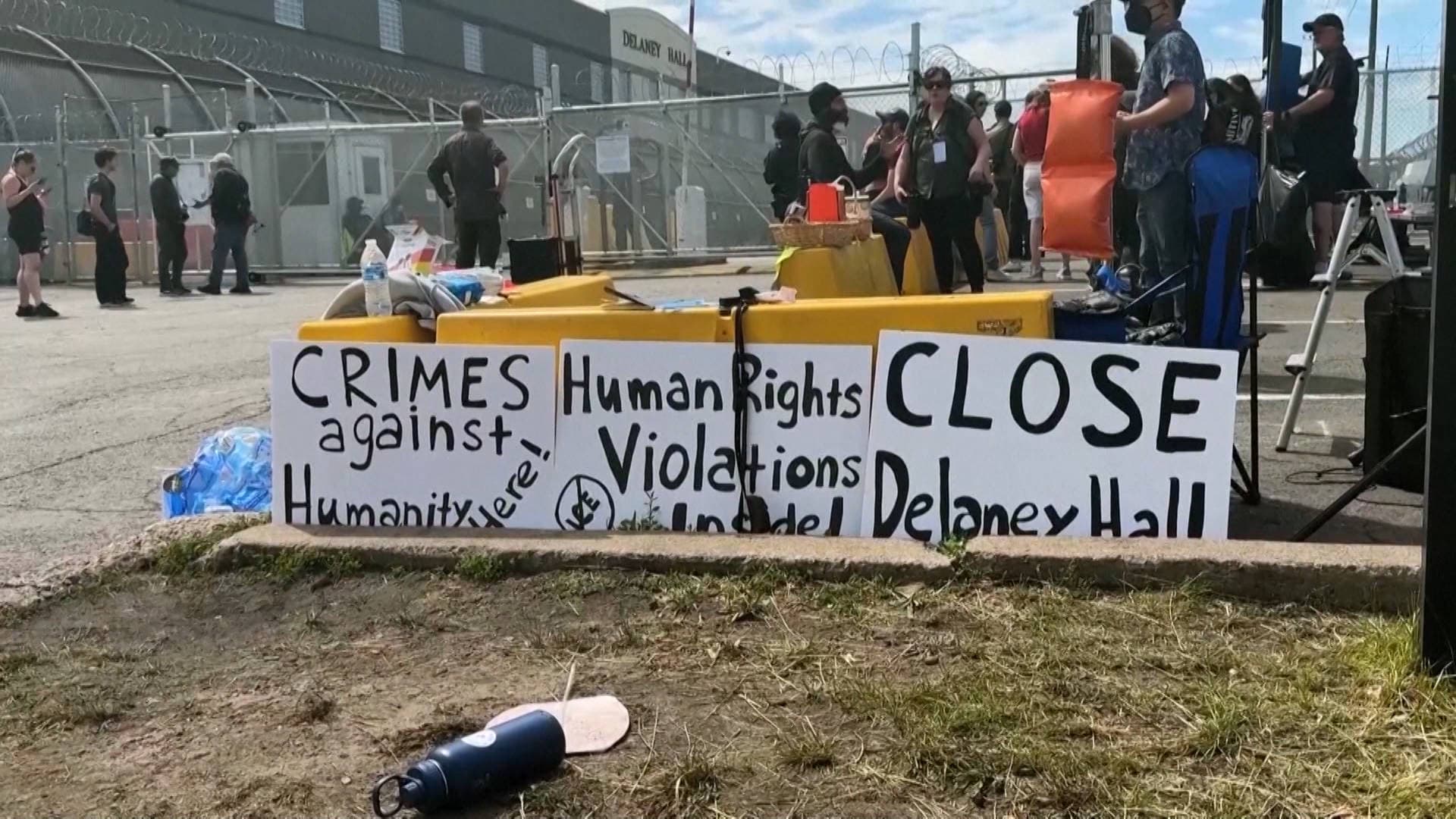
 Protesters gather outside ICE detention facility with signs demanding closure of Delaney Hall
ICE Agents Use Tear Gas, Batons Against Hunger Strike Protesters
Left says
- •Detainees are protesting inhumane conditions including spoiled food with maggots, overcrowding, inadequate medical care, and forced labor for $1 per day wages
- •ICE agents and guards are retaliating against peaceful protesters with violence, pepper spray, beatings, and isolation transfers
- •The private prison company GEO Group profits from exploiting detained immigrants while providing substandard conditions
- •Federal immigration enforcement has become increasingly militarized and operates with impunity under current policies
Right says
- •ICE agents were responding to protesters who blocked government vehicles and created public safety concerns outside the detention facility
- •Detention facilities must maintain order and security protocols to protect staff, detainees, and the surrounding community
- •Work programs provide detainees with structure, skills, and compensation while helping facilities operate efficiently
- •Immigration enforcement agencies have legal authority to detain individuals pending deportation proceedings and transfer them as needed
Common Take
High Consensus- Hundreds of detainees at Delaney Hall have been on hunger and labor strikes for nearly two weeks
- Physical confrontations occurred between protesters and ICE agents outside the Newark facility
- Family members and advocates have been demonstrating outside Delaney Hall in solidarity with detainees
- New Jersey officials including the Attorney General have taken legal action seeking greater oversight of the facility
The Arguments
Left argues
Detainees are protesting genuinely inhumane conditions including food with maggots, overcrowding, and inadequate medical care, yet ICE agents responded to peaceful hunger strikers with violence including pepper spray, beatings, and punitive transfers.
Right counters
ICE agents were responding to protesters who blocked government vehicles and created public safety risks, requiring law enforcement to maintain order and security protocols to protect staff, detainees, and the community.
Right argues
Work programs provide detainees with structure, skills, and compensation while helping facilities operate efficiently, and immigration enforcement agencies have legal authority to detain individuals pending deportation proceedings.
Left counters
Paying detainees $1-4 per day for essential facility operations while charging $24 for shoes constitutes exploitative forced labor that primarily benefits the private prison company's profit margins, not the detainees.
Left argues
The private prison company GEO Group profits from a system that incentivizes keeping people detained in substandard conditions, creating a fundamental conflict between human welfare and corporate profits.
Right counters
Private contractors operate under federal oversight and must meet contractual standards, while providing cost-effective detention services that allow government agencies to focus resources on enforcement rather than facility management.
Right argues
Detention facilities must maintain strict security protocols and order to ensure the safety of staff, other detainees, and prevent escapes or violence that could endanger the surrounding community.
Left counters
Using tear gas and batons against people conducting peaceful hunger strikes represents excessive force that violates basic human rights and constitutional protections, regardless of security concerns.
Left argues
Federal immigration enforcement has become increasingly militarized and operates with impunity, as evidenced by masked agents using military-style tactics against protesters and even arresting local elected officials.
Right counters
Federal agents have jurisdiction and authority to enforce immigration law, and when protesters interfere with official operations or block government vehicles, law enforcement must respond appropriately to maintain the rule of law.
Challenge Questions
These questions target genuine internal contradictions — meant to provoke honest reflection.
Right asks Left
“If the conditions at Delaney Hall are truly as deplorable as described, why haven't state health inspectors or federal oversight agencies already intervened to shut down the facility or mandate immediate improvements?”
Left asks Right
“How can a system that relies on detainees working for $1-4 per day to maintain basic facility operations be considered anything other than a form of forced labor, especially when detainees face punishment for refusing to work?”
Outlier Report
Left Fringe
Abolish ICE activists like Alexandria Ocasio-Cortez and groups calling for complete dismantling of immigration enforcement represent roughly 15-20% of the left. Most Democrats support immigration reform and better conditions rather than elimination of detention entirely.
Right Fringe
Immigration hardliners like Stephen Miller and some Trump administration officials who defend any level of force against detained immigrants represent about 25% of the right. Most Republicans support border security but not necessarily harsh treatment of detainees in custody.
Noise Assessment
Moderate noise level. While advocacy groups amplify the story significantly, the core issues of detention conditions and use of force against protesters resonate with genuine public concern beyond activist circles.
Sources (6)
Anger building over conditions at Immigration and Customs Enforcement detention centers is focused again Tuesday on a facility in Newark, New Jersey, where protesters are still gathered a day after their charged demonstration turned chaotic. Protesters at Delaney Hall – a privately owned, 1,000-bed facility where inhumane conditions have been alleged for months – blocked unmarked government vehicles and tussled with armed, masked ICE agents, including some who used gas canisters and batons, video from Freedom News TV obtained by CNN shows.
Hundreds of immigrants detained at the <span class="caps">ICE</span> jail known as Delaney Hall in Newark, New Jersey, have been on a hunger and labor strike for nearly two weeks. They are protesting the conditions at the jail, including spoiled food that has had maggots in it, overcrowding and inadequate medical care. Detainees are also forced to work for around $1 per day. In retaliation against the strike, guards at Delaney Hall have reportedly beaten participants, and family visitation was temporarily suspended. The strikers are demanding their release from the <span class="caps">ICE</span> jail and that the most vulnerable populations are freed first.</p> <p>Detainees’ family members, along with immigration advocates and anti-<span class="caps">ICE</span> protesters, have been rallying outside Delaney Hall since the strike began. <em>Democracy Now!</em>’s María Taracena was outside Delaney on Tuesday. She spoke to a man who had just been released from detention, a community organizer, a lawyer and family members who were waiting to visit their loved ones inside the <span class="caps">ICE</span> jail.</p> <p>Police have erected barricades half a mile around Delaney Hall, “making it more and more difficult to go and visit those who are on labor and hunger strike,” says Natalie, a New Jersey volunteer with the mutual aid group Eyes on <span class="caps">ICE</span>. “I was trying to see my father. He recently got put in,” says the daughter of a man being held in Delaney Hall. She is struggling to find legal support for her father. “He does not deserve to go to another country when he belongs in this one.”
We get an update on protests at Newark, New Jersey’s Delaney Hall, an <span class="caps">ICE</span> facility owned and operated by the private prison company <span class="caps">GEO</span> Group, where hundreds of immigrant detainees have been on a hunger and labor strike for the past week demanding their immediate release. New Jersey Congressmember Analilia Mejía recently toured the facility and spoke to people who described being arrested and detained after attending routine <span class="caps">ICE</span> check-ins, being held for months in appalling conditions even after signing voluntary deportation orders, and being hospitalized after they were beaten and pepper-sprayed by armed <span class="caps">ICE</span> agents. “What we need to understand is that this is a for-profit model, and they are failing human beings,” she says. “The reality is that this is a rogue administration that has handed undue power to agencies, to <span class="caps">ICE</span> agents and to entities like <span class="caps">GEO</span> Group [that] are now acting with impunity.”</p> <p>Meanwhile, says Li Adorno, a community organizer with the immigrant rights group Movimiento Cosecha, protests outside the facility in solidarity with the strike have grown increasingly contentious. Local investigative journalist Bob Hennelly explains that the Trump administration’s targeting of Newark for immigration enforcement has escalated since federal agents arrested and charged Newark Mayor Ras Baraka and New Jersey Congressmember LaMonica McIver with trespassing after inviting them into Delaney Hall last May. Hennelly says “there’s a much broader implosion of the administration of law in New Jersey … [and] a collapse of federal law enforcement in Newark.”
Around 300 immigrants detained at the Delaney Hall <span class="caps">ICE</span> jail in Newark, New Jersey, have been on a hunger and work strike since Friday to protest inhumane conditions and due process violations. Delaney Hall is operated by the private prison company <span class="caps">GEO</span> Group. Since the hunger strike was launched, immigration advocates have been staging a solidarity protest outside Delaney Hall to promote the detainees’ demands for freedom. Protesters and <span class="caps">ICE</span> agents have clashed outside the jail, and three people have been arrested. Tensions escalated on Sunday when <span class="caps">ICE</span> removed a hunger strike organizer, Martín Soto, prompting protesters outside the <span class="caps">ICE</span> jail to block a van being used to transport him. Masked <span class="caps">ICE</span> agents responded by firing tear gas and pushing people to the ground. Soto was ultimately transferred to an <span class="caps">ICE</span> jail in Elizabeth, New Jersey, and is now facing criminal charges for allegedly assaulting an <span class="caps">ICE</span> officer.</p> <p>We speak to Gabriela Soto, Martín Soto’s wife, and Li Adorno, an organizer with the group Movimiento Cosecha. Both have helped lead the protest outside Delaney Hall.</p> <p>Gabriela Soto says that she started the protest in conjunction with the detainees’ strike so that the media could see how <span class="caps">ICE</span> is “destroying families and separating them.” Soto says that when she was blocked from seeing her husband during visiting hours on Saturday, a guard asked her why she was “spreading lies” and talking to the press. “He said, 'Why are you telling people that we're feeding them worms? Why are you telling people that we don’t give them medical care?’ I said, 'Because it's true.’”
It has now been almost two weeks since the laborers keeping ICE’s Delaney Hall mega-jail open went on strike—demanding a chance to speak with New Jersey Gov. Mikie Sherrill, reviews of their cases, and ultimately, their freedom. Those workers are the detainees themselves, who serve as custodians, line cooks, hairdressers, laundry workers, and janitors at […]
<p>Detainees told a visiting member of Congress that the attacks were “retribution for the ongoing hunger strike.”</p> <p>The post <a href="https://theintercept.com/2026/05/29/ice-pepper-spray-nj-newark-delaney/">ICE Pepper-Sprayed, Beat Detainees for Protesting “Horrific Conditions” in Delaney Hall Jail</a> appeared first on <a href="https://theintercept.com">The Intercept</a>.</p>