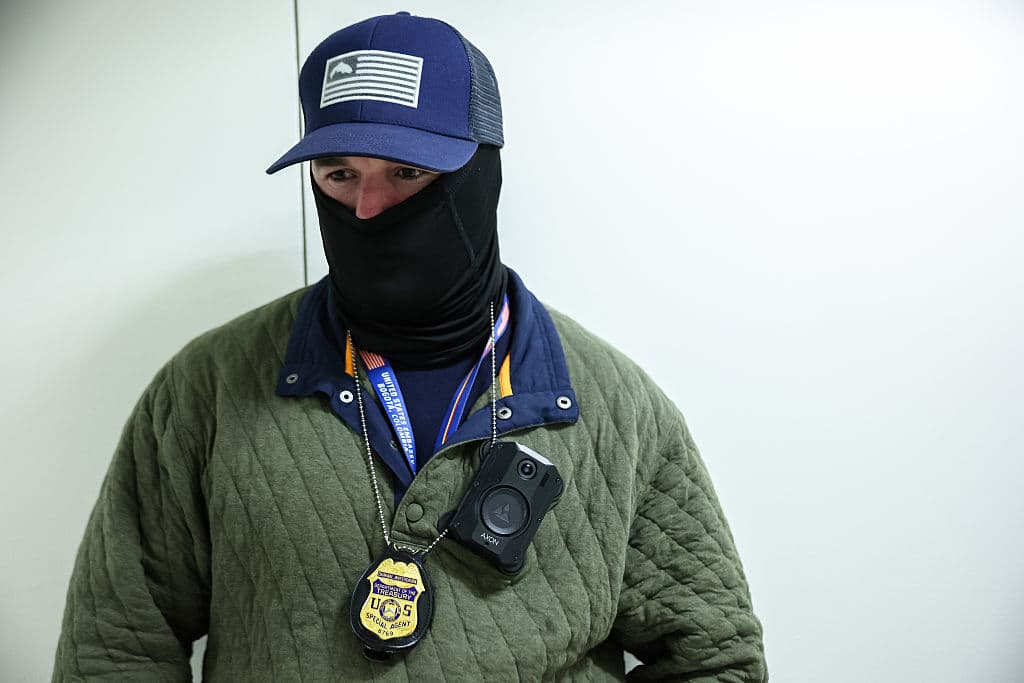
 Masked federal agent wearing a visible body camera around his neck.
ICE Body Cameras Coming, But Agency Controls What Public Sees
Left says
- •ICE's discretion to withhold footage after deaths or serious injuries undermines the accountability body cameras are supposed to provide, especially as fatal shootings by immigration officers have mounted.
- •The 'best interests of the agency' standard lets the ICE director release footage that flatters the agency while burying incidents that don't, effectively turning body cameras into a public-relations tool rather than an oversight mechanism.
- •Experts note that neither of two recent fatal shootings in Texas and Maine was captured on body camera at all, raising doubts about how consistently the technology will actually be deployed and activated during critical incidents.
- •Selective-release policies are common elsewhere in policing, but rights advocates stress that codifying image management so explicitly in written policy is unusually blunt and normalizes withholding evidence from the public that funds the program.
Right says
- •ICE is finally delivering on a long-promised expansion of body cameras, equipping virtually its entire field force within months, which should be recognized as a significant step toward transparency and officer accountability.
- •Acting Director Venturella says the Associated Press mischaracterized the policy by conflating a narrow provision about expedited release after death or serious injury with the agency's broader, separate authority to release footage generally.
- •ICE's approach to withholding footage that could compromise investigations or violate privacy mirrors standard practice at other federal law enforcement agencies and complies with FOIA and the Privacy Act.
- •Critics and media reports are accused of ginning up a scandal over routine law-enforcement discretion rather than acknowledging the substantial investment and rapid rollout the agency has undertaken.
Common Take
High Consensus- ICE plans to have body cameras on all field officers and agents by the end of August or September, depending on the report.
- The rollout follows years of delay and comes amid intensified scrutiny after recent fatal shootings by immigration officers in Texas and Maine.
- ICE's written policy explicitly ties release of footage after deaths or serious injuries to a determination that doing so serves the agency's 'best interests.'
- Neither side disputes that a review committee of senior officials and attorneys will evaluate footage before recommending release, with the director retaining power to delay it.
The Arguments
Left argues
By explicitly conditioning expedited release of footage from deaths and serious injuries on the 'best interests of the agency,' ICE has written image management directly into policy, letting officials release flattering footage while burying damaging incidents.
Right counters
Venturella says this conflates a narrow expedited-release provision with ICE's broader release authority, and that the actual standard is whether disclosure would compromise investigations or privacy—the same limits other federal agencies operate under.
Right argues
ICE is completing a long-delayed rollout that will put cameras on virtually every field officer within months, a major investment and operational shift that deserves recognition as a step toward accountability rather than reflexive suspicion.
Left counters
Equipping officers with cameras means little for accountability if the public can be kept from seeing the footage indefinitely whenever the agency decides release isn't in its interest, and if cameras aren't even activated during fatal encounters as happened in Texas and Maine.
Right argues
ICE's discretion to withhold footage that could compromise investigations or violate privacy mirrors standard federal law enforcement practice and complies with FOIA and the Privacy Act, so singling out ICE's policy as uniquely alarming is unfair.
Left counters
Experts note that while selective release is common elsewhere, explicitly codifying an 'agency's best interests' standard in written policy is unusually blunt, openly normalizing image management in a way most agencies avoid stating outright.
Left argues
The fact that neither recent fatal shooting in Texas nor Maine was captured on body camera raises serious doubts about whether officers will reliably activate cameras during the critical incidents where accountability matters most.
Right counters
These incidents predate the completed rollout, and rapidly expanding camera coverage to nearly all field officers by August is precisely the kind of infrastructure investment that will reduce such gaps going forward.
Right argues
Media coverage framed a routine, legally consistent discretion provision as a scandal, mischaracterizing the policy by conflating the expedited-release rule for deaths/injuries with ICE's separate general release authority.
Left counters
The AP report never claimed the provision governs all releases—it specifically examined the policy for serious injuries and deaths, the exact scenarios where public accountability is most urgent and where discretion is most consequential.
Challenge Questions
These questions target genuine internal contradictions — meant to provoke honest reflection.
Right asks Left
“If selective release discretion is standard practice across federal law enforcement agencies, why should ICE's version be treated as uniquely scandalous rather than as ICE simply adopting existing norms?”
Left asks Right
“If the policy's discretionary standard is truly just routine and comparable to other agencies, why did ICE need to publicly rebut the AP's characterization rather than simply pointing to those comparable agency policies as self-evident proof?”
Outlier Report
Left Fringe
Groups like Mijente and some immigrant-rights activists who argue body cameras are meaningless PR theater and ICE itself should be abolished represent roughly 10-15% of the left, more extreme than the synopsis's accountability-reform framing.
Right Fringe
Commentators like RedState's contributors and some pro-Trump media figures who dismiss any scrutiny of ICE as media 'ginning up scandal' represent a vocal but not universal slice, maybe 25-30% of the right, while more moderate conservatives may still want genuine transparency.
Noise Assessment
Moderate; the AP-vs-ICE dispute over 'mischaracterization' is largely an elite media/political fight, while most ordinary Americans likely hold a simpler, less partisan view that cameras are good but self-policing on release is concerning.
Sources (7)
U.S. Immigration and Customs Enforcement said it expects every field officer and agent to have a body camera by the end of August, providing a broad visual record of federal immigration enforcement.
The agency defended its body-worn camera policy amid questions about provisions allowing ICE leadership to withhold or indefinitely delay footage after serious injuries or deaths in custody.
U.S. Immigration and Customs Enforcement (ICE) will equip its officers with body cameras over the next two months, according to reports, but the agency’s policy gives officials broad discretion over footage released to the public that’s deemed in its “best interests.” More than half of the agency’s field officers have already been outfitted with the body…
Immigration and Customs Enforcement is moving to equip officers with body cameras in the next two months but the agency's policy gives it broad control over what footage will be made public by specifying any releases must be in its "best interests."
Immigration and Customs Enforcement is moving to equip officers with body cameras in the next two months but the public should not expect to quickly see footage of every critical incident
Officers to wear cameras by September, but ICE retains broad discretion over releasing serious-incident footage