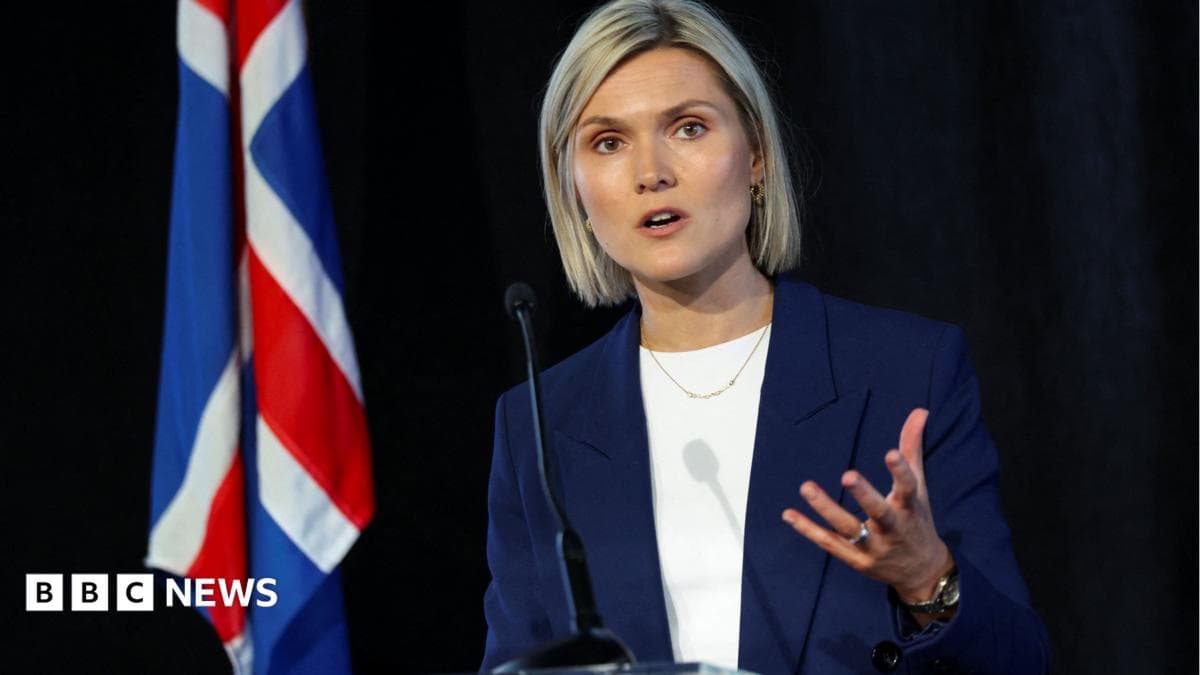
Iceland Narrowly Rejects Resuming EU Membership Talks
Left says
- •Iceland already complies with roughly 75% of EU rules through the European Economic Area, so full membership represents a logical next step rather than a radical shift, and joining would not fundamentally upend the Icelandic economy or way of life.
- •EU membership could bring lower inflation and interest rates and eventual adoption of the euro, offering greater economic stability for a small economy vulnerable to shocks like the 2008 banking collapse.
- •The referendum itself is a democratic win, giving citizens a direct voice on a long-debated question after years of the issue being shelved by prior euroskeptic governments.
- •Rising geopolitical tensions, including Trump's rhetoric about Greenland, underscore the value of deeper security and economic ties with European partners for a nation without its own military.
Right says
- •Icelanders prioritized protecting sovereignty over their fishing grounds, a resource that accounts for nearly 40% of exports and would be subject to the EU's common fisheries policy under membership.
- •Iceland already enjoys the practical benefits of free trade and travel through the European Economic Area and Schengen zone without having to cede decision-making power to Brussels.
- •As a small nation of under 400,000 people, Iceland's voice would be easily outweighed in a European Parliament dominated by 27 other member states, making independent trade deals, such as with China, a preferable path.
- •Trump's threats toward Greenland were not persuasive enough to push voters toward the EU, showing that fears about fishing rights and sovereignty outweighed any perceived security benefits from closer European integration.
Common Take
High Consensus- 52.8% of voters rejected resuming EU accession talks while 47.2% supported it, a margin of about 12,600 votes.
- Turnout reached 82.5%, the highest in any Icelandic election since 2009.
- Reykjavik was the only region where a majority backed resuming talks.
- Fishing rights and concerns over sovereignty were central to the debate on both sides.
- Prime Minister Kristrún Frostadóttir's government has committed to respecting the result despite the referendum being nonbinding.
The Arguments
Left argues
Iceland already complies with roughly 75% of EU rules through the European Economic Area, so full membership is a logical continuation rather than a radical shift, and it would not fundamentally upend the Icelandic economy or way of life.
Right counters
If Iceland already gets nearly all the practical benefits of membership through the EEA and Schengen without ceding sovereignty over fisheries or a seat at the table dominated by 27 larger states, the remaining 25% represents precisely the meaningful decision-making power worth protecting.
Right argues
Icelanders prioritized protecting their fishing grounds, which account for nearly 40% of exports, from being subject to the EU's common fisheries policy, a resource they fought to secure from foreign fleets during the Cod Wars.
Left counters
Fishing rights concerns, while legitimate, could plausibly have been negotiated as part of accession terms rather than serving as a blanket reason to reject even opening talks, especially since a 'yes' vote would only have started negotiations, not guaranteed final membership terms.
Left argues
EU membership could bring lower inflation and interest rates and eventual adoption of the euro, offering greater economic stability for a small economy that was devastated by the 2008 banking collapse.
Right counters
Currency and monetary stability arguments overlook that Iceland has already recovered and stabilized its own currency since 2008 without the euro, and adopting it would strip the country of independent monetary policy tools it might need during future asymmetric shocks.
Right argues
As a small nation of under 400,000 people, Iceland's voice would be easily outweighed in a European Parliament dominated by 27 other member states, making independent trade deals, such as with China, a preferable path to preserve its influence.
Left counters
Small EU members like Malta and Luxembourg still exercise real influence and veto power on key issues, and pooling sovereignty with a bloc of like-minded democracies may offer more genuine leverage than a lone 400,000-person nation negotiating bilaterally against much larger powers like China.
Left argues
Rising geopolitical tensions, including Trump's rhetoric about Greenland, underscore the value of deeper security and economic ties with European partners for a nation without its own military.
Right counters
The referendum results show this argument failed to persuade voters, who apparently judged that Iceland's existing NATO membership and U.S. defense agreement already provide sufficient security without needing to trade away fishing rights and sovereignty for EU membership.
Challenge Questions
These questions target genuine internal contradictions — meant to provoke honest reflection.
Right asks Left
“If the Prime Minister herself argues Iceland already follows 75% of EU rules and that membership 'is not going to sink the country,' why should voters see full accession as a meaningful economic upgrade rather than a symbolic transfer of sovereignty with modest practical benefit?”
Left asks Right
“If Iceland values the frictionless trade and travel benefits of the EEA and Schengen zone without formal EU membership, does relying on independent deals with powers like China truly offer more leverage or protection than pooling influence with a bloc of democratic allies, especially amid rising great-power pressure on small nations?”
Outlier Report
Left Fringe
Ardent EU-integrationist commentators and outlets like Vox or some MSNBC contributors might frame the 'no' vote as a populist/nationalist backlash akin to Brexit, casting it negatively; this view represents maybe 10-15% of the left.
Right Fringe
Hardline nationalist voices, such as some in the America First media ecosystem (e.g., commentators sympathetic to Steve Bannon's worldview), might over-interpret the vote as validation of Trump's Greenland rhetoric or anti-globalist sentiment; this represents maybe 10% of the right.
Noise Assessment
Overall discourse volume is low since this is a niche foreign policy story; most Americans have limited awareness or investment in Icelandic EU politics, so actual public opinion signals are weak and largely inferred from general ideological priors rather than direct engagement.
Sources (6)
Broadcaster RUV reports that 52.8% of voters rejected the government's proposal to resume talks.
The country is already part of the European Economic Area and the Schengen Area, which allows frictionless movement of people, goods, capital and services.
Icelandic voters reportedly narrowly rejected a proposal to restart negotiations to join the European Union, as voters sided with independence versus the capital city's general desire to restart talks that were suspended more than a decade ago.
The measure to restart negotiations to join the EU was shot down with 52.8% of voters opposing the effort, while 47.2% were in support, according to the Associated Press.
Trump’s threat to annex Greenland was not enough to convince skeptical Icelanders to keep trying to join the EU.
The vote against the EU led by 52.8 percent with nearly all votes counted,<a href="https://www.ruv.is/frettir/innlent/2026-08-29-styttist-i-lokun-kjorstada-485355" target="_blank"> according to RÚV</a>, Iceland's broadcaster.