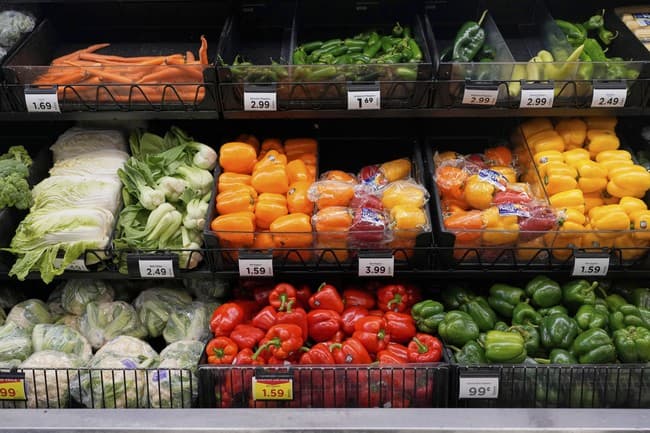
 Grocery store produce aisle with prices, symbolizing consumer inflation data.
Inflation Cools to 3.4%, But Is the Economy's 'K-Shape' Really Over?
Left says
- •Prices remain 3% higher than average wages can comfortably absorb, so families are still struggling with groceries, gas, and healthcare costs even as the headline number cools.
- •The Iran war's lingering effects on gas prices show inflation is still elevated compared to pre-war levels of 2.4%, undercutting claims of full recovery.
- •Declaring the K-shaped economy 'over' based on bank transaction data may not reflect how lower-income Americans actually feel, since their sentiment still lags higher earners by 12 points.
- •Wage gains for lower-income workers are a genuinely positive sign worth crediting, but the improvement stems from more people finding jobs rather than a fundamental fix to structural inequality.
Right says
- •The mild inflation report, with core CPI at a post-pandemic low, removes any justification for the Federal Reserve to raise interest rates and validates a hold on hikes.
- •Falling energy and grocery prices, including a 25.7% egg price drop and cooling meat prices, show the economy stabilizing without government intervention.
- •The Treasury Secretary's declaration that 'the K-shaped economy is over' is backed by real data showing lower-income spending and wage growth now outpacing wealthier households for the first time since December 2024.
- •Improving labor market participation among lower-income households, not new redistribution policy, is driving the narrowing gap between rich and poor spending.
Common Take
High Consensus- The annual inflation rate fell to 3.4% in July from 3.5% in June, marking the second consecutive monthly decline.
- Core CPI, excluding food and energy, slipped to 2.5% year-over-year, matching a post-pandemic low.
- Inflation remains above the 2.4% level recorded before the Iran war began.
- Energy prices, while down from their late-April peak, remain significantly higher than a year ago, and gas prices are still elevated at the pump.
The Arguments
Left argues
Even with headline inflation cooling to 3.4%, prices remain higher than they were before the Iran war (2.4%), and costs are still rising faster than average wages, meaning families continue to struggle with groceries, gas, and healthcare regardless of the improved trendline.
Right counters
Core CPI at 2.5% has matched a post-pandemic low, and the three-month annualized core rate of 1.6% shows underlying price pressures are genuinely easing, meaning the war-driven energy spike is a temporary distortion rather than evidence of persistent structural inflation.
Right argues
The mild CPI report, with core inflation at a post-pandemic low and three-month annualized headline inflation at its lowest since 2020, removes any economic justification for the Fed to raise rates and validates a hold, especially given weak wage growth and a surprise drop in jobs.
Left counters
A 3.4% annual inflation rate is still nearly double the Fed's 2% target and higher than pre-war levels, so declaring victory on rates ignores that the underlying trend has genuinely worsened compared to earlier in the year, not merely stabilized.
Right argues
Bank of America and PNC transaction data show lower-income spending and wage growth now outpacing wealthier households for the first time since December 2024, driven by improving labor force participation rather than any redistribution policy, which is a legitimate market-driven correction of the K-shaped divide.
Left counters
Declaring the K-shaped economy 'over' based on bank transaction data overlooks that lower-income sentiment still lags higher earners by 12 points in the University of Michigan survey, and the very richest households continue to see spending growth outpace everyone else, meaning the convergence is partial at best.
Left argues
The narrowing of the spending gap stems primarily from more lower-income people finding jobs, not a structural fix to inequality, so crediting it as evidence the K-shape is fully resolved overstates the durability and depth of the change.
Right counters
Whether the cause is more jobs or a policy fix, JPMorgan's CFO and multiple banks independently confirm the underlying data no longer supports the K-shape narrative, suggesting the convergence is real and broad-based rather than a statistical illusion.
Left argues
Elevated grocery, gas, and healthcare costs relative to wages are a lived reality that headline inflation numbers and bank convergence data don't fully capture, especially with the midterms approaching and voters still feeling squeezed.
Right counters
Specific price drops — like the 25.7% plunge in egg prices and falling meat and lettuce prices — show tangible relief at the grocery store that directly counters the narrative that all costs remain painfully elevated.
Challenge Questions
These questions target genuine internal contradictions — meant to provoke honest reflection.
Right asks Left
“If lower-income wage growth is now outpacing higher-income wage growth for the first time in over a year according to multiple independent bank datasets, what specific evidence would it take for you to accept that the K-shaped divide is meaningfully closing, rather than attributing any positive data to temporary or insufficient causes?”
Left asks Right
“If the case for a Fed hold rests on core inflation being at a post-pandemic low, how do you reconcile that with headline inflation still running at 3.4%, well above the Fed's 2% target and higher than pre-war levels, without conceding that meaningful inflation pressure persists?”
Outlier Report
Left Fringe
Figures like Robert Reich or progressive commentators (e.g., some in the Justice Democrats orbit) who argue the K-shaped economy reflects deep structural inequality requiring redistribution policy, not just labor market improvement, represent maybe 15-20% of the left and reject any 'it's over' narrative entirely.
Right Fringe
Commentators like Stephen Moore or some Breitbart Business Digest contributors who frame any inflation data as full vindication of deregulatory, anti-Fed-intervention policy represent about 15-20% of the right and dismiss residual struggles as media narrative rather than reality.
Noise Assessment
Moderate-to-high; much of the sharpest rhetoric (full recovery vs. lingering crisis) is amplified by partisan economic commentators and White House messaging (e.g., Bessent's 'K-shaped economy is over' claim) rather than reflecting how most consumers actually describe their day-to-day experience, which tends to be more mixed and cautious.
Sources (9)
Stabilizing energy prices helped cool off inflation pressures for the second straight month, new government data released on Aug. 12 show. July's U.S. annual inflation rate slowed to 3.4 percent, from 3.5 percent in the previous month, according to the Bureau of Labor Statistics' Consumer Price Index report. This was in line with economists' expectations.
<p>For years, America's economy has been defined by a "<a href="https://www.axios.com/2026/07/09/k-shaped-economy-wage-growth" target="_blank">K-shaped</a>" gap: The rich kept spending at a rapid pace, while everyone else struggled to keep up. </p><ul><li>That divide is suddenly narrowing.</li></ul><p><strong>Why it matters: </strong>Economists warned that consumer spending growth was increasingly reliant on wealthy Americans, leaving the economy vulnerable to a stock market downturn or any other wealth shock.</p><ul><li>Importantly, the "K" appears to be closing from the bottom up, meaning that lower- and middle-income Americans are catching up, rather than affluent households pulling back.</li></ul><hr /><ul><li>That could put consumer spending on a more resilient footing.</li></ul><p><strong>Zoom in: </strong>Bank of America is calling it the "great convergence."</p><ul><li>The bank's data shows spending and wage growth among its customers has converged across income groups since May. </li><li>Spending growth among lower-income households hit 5.4% year over year, slightly exceeding the 4.9% rate among middle-income households. </li><li>Lower-income Americans are also seeing stronger pay gains: After-tax wages rose 5.2% in July from the same period a year ago, surpassing the wage growth rate for higher-income households for the first time since December 2024.</li></ul><p><strong>The big picture: </strong>PNC said Monday that the gap between spending growth among its richest and poorest account holders shrank to just 0.1 percentage point in July, from a peak of 5 percentage points last year.</p><ul><li>The bank says the shrinking gap largely reflects an improving labor market: More lower-income households are working and collecting paychecks, giving them more room to spend.</li></ul><p><strong>"From our perspective, </strong>through all the various dimensions, there's not like that much there in terms of support for the K-shape narrative," JPMorgan Chase chief financial officer Jeremy Barnum told investors last month.</p><p><strong>The intrigue: </strong>The White House is seizing on the shift. Treasury Secretary Scott Bessent <a href="https://www.cnbc.com/2026/08/04/cnbc-transcript-us-treasury-secretary-scott-bessent-speaks-with-cnbcs-squawk-box-today.html" target="_blank">told CNBC</a> last week that "the K-shaped economy is over," arguing that lower-wage workers are finally catching up.</p><ul><li>Even if the transaction data shows the gap closing, declaring the "K" is over may ring hollow for Americans who still say they feel bad about the economy.</li><li>Economic sentiment among lower-income Americans is improving, though it still lags those in the higher-income cohort by 12 points, according to the latest University of Michigan data.</li></ul><p><strong>And the very richest</strong> Americans appear to be the convergence exception.</p><ul><li>Spending growth among the top 5% continues to outpace everyone else, even as their wage growth has cooled, Bank of America says. </li></ul>
<p>Fed Hawk Down Someone go check on the health of the Fed hawks. The wind has been taken from beneath their wings. The benign inflation report released Wednesday confirms earlier data suggesting there is no need for a rate hike</p> <p>The post <a href="https://www.breitbart.com/economy/2026/08/12/breitbart-business-digest-julys-mild-inflation-report-should-keep-the-fed-on-hold/" rel="nofollow">Breitbart Business Digest: July’s Mild Inflation Report Should Keep the Fed on Hold</a> appeared first on <a href="https://www.breitbart.com" rel="nofollow">Breitbart</a>.</p>
Inflation has been pushed higher by a series of shocks to the economy.
The modest decline could ease pressure on the Federal Reserve to raise their key interest rate to combat rising costs. Yet prices are still rising more quickly than average wages, underscoring the struggle many Americans have had with more expensive groceries, gas, and healthcare.
U.S. consumer prices increased slightly in July, potentially weakening the argument for an interest rate increase from the Federal Reserve next month. The consumer price index edged up 0.1% last month after dropping 0.4% in June, which was the first decline in six years, the Labor Department’s Bureau of Labor Statistics said on Wednesday. In...
<p>Energy is cheaper than at its peak in late April, but gas is still nearly $1 a gallon more expensive than before the Iran war</p><p>US consumer prices cooled slightly in July as the annualized inflation rate dipped down to 3.4%, though prices still remain higher than levels seen before the war with Iran.</p><p>Though inflation decreased 0.7 percentage points in June during a brief ceasefire between the US and Iran that brought energy prices down, consumer prices have remained elevated. Price increases hit a three-year high in May, with annual inflation reaching 4.2%.</p> <a href="https://www.theguardian.com/business/2026/aug/12/inflation-data-july">Continue reading...</a>
Inflation ticked down slightly in July, amid the resumption of strikes between the U.S. and Iran. The consumer price index (CPI) increased 0.1 percent last month, according to data released Wednesday by the Bureau of Labor Statistics (BLS). The annual inflation rate declined to 3.4 percent, down from 3.5 percent in June.  Both tallies landed…