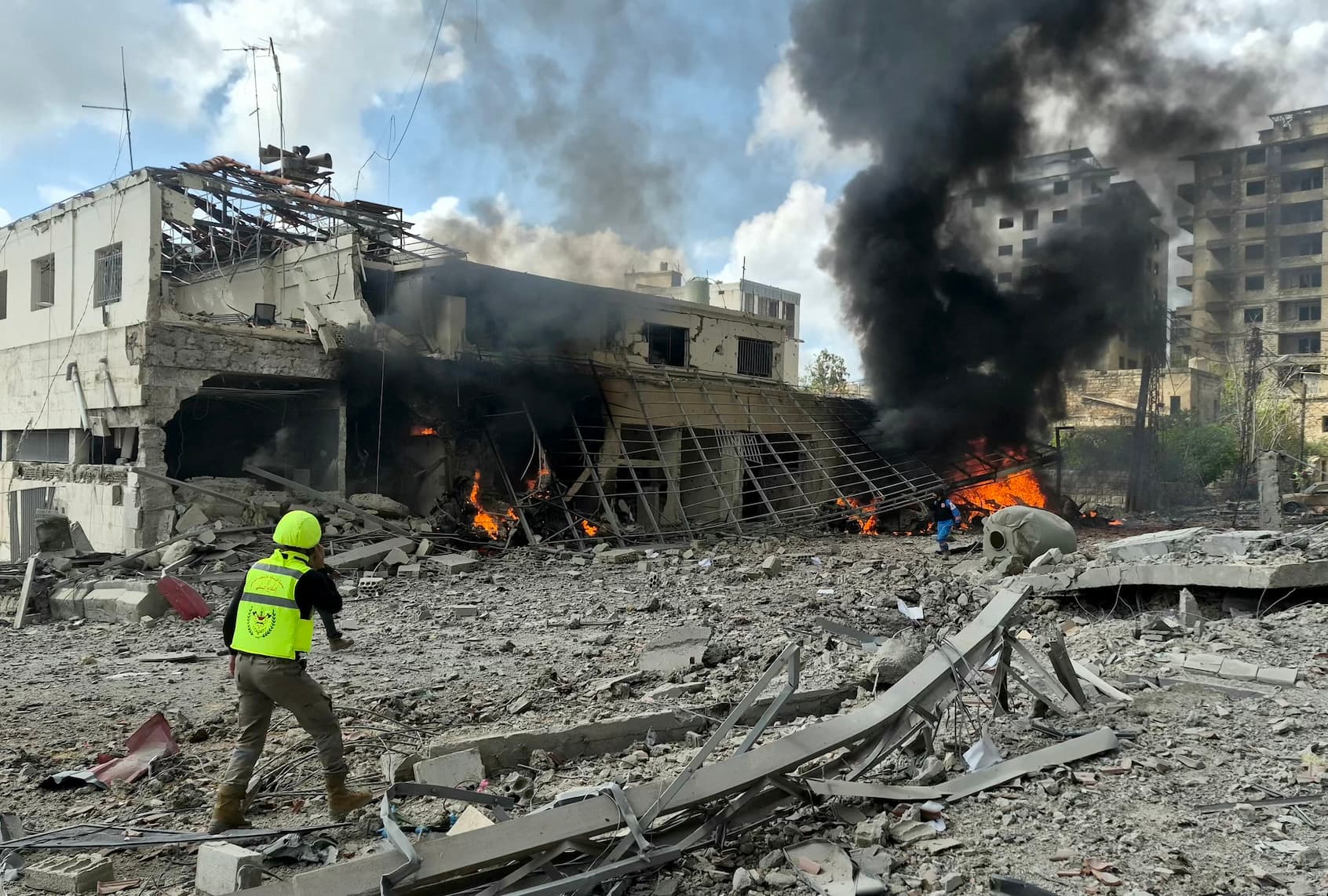
 Destruction and smoke from conflict zone showing aftermath of violence
Iran Ceasefire Clouded by Confusion and Contradictions
Intra-Party Split Detected
Republican hawks like Sen. Lindsey Graham express skepticism about Trump's Iran ceasefire deal, concerned about potential concessions to Iran
Left says
- •Trump's hasty ceasefire agreement appears to give Iran significant concessions, including potential control over the Strait of Hormuz with toll collection rights and continued uranium enrichment capabilities
- •Israel's ongoing attacks in Lebanon violate the ceasefire terms and undermine diplomatic progress, with over 300 Lebanese civilians killed in a single day despite calls for restraint
- •The deal could make Trump the first president in recent memory to lift economic sanctions on Iran without securing meaningful nuclear disarmament or regime change
- •Contradictory statements from U.S. officials reveal poor coordination and suggest the administration lacks a coherent strategy for the negotiations
Right says
- •The ceasefire represents a decisive U.S. military victory that decimated Iran's capabilities, with Defense Secretary Hegseth stating Iran's missile program was 'functionally destroyed' and their navy 'at the bottom of the sea'
- •Iran 'begged for this ceasefire' after suffering crushing defeats, demonstrating the effectiveness of Trump's maximum pressure approach and military superiority
- •The U.S. maintains military readiness to resume operations immediately if Iran violates terms, with forces remaining in the region to ensure compliance
- •Trump's negotiating position from strength allows America to dictate terms while keeping Iran's nuclear ambitions in check through continued oversight
Common Take
High Consensus- A two-week ceasefire is currently in effect between the U.S. and Iran, with peace talks scheduled to continue in Islamabad, Pakistan
- The Strait of Hormuz remains only partially open with Iran maintaining strict control over shipping traffic
- Both sides acknowledge the ceasefire is fragile and could collapse if key disagreements are not resolved
- Israel's continued military operations in Lebanon represent a major complicating factor for the peace process
The Arguments
Right argues
The ceasefire represents a decisive military victory where Iran's missile program was 'functionally destroyed' and their navy is 'at the bottom of the sea,' forcing Iran to 'beg for this ceasefire' after suffering crushing defeats.
Left counters
The deal appears to give Iran significant concessions including potential control over the Strait of Hormuz with toll collection rights and continued uranium enrichment capabilities, hardly the terms of a defeated nation.
Left argues
Israel's ongoing attacks in Lebanon that killed over 300 civilians in a single day directly violate ceasefire terms and demonstrate the administration's inability to control its ally or maintain diplomatic agreements.
Right counters
The U.S. maintains military readiness to resume operations immediately if terms are violated, with forces remaining in the region to ensure compliance, showing strength rather than weakness in enforcement.
Left argues
Contradictory statements from U.S. officials about what was actually agreed to reveal poor coordination and suggest the administration lacks a coherent strategy, with Trump and his team offering conflicting versions of the same deal.
Right counters
Negotiating from a position of military strength allows America to dictate terms while maintaining flexibility, and initial confusion is normal in complex diplomatic arrangements that will be clarified in formal talks.
Right argues
Trump's maximum pressure approach and demonstration of military superiority forced Iran to the negotiating table, proving that strength-based diplomacy works better than previous administrations' appeasement strategies.
Left counters
The deal could make Trump the first president in recent memory to lift economic sanctions on Iran without securing meaningful nuclear disarmament or regime change, potentially rewarding Iranian aggression.
Left argues
Iran's ability to maintain strict control over the Strait of Hormuz while charging tolls and continuing uranium enrichment shows they achieved their core objectives despite supposed military defeats.
Right counters
The U.S. successfully reopened the strait and maintains oversight capabilities to keep Iran's nuclear ambitions in check, while preserving the option to resume military action if Iran violates agreements.
Challenge Questions
These questions target genuine internal contradictions — meant to provoke honest reflection.
Right asks Left
“If Iran's military was truly 'decimated' and they 'begged for ceasefire' as you claim the right argues, then why would the U.S. agree to potentially lift sanctions and allow continued uranium enrichment - wouldn't a victorious America demand unconditional surrender instead of making concessions?”
Left asks Right
“If Trump's approach represents such a diplomatic failure with contradictory messaging as you argue, then how do you explain Iran's apparent willingness to engage in negotiations and reopen the strait after weeks of refusing to do so under previous pressure?”
Outlier Report
Left Fringe
Progressive anti-war activists like CodePink's Medea Benjamin and some Squad members who might argue any ceasefire legitimizes Trump's illegal war represent about 15% of the left.
Right Fringe
Hardline hawks like Senator Lindsey Graham and neoconservatives who oppose any negotiations with Iran and want continued military action represent about 20% of the right.
Noise Assessment
Moderate noise level - most discourse reflects genuine policy disagreements, though some social media amplification of 'total victory' vs 'diplomatic disaster' narratives exceeds actual public engagement with policy details.
Sources (7)
<p>The U.S., Israel and <a href="https://www.axios.com/world/iran" target="_blank">Iran</a> agree that a ceasefire is now in effect, but they're contradicting each other and themselves in terms of what's actually been agreed to and what happens now.</p><p><strong>Why it matters: </strong>Those differences will have to be reconciled at the negotiating table, beginning on <a href="https://www.axios.com/2026/04/07/iran-peace-talks-islamabad" target="_blank">Saturday in Islamabad</a>. One thing everyone agrees on is that there is no guarantee this war is actually over. </p><hr /><p><strong>Breaking it down: </strong>President Trump's key condition for a <a href="https://www.axios.com/2026/04/07/iran-2-week-ceasfire-trump-pakistan" target="_blank">ceasefire</a> was the reopening of the Strait of Hormuz, but we still don't know just how "open" it will be or whether Iran will charge ships to pass through.</p><ul><li>Meanwhile, the Pakistani mediators announced that the ceasefire also applied in Lebanon. Israel says it doesn't and has intensified its attacks.</li><li>Attacks have also taken place on oil facilities in Iran, Saudi Arabia, the UAE and Kuwait in the first 12 hours since the ceasefire came into force. Pakistan's prime minister warned that they "undermine the spirit of the peace process."</li><li>Talks are expected in Islamabad on Saturday, but the parties have offered contradictory statements about the basis on which they are negotiating. </li></ul><h2>Attacks continue</h2><p><strong>The fighting has reduced </strong>significantly, but not ended entirely.</p><ul><li>Iran claimed its missile and drone attacks on Israel and oil facilities in the UAE, Kuwait and Saudi Arabia after the ceasefire was announced were in retaliation for U.S. and Israeli attacks on Iran, including on an oil refinery.</li><li>A U.S. defense official claimed the strike on the Iranian refinery wasn't conducted by the U.S. or Israel. </li><li>Secretary of Defense Pete Hegseth claimed at a press conference on Wednesday that the attacks continued because of poor command and control in Iran, with some commanders out of reach due to communications issues.</li><li>"It takes time for a ceasefire to take hold. We think it will," he said.</li></ul><h2>State of the strait</h2><p><strong>Soon after President Trump</strong> declared on Tuesday that the Strait of Hormuz would now be open, Iran's foreign minister issued a much more cautious statement: Ships that wanted to pass through would need to coordinate with Iran's military, and there would be limitations on the number.</p><ul><li>Iranian media cited officials as saying ships would need to pay a toll, a scenario that has been worrying officials around the world for weeks.</li><li>Hegseth said that "what we agreed is that the strait is opened."</li><li>Trump added to the confusion, telling ABC's Jon Karl that the U.S. and Iran might jointly operate a toll system in the strait.</li></ul><h2>What's on the table</h2><p><strong>Trump surprised some </strong>of his hawkish allies by declaring in his <a href="https://truthsocial.com/%40realDonaldTrump/posts/116365796713313030" target="_blank">statement</a> accepting the ceasefire that Iran's list of 10 conditions for ending the war were a "workable basis on which to negotiate."</p><ul><li>Those conditions included Iran controlling the strait, retaining the right to enrich uranium, having all sanctions lifted and receiving compensation for the war, according to a version published by Iran's Security Council.</li><li>Vice President Vance claimed Wednesday that some members of the Iranian regime "are lying" about what's been agreed.</li></ul><p><strong>On Wednesday, </strong>Trump published a <a href="https://truthsocial.com/%40realDonaldTrump/posts/116368825638596650" target="_blank">post</a> on Truth Social that didn't refer to the Iranian 10 points, but rather to the U.S. 15-point proposal for negotiations — which Iran previously rejected. He claimed there was agreement on many of them. </p><ul><li>Trump made clear the U.S. wouldn't accept Iran's right to enrich uranium and wouldn't allow Iran to have a highly enriched uranium stockpile. </li><li>"There will be no enrichment of Uranium, and the United States will, working with Iran, dig up and remove all of the deeply buried ... Nuclear 'Dust,'" he wrote, referring to Iran's stockpile of highly enriched uranium.</li><li>Trump also said that the U.S. would discuss "Tariff and Sanctions relief" with Iran during the negotiations.</li></ul><p><strong>The latest:</strong> In a second Truth Social post, Trump wrote that the ten points Iran published were different than the ten which were given to the U.S. and would be discussed "behind closed doors during these Negotiations." </p><ul><li>"These are the POINTS that are the basis on which we agreed to a CEASEFIRE. It is something that is reasonable, and can easily be dispensed with," he wrote.</li></ul><p><strong>Israeli Prime Minister Benjamin Netanyahu </strong>and Republican hawks like Sen. Lindsey Graham (R-S.C.) are highly skeptical of the agreement and concerned about what concessions might be on the table.</p><ul><li>Graham took to X to send a <a href="https://x.com/LindseyGrahamSC/status/2041871542032716010" target="_blank">shot across the bow</a> to U.S. negotiators.</li><li>"The supposed negotiating document, in my view, has some troubling aspects, but time will tell. I look forward to the architects of this proposal, the Vice President and others, coming forward to Congress and explaining how a negotiated deal meets our national security objectives in Iran," he wrote. </li></ul><h2>Lebanon war continues</h2><p><strong>Meanwhile, </strong>Netanyahu rejected the claims from Pakistan and Iran that the ceasefire also applied to Lebanon.</p><ul><li>According to the Lebanese Red Cross, more than 80 people have been killed and 200 wounded. Iranian officials called that a violation and warned it could compromise the ceasefire and lead to the shutting down of the strait.</li><li>The U.S. hasn't clarified its position on this issue so far. </li></ul><h2>What's next</h2><p><strong>Joint Chiefs Chairman </strong>Gen. Dan Caine defined the ceasefire in a press conference on Wednesday as a "pause" and stressed the U.S. military is ready to resume combat. </p><ul><li>"We will be hanging around to make sure Iran complies. ... We are prepared to restart in a moment's notice," Hegseth said. </li><li>The Iranians sent out the same message on Wednesday. "We are with our hand on the trigger, ready to respond to any attack with more force," the Islamic Revolutionary Guard Corps said in a statement. </li><li>Attention will shift to Islamabad on Saturday, with Vice President Vance likely to lead the U.S. negotiating team. </li></ul><p><strong>The bottom line: </strong>The confusion over big picture agreements like opening the strait shows how challenging those negotiations will be.</p><ul><li>The parties are far apart on core issues concerning money for Iran's rebuilding, eliminating its nuclear weapons program, and ending the war between Israel and Hezbollah. </li></ul>
<p>Pakistani Prime Minister Shehbaz Sharif on Tuesday called on President <a href="https://www.axios.com/politics-policy/donald-trump" target="_blank">Trump</a> and the Iranian regime to agree to a two-week ceasefire to give time for peace talks.</p><ul><li>White House press secretary Karoline Leavitt told Axios: "The President has been made aware of the proposal, and a response will come."</li></ul><p><strong>Why it matters:</strong> Sharif's statement comes less than five hours before Trump's deadline to either get a deal or launch a massive bombing campaign on Iranian infrastructure. Pakistan has been the primary mediator between the U.S. and <a href="https://www.axios.com/world/iran" target="_blank">Iran</a> over the last several weeks. </p><hr /><ul><li>As Axios reported, negotiations between the U.S. and Iran have made progress over the last 24 hours. </li><li>This proposal could give both sides a temporary off-ramp.</li><li>A senior Iranian official told Reuters that Tehran was "positively reviewing" the Pakistani proposal. </li></ul><p><strong>What he's saying:</strong> "Diplomatic efforts for peaceful settlement of the ongoing war in the Middle East are progressing steadily, strongly and powerfully with the potential to lead to substantive results in near future," <a href="https://x.com/CMShehbaz/status/2041596151108137363" target="_blank">Sharif wrote on X</a>. </p><ul><li>"To allow diplomacy to run its course, I earnestly request President Trump to extend the deadline for two weeks. Pakistan, in all sincerity, requests the Iranian brothers to open Strait of Hormuz for a corresponding period of two weeks as a goodwill gesture."</li><li>"We also urge all warring parties to observe a ceasefire everywhere for two weeks to allow diplomacy to achieve conclusive termination of war, in the interest of long-term peace and stability in the region."</li></ul><p><em><a href="https://www.axios.com/2026/04/07/iran-negotiations-trump-threat-progress" target="_blank">Go deeper</a></em></p>
Jessica Tarlov noted Israeli strikes have continued against Lebanon and made a fascinating prediction about U.S. sanctions on Iran.
The Iranian delegation, led by Parliament Speaker Mohammad Bagher Qalibaf, has also arrived in Islamabad.
JD Vance will lead peace talks in Pakistan Saturday as Iran calls Israel's assault on Lebanon a ceasefire violation
<p>Both sides are claiming a triumphant victory, but the peace that’s in place now is very delicate and will have to survive tumultuous negotiations.</p> <p>The post <a href="https://www.twz.com/news-features/questions-loom-over-iran-ceasefire">Questions Loom Over Iran Ceasefire</a> appeared first on <a href="https://www.twz.com">The War Zone</a>.</p>
<p>As Trump's deadline for making Iran into a "living hell" fast approaches, a chasm remains between the two foes on a way to even temporarily pause the war.</p> <p>The post <a href="https://www.twz.com/news-features/iran-rejects-u-s-ceasefire-deal">Iran Rejects Ceasefire Deal (Updated)</a> appeared first on <a href="https://www.twz.com">The War Zone</a>.</p>