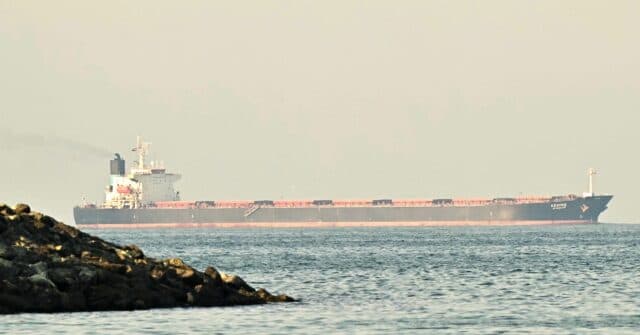
 Oil tanker ship navigating waters near the Strait of Hormuz
Iran Claims 'Inalienable Right' to Control Strait of Hormuz
Left says
- •Iran's claims violate international maritime law, as the Strait of Hormuz is recognized as an international waterway under the UN Convention on the Law of the Sea
- •Allowing Iran to control this critical shipping route would enable economic blackmail against the global community and set a dangerous precedent for other nations to claim sovereignty over international waters
- •The international community must respond collectively through diplomatic and economic pressure rather than unilateral military action that could escalate regional tensions
- •Trump's threats against Iranian civilian infrastructure like power plants represent potential war crimes that would harm innocent civilians
Right says
- •Iran cannot be allowed to hold the world economy hostage by controlling a waterway through which 20% of global oil passes
- •The U.S. Navy and President Trump have the authority and responsibility to ensure free passage through international waters regardless of Iranian claims
- •Iran's threats demonstrate the regime's weakness and isolation after successful strikes against their leadership structure
- •Strong deterrence including threats against Iranian infrastructure may be necessary to prevent Iran from weaponizing critical shipping lanes
Common Take
High Consensus- The Strait of Hormuz is a critical global shipping route that carries approximately 20% of the world's oil supply
- Iran's ability to disrupt shipping through the strait poses significant risks to the global economy
- International maritime law governs the rights of passage through strategic waterways
- Multiple vessels have reportedly come under attack in the strait, creating immediate safety concerns for commercial shipping
The Arguments
Left argues
Iran's claims violate the UN Convention on the Law of the Sea, which establishes the Strait of Hormuz as an international waterway, and allowing such control would set a dangerous precedent for other nations to weaponize critical shipping routes for economic blackmail.
Right counters
Legal frameworks are meaningless if they cannot be enforced, and Iran's demonstrated willingness to fire on vessels shows that only credible military deterrence can protect the 20% of global oil that passes through this chokepoint.
Right argues
Iran's threats demonstrate the regime's weakness and isolation after successful strikes against their leadership, with confusion between their foreign ministry and IRGC showing internal discord that strong deterrence can exploit.
Left counters
Targeting a weakened regime with threats against civilian infrastructure like power plants risks escalating into broader conflict while potentially constituting war crimes that would harm innocent Iranian civilians.
Left argues
The international community's collective response through diplomatic pressure and multilateral action is more sustainable than unilateral military threats, as evidenced by 135 countries condemning Iran's actions at the UN.
Right counters
Diplomatic condemnation is ineffective when Iran continues to fire on ships and threaten global energy supplies, requiring immediate action from the U.S. Navy as the only force capable of ensuring free passage.
Right argues
The U.S. Navy and President Trump have both the authority and responsibility as commander-in-chief to prevent Iran from holding the world economy hostage through control of critical shipping lanes.
Left counters
Unilateral military action without international coordination risks escalating regional tensions and undermines the multilateral institutions needed for long-term stability in the Persian Gulf.
Left argues
Iran's hardline parliament is moving to enshrine Strait control in law based on constitutional authority over maritime safety and national security, making this a long-term strategic position rather than a temporary negotiating tactic.
Right counters
Iran's attempt to legally codify control over international waters demonstrates exactly why immediate deterrent action is necessary before they can establish facts on the ground that become harder to reverse.
Challenge Questions
These questions target genuine internal contradictions — meant to provoke honest reflection.
Right asks Left
“If multilateral diplomatic pressure and international law are the preferred solutions, how do you reconcile the fact that Iran continues to fire on vessels and threaten closure despite 135 countries condemning their actions at the UN - doesn't this prove that diplomatic approaches are insufficient when dealing with a regime willing to use force?”
Left asks Right
“If the goal is to ensure free passage through international waters and prevent economic blackmail, how does threatening Iranian civilian infrastructure like power plants - which would harm innocent civilians - align with the principle of proportional response and international humanitarian law that distinguishes between military and civilian targets?”
Outlier Report
Left Fringe
Progressive anti-war activists like CodePink's Medea Benjamin and some Squad members who might oppose any U.S. military presence in the region entirely, representing roughly 15-20% of the left coalition.
Right Fringe
Hardline hawks like Senator Tom Cotton or John Bolton who might advocate for immediate preemptive strikes on Iranian military assets without diplomatic engagement, representing about 25-30% of the right coalition.
Noise Assessment
Moderate noise level - most discourse reflects genuine policy disagreements rather than performative positioning, though Trump's specific threats against civilian infrastructure generate outsized social media reaction relative to broader public support for maintaining shipping access.
Sources (6)
Lyse Doucet speaks to Ebrahim Azizi, who says Iran "will decide the right of passage" through the crucial shipping route.
<p>On Sunday, on NBC's "Meet the Press," U.S. Ambassador to the United Nations Mike Waltz said the Strait of Hormuz was an international waterway, thus Iran's claim of ownership "is a violation of international law."</p> <p>The post <a href="https://www.breitbart.com/clips/2026/04/19/waltz-iran-claiming-ownership-of-strait-of-hormuz-a-violation-of-international-law/" rel="nofollow">Waltz: Iran Claiming Ownership of Strait of Hormuz a ‘Violation of International Law’</a> appeared first on <a href="https://www.breitbart.com" rel="nofollow">Breitbart</a>.</p>
<p>President Donald Trump said that the United States will not be "blackmailed" after the Iranian military has once again proclaimed that the Strait of Hormuz will be closed and allegedly fired on multiple vessels on Saturday.</p> <p>The post <a href="https://www.breitbart.com/europe/2026/04/18/trump-says-iran-cant-blackmail-united-states-after-ships-come-under-fire-in-strait-of-hormuz/" rel="nofollow">Trump Says Iran ‘Can’t Blackmail’ United States, After Ships Come Under Fire in Strait of Hormuz</a> appeared first on <a href="https://www.breitbart.com" rel="nofollow">Breitbart</a>.</p>
<p>On Friday’s broadcast of CNN’s “The Lead,” British Ambassador to the U.S. Christian Turner responded to President Donald Trump’s criticisms of NATO by saying that Trump has been right to push on defense spending, “one of the things we should</p> <p>The post <a href="https://www.breitbart.com/clips/2026/04/17/u-k-ambassador-on-trump-nato-criticism-were-leaning-in-to-what-he-wants-on-strait/" rel="nofollow">U.K. Ambassador on Trump NATO Criticism: We’re Leaning In to What He Wants on Strait</a> appeared first on <a href="https://www.breitbart.com" rel="nofollow">Breitbart</a>.</p>
U.S. Ambassador to the United Nations Mike Waltz on Sunday said “all options are on the table” when it comes to limiting Iran’s control of the Strait of Hormuz and economic benefits tied to opening the critical shipping channel.  When asked if U.S. troops would board vessels headed to China, Waltz said, “Well I’m not…
U.S. Ambassador to the United Nations Mike Waltz on Sunday defended President Trump’s threats to strike Iranian civilian infrastructure. Earlier Sunday, Trump said if Iran does not accept the “very fair and reasonable” peace deal his administration is proposing, then the U.S. military “is going to knock out every single Power Plant, and every single…