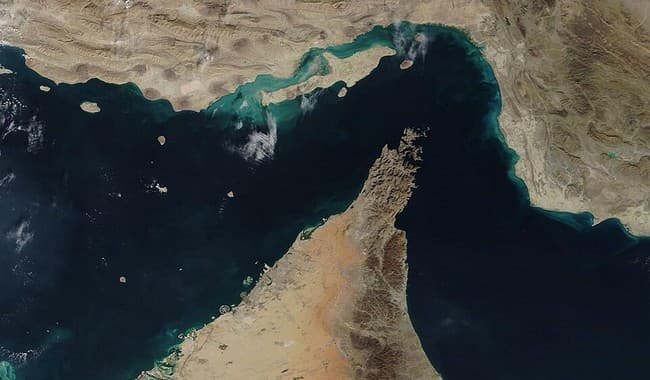
 Satellite view of the Strait of Hormuz, the vital waterway at the center of Iran's demands.
Iran Demands US Reparations, Troop Withdrawal to Reopen Hormuz
Left says
- •Iran's demands reflect the reality that a durable resolution requires addressing underlying grievances, including sanctions relief and accountability for war damages, rather than expecting unilateral capitulation.
- •The Pentagon's push to rapidly replenish depleted munitions stockpiles signals the conflict has strained U.S. military readiness more than officials initially acknowledged, raising questions about the war's sustainability and cost.
- •Ongoing attacks on commercial vessels like the Abu Dhabi National Oil Company ship highlight the humanitarian and economic stakes of prolonging the standoff, underscoring the urgency of diplomacy over further military escalation.
- •New regional alliances, such as the Saudi Arabia-Turkey-Pakistan mutual defense pact, suggest the conflict is reshaping global power dynamics in ways that could outlast any single negotiation, warranting careful multilateral engagement.
Right says
- •Iran's list of demands, including reparations and a full U.S. troop withdrawal, are widely seen as unrealistic and designed to stall rather than genuinely resolve the crisis.
- •The Trump administration has maintained that sanctions relief and unfrozen assets remain contingent on Iran abandoning its highly enriched uranium program, a firm and reasonable red line.
- •Vice President Vance's insistence that the U.S. is still in the 'middle of the game' reflects a strategy of sustained pressure rather than premature concessions to a regime with a history of overreach.
- •Iran's continued targeting of commercial shipping even amid negotiations demonstrates bad faith and undercuts any claim that Tehran is negotiating sincerely toward de-escalation.
Common Take
High Consensus- Iran and Oman are close to finalizing a navigation framework for the Strait of Hormuz, even though officials on all sides agree this alone would not fully reopen the waterway.
- The Strait of Hormuz remains a critical global trade route, and its closure carries significant economic consequences worldwide.
- Both Iranian and U.S. officials describe the current moment as unresolved, with neither side declaring the conflict over or a final deal reached.
- Commercial vessels have continued to be targeted in the strait even as diplomatic talks proceed, a fact acknowledged across all reporting.
The Arguments
Left argues
A durable resolution to the Hormuz crisis requires addressing Iran's underlying grievances—sanctions relief, frozen assets, and accountability for war damages—rather than expecting Tehran to simply capitulate after a war it did not start.
Right counters
Demanding reparations and a full U.S. troop withdrawal from the entire region is not a negotiating position but a maximalist wish list designed to be rejected, allowing Iran to blame the U.S. for continued closure while it stalls for time.
Right argues
The Trump administration's insistence that sanctions relief and unfrozen assets remain contingent on Iran abandoning its highly enriched uranium program is a firm, reasonable red line given Iran's history of using negotiations to buy time for weapons development.
Left counters
Treating denuclearization as a precondition rather than a negotiated outcome ignores that sanctions relief and asset access could themselves be the leverage that brings Iran to genuinely dismantle its program, rather than an unconditional reward for compliance that will never come.
Right argues
Iran's continued attacks on commercial vessels like the Abu Dhabi National Oil Company ship, even while claiming to be near a deal with Oman, demonstrate bad faith and undercut any narrative that Tehran is negotiating sincerely toward de-escalation.
Left counters
Ongoing attacks on shipping are exactly why diplomacy is urgent rather than discredited—every day the standoff continues without a framework addressing Iran's core demands, civilians and global trade bear the cost, which argues for engagement, not abandonment of talks.
Left argues
The Pentagon's urgent push to accelerate munitions production, with a 21-day deadline for defense contractors, reveals that the conflict has strained U.S. military readiness far more than officials have publicly acknowledged, raising serious questions about the war's long-term sustainability.
Right counters
Pentagon spokesman Sean Parnell explicitly stated this modernization effort predates the five-month conflict and is about long-term readiness, not a sign of crisis or depletion specific to this war.
Left argues
The new Saudi Arabia-Turkey-Pakistan mutual defense pact signals that the conflict is reshaping regional power dynamics in ways that could outlast any single U.S.-Iran negotiation, making careful multilateral diplomacy more urgent than continued unilateral pressure.
Right counters
A new regional defense pact among U.S.-aligned and non-aligned powers doesn't necessarily undermine American leverage—it could just as easily reflect regional actors hedging against Iranian aggression, reinforcing rather than replacing the case for sustained pressure on Tehran.
Challenge Questions
These questions target genuine internal contradictions — meant to provoke honest reflection.
Right asks Left
“If sanctions relief and reparations should precede or accompany negotiations as the left suggests, what specific mechanism would ensure Iran doesn't simply pocket those concessions and continue its enrichment program and regional attacks, as it has allegedly done before?”
Left asks Right
“If Iran's demands are dismissed as unrealistic stalling tactics, does the administration have a concrete counteroffer that addresses any of Iran's grievances, or is 'maximum pressure with no concessions' itself simply a different strategy for prolonging the standoff indefinitely?”
Outlier Report
Left Fringe
Progressive anti-war voices like Rep. Rashida Tlaib and commentators such as Glenn Greenwald or those aligned with the Quincy Institute represent perhaps 15-20% of the left who would frame U.S. sanctions and military presence as the primary obstacle to peace, sympathizing more with Iran's grievance framing.
Right Fringe
A small hawkish fringe including figures like Sen. Lindsey Graham or commentators pushing for continued/expanded military action (rather than negotiation at all) represent maybe 10% of the right who view even Vance's 'middle of the game' patience as too conciliatory toward Iran.
Noise Assessment
High noise ratio; cable news and partisan outlets amplify extreme framings (either Iran-sympathetic or war-hawk) far more than the median American, who mostly wants the conflict resolved without escalation but distrusts Iran's stated terms.
Sources (9)
<p>Iran’s top national security official warned Saturday that the Strait of Hormuz will remain closed until the United States “corrects its behavior,” issuing a sweeping list of demands as Vice President JD Vance said Washington remains in the “middle of the game” and is continuing to apply diplomatic, economic, and military pressure on Tehran.</p> <p>The post <a href="https://www.breitbart.com/the-media/2026/08/08/iran-security-chief-hormuz-closed-until-america-corrects-its-behavior-vance-says-u-s-still-middle-of-the-game/" rel="nofollow">Iran Security Chief: Hormuz Closed ‘Until America Corrects Its Behavior’ — Vance Says U.S. Still ‘Middle of the Game’</a> appeared first on <a href="https://www.breitbart.com" rel="nofollow">Breitbart</a>.</p>
The United Arab Emirates' Abu Dhabi National Oil Company said one of its ships was targeted while transiting the strait.
Iran on Saturday issued a new list of demands to the United States, complicating efforts to reopen the critical Strait of Hormuz. NBC News’ Keir Simmons reports from Doha.
The head of Iran’s Supreme National Security Council said that the Strait of Hormuz would remain closed until the United States met certain conditions.
There is a new partnership in the Middle East and South Asia. Saudi Arabia, Turkey and Pakistan signed an agreement similar to NATO's Article 5, pledging that a strike against one of them would be considered a strike against all of them. But despite reports that it was close, no deal was announced between the United States and Iran. Nick Schifrin explains.
The secretary of Iran’s Supreme National Security Council, Mohammad Bagher Zolghadr, laid out the country’s key demands for the U.S. amid negotiations to reopen the Strait of Hormuz on Saturday.  Iran and Oman are engaged in ongoing discussions around this key waterway, which carries a significant portion of the world’s oil supply and has been…
Vice President Vance said Saturday that the U.S. had made progress in negotiations with Iran but warned the war is still “in the middle of the game” as the Trump administration presses Tehran for concessions to help bring the conflict to an end. “I do think that we’ve made some progress over the last few…